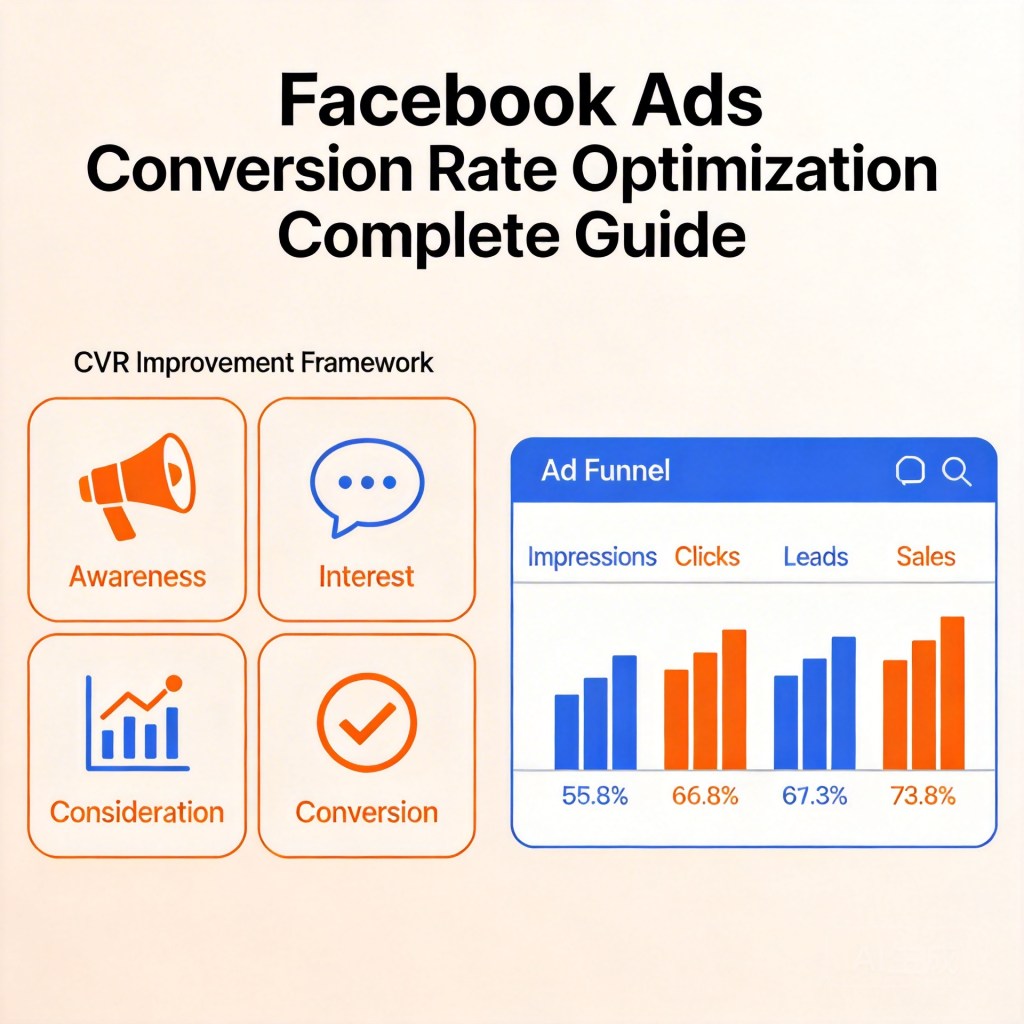
Facebook ads conversion rate optimization (CVR optimization) is the single highest-leverage activity for any performance advertiser. You can have a flawless targeting setup, a generous budget, and a creative team producing daily content—but if your CVR is below the industry benchmark, every dollar you spend is partially wasted. This guide covers the complete framework: from understanding what drives CVR, to auditing your funnel, fixing your landing pages, refining your audiences, and testing your creatives systematically.
→ If you’re already looking for a fix, Book a Free Demo and our team will audit your post-click funnel for free.
What Is Facebook Ads CVR and Why Does It Matter?
CVR (conversion rate) is the percentage of ad clicks that result in a desired action—a purchase, app install, sign-up, or lead form submission. The formula is simple: CVR = Conversions ÷ Clicks × 100. Yet most advertisers track it without understanding the two distinct conversion windows it represents:
- Click-to-landing-page CVR: How many clicks actually load your landing page (affected by page speed, mobile UX, and redirect chains)
- Landing-page-to-conversion CVR: How many visitors who land on your page complete the action
Industry benchmark data (WordStream, 2024): The average Facebook Ads CVR across all industries is 9.21%. However, there is significant variance by vertical:
| Industry | Average CVR |
|---|---|
| Fitness & Supplements | 14.29% |
| Education & E-learning | 13.58% |
| Real Estate | 10.68% |
| E-commerce (general) | 9.21% |
| Software / SaaS / Apps | 7.85% |
| Finance & Insurance | 5.60% |
| Gaming / Mobile Apps | 6.30% |
If your CVR is sitting below your industry average, you likely have a systematic problem in one or more of three layers: audience targeting, creative messaging, or post-click experience. This guide walks through each.
Why does CVR matter so much? Because improving CVR directly reduces your CPA (cost per acquisition) without requiring you to spend more. Doubling your CVR from 5% to 10% cuts your CPA in half. No budget increase required.
The Three-Layer CVR Framework: Audience, Creative, and Landing Page
Most advertiser teams debug CVR problems in silos—the media buyer blames the creative, the creative team blames the landing page, and the landing page team blames traffic quality. A systematic framework eliminates this ambiguity.
Layer 1: Audience Alignment
Audience misalignment is the most common root cause of low CVR. When your ad reaches people who are not ready or motivated to convert, no amount of creative or landing page optimization will save you. Signs of audience misalignment:
- High CTR (>3%) but low CVR (<3%): Your ad is interesting but the offer doesn’t match intent
- High bounce rate on landing page (>70%): Traffic quality problem
- Low add-to-cart rate for e-commerce: Visitors are browsing, not buying
Layer 2: Creative Message-Match
Your ad creative sets an expectation. Your landing page must fulfill that expectation immediately. When there is a disconnect—different headline language, different imagery, different offer terms—visitors experience “creative-to-page mismatch” and leave. This is one of the most underdiagnosed CVR killers.
Layer 3: Post-Click Experience
Post-click experience encompasses everything from page load speed to form UX to trust signals. According to Google’s research, a 1-second delay in mobile page load reduces conversions by up to 20%. For Facebook traffic—which is predominantly mobile—this is critical. See our detailed guide on Facebook Ads Post-Click Experience: 5 Steps to Boost CVR for a complete checklist.
Audience Targeting Strategies That Improve CVR
Targeting the right audience is the upstream fix for almost every CVR problem. Here are the highest-impact tactics:
1. Retargeting Warm Audiences
Retargeting people who have already visited your site, viewed your product, or engaged with your content consistently produces 3-5× higher CVR than cold audiences. Best practices:
- Create custom audiences from website visitors (30-day and 60-day windows)
- Segment by behavior: product page viewers vs. add-to-cart abandoners vs. checkout abandoners
- Use dynamic product ads (DPA) to show the exact item a visitor viewed
- Set frequency caps at 3-4 impressions per week to avoid fatigue
2. Lookalike Audiences Built from Converters
A Lookalike Audience seeded from your highest-value converters (not just all purchasers) dramatically improves traffic quality. Use 1% Lookalikes for precision, 2-5% for scale. Refresh your seed audiences every 30-60 days to maintain signal quality.
3. Advantage+ Shopping and Audience Expansion
Meta’s Advantage+ audience tools use machine learning to find convertible users beyond your manually defined segments. In 2024, advertisers using Advantage+ Shopping Campaigns reported an average 12% improvement in ROAS (Meta, 2024). The tradeoff: less control, so combine with strong creative guardrails.
4. Exclusion Audiences
Excluding recent purchasers, current customers, and unqualified segments (e.g., age groups that historically don’t convert) reduces wasted spend and improves blended CVR. This is often overlooked but can improve CVR by 15-25% for established accounts.
Creative Optimization: What Actually Moves the CVR Needle
Creative is the variable most advertisers A/B test, but most tests are structured incorrectly. Here is a systematic approach:
Creative Testing Framework
Run structured creative tests with one variable changed at a time (hook, format, CTA, social proof, value proposition). Use Meta’s built-in A/B test tool rather than comparing across campaigns, as this controls for audience overlap. Statistical significance requires at least 100 conversion events per variant—don’t call a winner at 20.
High-Impact Creative Variables
- Hook (first 3 seconds for video): This is your single most important variable. Test question hooks vs. problem-statement hooks vs. social proof hooks.
- Format: Static image vs. single video vs. carousel vs. collection. For app installs, video outperforms static by 2× on average (Meta Creative Research, 2024).
- CTA button copy: “Learn More” vs. “Shop Now” vs. “Get Offer” produces measurable CVR differences.
- Social proof overlays: Adding “10,000 customers trust us” or star ratings directly on the creative image increases CTR and downstream CVR.
- Benefit vs. Feature framing: “Lose 10 lbs in 30 days” outperforms “Advanced metabolic formula” for most audiences.
Creative Fatigue and Refresh Cadence
Creative fatigue occurs when frequency exceeds 4-5 and CVR drops 20%+. Monitor your Frequency metric at the ad level, not campaign level. Establish a creative refresh cycle—typically every 2-4 weeks for high-spend campaigns. Keep your top performers running while introducing new variants, rather than replacing everything.
Landing Page Optimization for Facebook Ads Traffic
Facebook traffic is fundamentally different from Google search traffic. Searchers have explicit intent; Facebook users are interrupted mid-scroll. Your landing page must create desire and reduce friction fast. Key principles:
Mobile-First Page Speed
Over 90% of Facebook ad clicks come from mobile devices. Your page must load in under 3 seconds on a 4G connection. Use Google PageSpeed Insights to benchmark. Key fixes: compress images (target <100KB per image), eliminate render-blocking JavaScript, use a CDN, and avoid redirect chains between your ad URL and landing page. Every redirect adds 300-500ms of latency.
Message Match: Ad to Page
The headline, imagery, and offer on your landing page must mirror what the ad promised. If your ad says “Get 50% off today,” your landing page H1 must restate that offer. A/B testing shows that matched ad-to-page messaging improves CVR by 30-40% compared to sending all traffic to a generic homepage (Unbounce, 2023).
Above-the-Fold Optimization
Everything above the fold (without scrolling) must communicate: what you offer, who it’s for, what they get, and how to get it. Best-practice above-the-fold elements:
- Benefit-led headline (not product name)
- Supporting subheadline with specifics
- Hero image showing the product in use or the outcome
- Primary CTA button (high contrast, action-oriented copy)
- 1-2 trust signals (reviews, security badges, media mentions)
Form and Checkout Friction Reduction
Each additional form field reduces completion rate by approximately 5-10% (HubSpot research). For lead gen, limit forms to 3-4 fields max. For e-commerce, offer guest checkout, autofill support, and multiple payment options (Apple Pay, Google Pay). Use progress indicators for multi-step forms.
For a deeper dive, read our post on 5 steps to improve your Facebook Ads post-click experience.
Post-Click Re-engagement: Recovering Lost Conversions
Even with an optimized landing page, most visitors don’t convert on the first visit. Industry data shows that only 2-5% of first-time visitors convert (Baymard Institute). The remaining 95-98% represent a massive opportunity for re-engagement.
Multi-Touch Retargeting Sequences
Build retargeting sequences that deliver different messages based on funnel stage:
- Day 1-3: Soft retarget with value-reinforcement content (blog post, testimonial video)
- Day 4-7: Direct offer retarget with urgency (limited-time discount, scarcity signal)
- Day 8-14: Social proof-heavy creative (case studies, reviews, before/after)
- Day 15-30: Final push or subscription offer (email capture for nurture)
Post-Click Link Optimization
One underutilized tactic is post-click link optimization: dynamically modifying the destination URL or page content based on the user’s click context (which ad, audience segment, device, time of day). This can increase CVR by 15-30% for accounts with sufficient traffic volume. DeepClick’s platform automates this process, eliminating the need for manual UTM-based landing page variants.
Re-engagement via Automated Triggers
Set up automated re-engagement campaigns triggered by specific behaviors: cart abandonment, checkout initiation, product page view depth (>50% scroll), or time spent on pricing page. These behavior-triggered campaigns typically generate 3-8× higher CVR than standard retargeting because the trigger signal confirms purchase intent.
Measuring and Diagnosing CVR Problems: A Data-Driven Audit
Before making any optimizations, you need to correctly diagnose where CVR is breaking down. Follow this audit sequence:
Step 1: Segment CVR by Placement
Separate your CVR data by placement (Facebook Feed, Instagram Stories, Audience Network, Reels). CVR varies significantly by placement. Audience Network placements, for example, often have 50-70% lower CVR than Facebook Feed due to lower intent traffic.
Step 2: Segment CVR by Device
Mobile CVR is typically 30-50% lower than desktop CVR for complex conversions (multi-step checkout, long forms). If mobile CVR is extremely low, prioritize mobile landing page optimization.
Step 3: Segment CVR by Audience
Compare CVR across cold (prospecting), warm (engaged), and hot (retargeting) audiences. If warm audiences have low CVR, your retargeting creative needs work. If cold audiences have unusually low CVR, your Lookalike audience seed needs refreshing.
Step 4: Check Pixel Event Fidelity
Many CVR “problems” are actually tracking problems. Verify your Meta Pixel is firing correctly for all conversion events using the Meta Pixel Helper browser extension. Check for duplicate events (inflating conversions) or missing events (underreporting conversions). Use the Events Manager to confirm event match quality scores are above 6.0.
Step 5: Calculate Your CVR Improvement Potential
Benchmark your current CVR against industry averages. If you’re at 3% CVR in an industry with a 9% average, a realistic target is 6-7% (not 9% immediately). Model the revenue impact: at $50 CPC and 3% CVR, your CPA is $1,667. At 6% CVR, your CPA drops to $833—a 50% reduction with zero budget change.
Advanced CVR Tactics for AI Apps and Mobile Games
AI social apps and mobile games represent two of the highest-spend verticals on Meta, and both face unique CVR challenges due to their long conversion funnels.
AI Social App CVR Optimization
AI dating and companion apps face a specific challenge: user intent is emotional and privacy-sensitive. High-CVR tactics for this vertical:
- Landing pages that emphasize safety, privacy, and community (not just product features)
- Social proof focused on user experiences and outcomes, not technical specs
- Frictionless sign-up (social login, email-only, no phone number required)
- Onboarding optimization: the first 5 minutes post-install determine D1 retention and downstream IAP conversion
For AI social apps, the post-install experience is as critical as the pre-click creative. The funnel doesn’t end at install—it extends to account creation, profile setup, and first meaningful interaction. Each friction point in onboarding reduces downstream paying user CVR. Track your onboarding funnel with Meta’s App Events: af_complete_registration, af_tutorial_completion, and first_purchase. If your registration completion rate is below 60%, your install-to-active CVR is effectively capped regardless of how well your ads convert to installs.
Mobile Game CVR Optimization
For mobile games (especially BC/IAP models), the “conversion” often spans days or weeks. Optimize for:
- Install-to-registration rate (immediate post-install action)
- Tutorial completion rate (D1 proxy metric)
- First purchase conversion rate (D3-D7 window)
Use Facebook’s App Event Optimization (AEO) and Value Optimization (VO) campaign objectives to train the algorithm toward users most likely to complete these downstream events, not just installs.
The highest-converting mobile game ad funnels share a common structure: the ad creative mirrors the in-game experience (gameplay footage, not cinematic trailers), the install flow uses instant experience or playable ads to reduce friction, and the onboarding sequence is personalized based on how the user arrived (e.g., a user who clicked an ad featuring PVP combat sees a PVP tutorial first). This message continuity from ad to in-game experience can improve D7 retention by 15-25%, which directly translates into a higher probability of first purchase.
The Role of Meta Pixel and Conversion API in CVR Optimization
Accurate measurement is the foundation of CVR optimization. Without reliable conversion data, Meta’s algorithm cannot optimize toward the right users, and your own reporting will mislead you. Two tracking tools are essential: the Meta Pixel and the Conversions API (CAPI).
Meta Pixel Setup Best Practices
The Meta Pixel fires browser-side JavaScript events when users take actions on your site. Common setup mistakes that undermine CVR optimization:
- Missing standard events: At minimum, implement ViewContent, AddToCart, InitiateCheckout, and Purchase (or the equivalent for your conversion goal). Each event gives Meta’s algorithm an additional training signal.
- Wrong event placement: The Purchase event must fire only on the confirmation page, not on the checkout page. Misplaced events inflate conversions and corrupt algorithm training.
- No event deduplication: If you run both Pixel and CAPI, you must deduplicate events using the same event_id parameter; otherwise Meta counts conversions twice and your CPA reporting is meaningless.
Conversions API (CAPI): Server-Side Reliability
Browser-based tracking is degraded by iOS 14+ privacy changes, ad blockers, and browser privacy settings. The Conversions API sends conversion data server-to-server, bypassing browser restrictions. Advertisers who implement CAPI alongside Pixel typically see 10-20% more reported conversions (Meta, 2024)—not because more conversions are happening, but because they were previously going unreported. This improved signal quality allows Meta’s algorithm to find converting users more efficiently, improving CVR for prospecting campaigns within 1-2 weeks of CAPI implementation.
Event Match Quality
Meta measures how well your customer data (email, phone, name, location) matches Meta user profiles through an Event Match Quality (EMQ) score from 0-10. Higher EMQ = better algorithm performance = lower CPA. To improve EMQ: send hashed email addresses with every conversion event, include customer phone numbers when available, and use advanced matching in the Pixel setup.
Stop losing conversions after the click.
DeepClick helps Meta advertisers fix post-click drop-offs and improve CVR by 30%+ through automated re-engagement and post-click link optimization.
CVR Optimization Action Checklist
Use this checklist to systematically audit and improve your Facebook Ads CVR:
Audience Layer:
- ☐ Set up custom audiences for all website visitors (30/60/90 day windows)
- ☐ Build Lookalike audiences from your highest-value converters
- ☐ Add exclusion audiences (recent purchasers, current customers)
- ☐ Segment retargeting by funnel stage
Creative Layer:
- ☐ Run structured A/B tests on one variable at a time
- ☐ Monitor Frequency—refresh creative when frequency exceeds 4
- ☐ Test video hooks (first 3 seconds) as your highest-priority variable
- ☐ Add social proof directly to ad creative
Landing Page Layer:
- ☐ Page load time ❤ seconds on mobile (test with PageSpeed Insights)
- ☐ Ad-to-page message match (headline, offer, imagery)
- ☐ Above-the-fold CTA visible without scrolling
- ☐ Form fields reduced to minimum viable set
- ☐ Trust signals present (reviews, security, social proof)
Measurement Layer:
- ☐ Pixel verified via Meta Pixel Helper
- ☐ Event match quality >6.0 in Events Manager
- ☐ CVR segmented by placement, device, and audience type
 DeepAds
留下评论