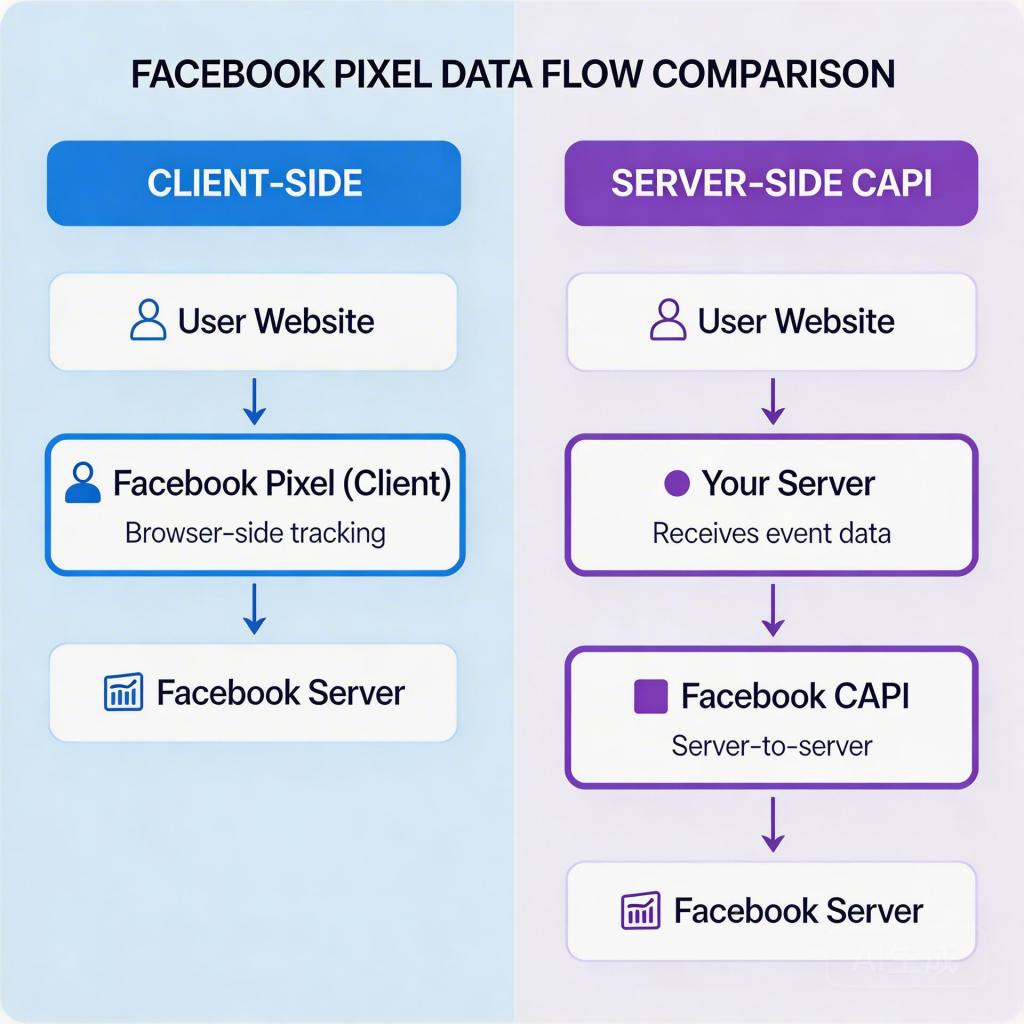
Why Your Tracking Setup Might Be Lying to You
Meta’s own data shows that advertisers using only the Facebook Pixel miss up to 37% of conversion events due to browser-based signal loss — a figure that has worsened every year since iOS 14 dropped in April 2021 (Meta Business Help Center, 2025). If your ROAS looks fine but your revenue doesn’t match, this is probably why.
→ If you’re already looking for a fix, Book a Free Demo and our team will audit your post-click funnel for free.
TL;DR: The Facebook Pixel works client-side and loses signal whenever a user blocks cookies or scripts. The Conversions API (CAPI) sends events server-side, recovering up to 37% of lost conversions. For most advertisers in 2026, the right answer is both — running in parallel with deduplication. This post shows you exactly how to set that up.
Tracking quality is the foundation of everything else in your Meta ad account. Before optimising bids, creatives, or audiences, you need reliable signal. For a full breakdown of conversion rate factors, see our Facebook Ads CVR Optimization pillar guide.
What Is the Facebook Pixel — and What Are Its Limits in 2026?
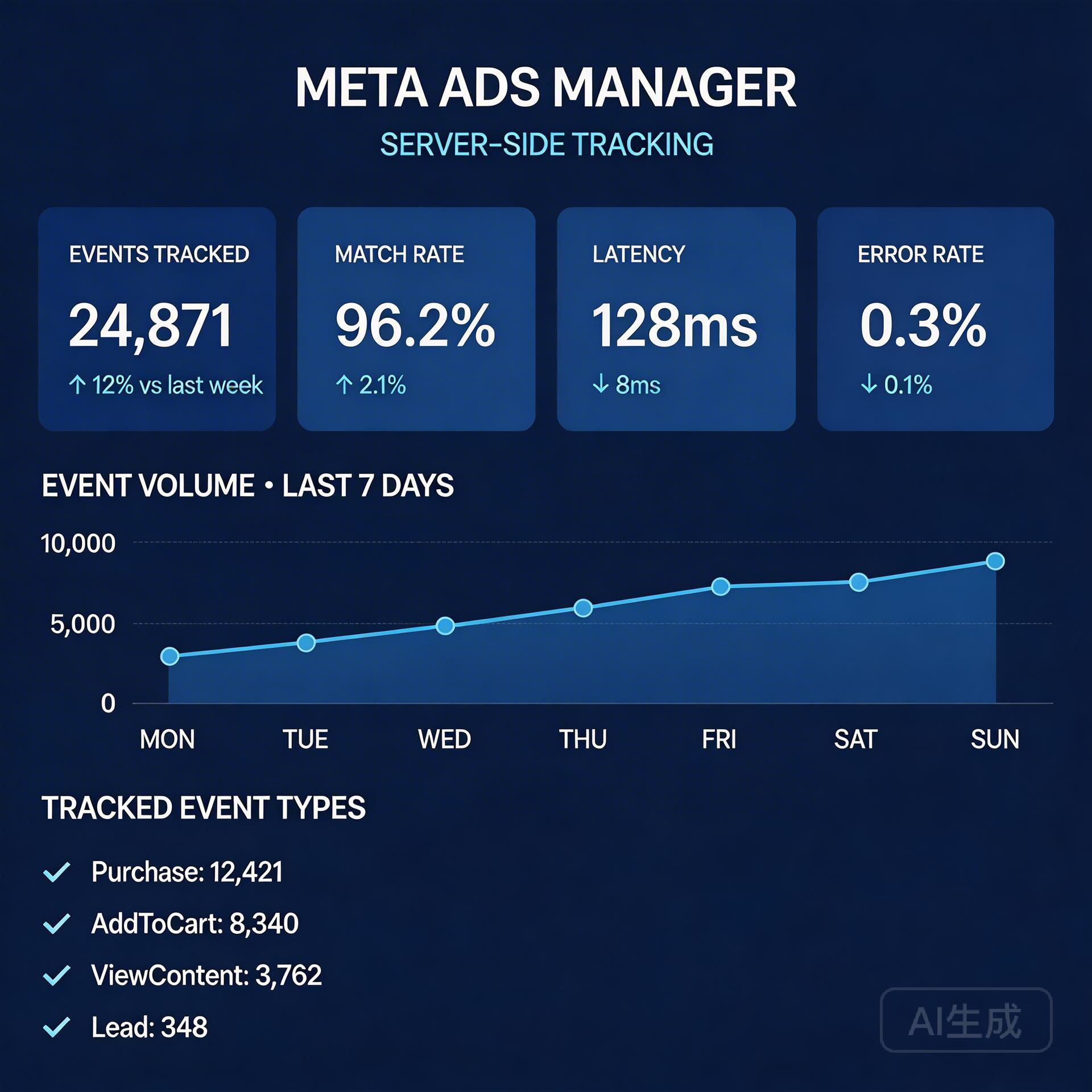
The Facebook Pixel is a JavaScript snippet that fires from the user’s browser when they land on your site or complete an action. As of Q1 2025, Apple’s ITP (Intelligent Tracking Prevention) and Safari’s default cookie blocking already prevent pixel data from being captured on roughly 26% of all web sessions globally (WebKit Blog, 2025). Add Chrome’s gradual third-party cookie deprecation and that number keeps climbing.
The pixel does three things: it fires a PageView event, fires standard events like Purchase or Lead, and transmits a browser cookie to match users. All three steps happen client-side. That means ad blockers, browser privacy settings, or a slow connection can silently kill the event before Meta ever sees it.
When the Pixel Alone Is Clearly Not Enough
If you’re running performance campaigns in privacy-conscious markets — Germany, France, or anywhere with strict GDPR enforcement — pixel match rates can fall below 50% (IAB Europe TCF, 2024). Below that threshold, Meta’s algorithm literally doesn’t have enough data to exit the learning phase on a 7-day attribution window.
What Is the Conversions API (CAPI) and How Does It Work?
The Conversions API sends conversion events directly from your server to Meta’s servers, bypassing the browser entirely. Meta reports that advertisers who implement CAPI alongside the Pixel see an average 19% reduction in cost per result compared to Pixel-only setups (Meta Business Help Center, 2025).
When a user completes a purchase on your site, your server-side code fires a CAPI event directly to Meta’s Graph API endpoint. That event carries the same parameters as a Pixel event — event name, timestamp, value, currency — plus hashed user data like email or phone number for matching. Meta then deduplicates the server event against any browser event it already received.
What User Data Does CAPI Send?
CAPI events are matched using hashed Personally Identifiable Information (PII). You send SHA-256 hashed versions of email addresses, phone numbers, names, and IP addresses. Meta never stores the raw values. Adding hashed email alone can lift Event Match Quality (EMQ) scores from 4/10 to 7/10.
Facebook Pixel vs Conversions API: A Direct Comparison
According to Meta’s performance benchmarks, advertisers running CAPI in parallel with the Pixel recover an average of 20–37% more conversion events than those using the Pixel alone (Meta Business Help Center, 2025).
| Factor | Facebook Pixel | Conversions API |
|---|---|---|
| Fires from | User’s browser | Your server |
| Affected by ad blockers | Yes | No |
| Affected by iOS 14+ changes | Yes | No |
| Setup complexity | Low (JS snippet) | Medium–High (API call) |
| User data matching | Cookie-based | Hashed PII |
| Event Match Quality | 3–6/10 typical | 6–9/10 typical |
| GDPR risk | Higher | Lower |
Signal quality also affects what happens after the click. If Meta can’t measure your Purchase events accurately, it will optimise toward cheaper, lower-quality signals — leading to higher bounce rates on your landing pages. We’ve covered this in detail in our guide on how to reduce bounce rate after ad click.
Which Should You Use in 2026?
Short answer: both, running in parallel with deduplication enabled. A 2024 study by Measured found that brands using dual-signal tracking (Pixel + CAPI) saw 23% lower CPA and 15% higher ROAS on average versus single-signal setups (Measured.com, 2024).
If you can only do one right now, prioritise CAPI for your bottom-funnel events: Purchase, Lead, Subscribe. These are the events that feed Meta’s bid optimisation directly. Pixel can continue handling upper-funnel events where signal loss is less damaging.
How to Set Up Pixel + CAPI in Parallel: 3 Action Steps
Setting up both tracking methods together is the single highest-leverage technical change most Meta advertisers can make.
Action Step 1: Audit Your Current Pixel Events
Before adding CAPI, open Meta Events Manager and check your Event Match Quality scores for each event. Any event below 6/10 is a priority for CAPI coverage.
Action Step 2: Implement CAPI for Purchase Events First
Start with your most valuable event. Shopify users can enable Meta’s native CAPI integration in the Marketing settings panel — it takes under 10 minutes and requires no code. Always pass the event_id field — a unique identifier you also fire from the Pixel — to enable deduplication.
Action Step 3: Monitor Event Match Quality and Deduplication Rate
After 48–72 hours, return to Events Manager. Your EMQ score should rise. A healthy parallel setup shows a deduplication rate of 30–70% for Purchase events. If your dedup rate is 0%, your event_ids aren’t matching.
Frequently Asked Questions
Does the Conversions API replace the Facebook Pixel?
No. Meta explicitly recommends running both in parallel. The Pixel captures browser-side context — page URL, UTM parameters, browser events — that CAPI alone can’t replicate. Dual-signal tracking consistently recovers 20–37% more conversion events (Meta Business Help Center, 2025).
Is the Conversions API hard to set up without a developer?
For Shopify and many major e-commerce platforms, no. Native integrations exist for Shopify, WooCommerce, and BigCommerce — under 15 minutes, no custom code. Custom stacks typically need 4–8 hours of developer time.
What’s a good Event Match Quality score to aim for?
Meta rates EMQ on a scale of 1–10. Scores below 5 indicate poor signal quality. Scores of 7 or above are considered strong. The fastest way to improve EMQ is to pass hashed email with every CAPI event — this single addition can lift scores by 2–3 points.
Key Takeaways
The Facebook Pixel vs Conversions API debate has a clear answer in 2026: it’s not a choice. The Pixel captures what happens in the browser; CAPI captures what happens on your server. Together, they recover the signal that iOS 14, ad blockers, and cookie restrictions have been eroding for the past four years.
For the next step in improving your Meta ad performance, read our complete guide to Facebook Ads conversion rate optimisation.
Stop losing conversions after the click.
DeepClick helps Meta advertisers fix post-click drop-offs and improve CVR by 30%+ through automated re-engagement and post-click link optimization.
 DeepAds
留下评论