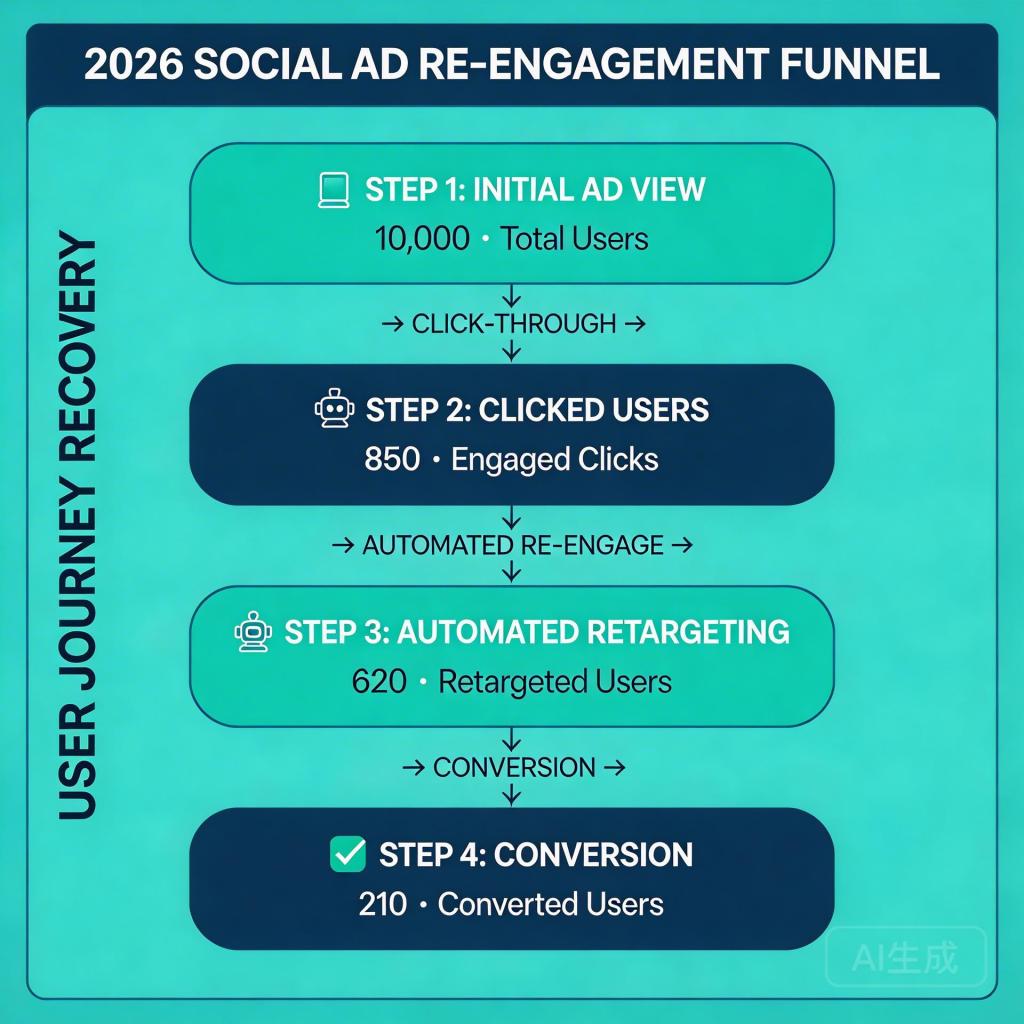
Most social ad campaigns are evaluated on click-through rates and cost-per-click — metrics that measure what happens before the click. But the majority of conversion losses happen after the click, when users land on a page that fails to re-engage their intent. Social ads post-click re-engagement in 2026 has become the defining differentiator between campaigns that scale profitably and those that plateau.
→ If you’re already looking for a fix, Book a Free Demo and our team will audit your post-click funnel for free.
The Post-Click Re-Engagement Problem: Where Budgets Go After the Click
On average, 70–80% of users who click a social ad leave without converting (Baymard Institute, 2024). For AI social apps and mobile games running on Meta or TikTok, that number can be even higher — reaching 85–90% on mobile placements where loading friction is compounded by app-switching behavior.
The traditional response is to build better landing pages — and while that matters, it addresses only the first encounter. What about the other 70–85% who leave? Without a deliberate re-engagement layer, those clicks are permanently lost budget. Post-click re-engagement converts that loss into a recoverable asset.
Three types of post-click exits that re-engagement can recover:
- Bounced non-starters: Users who arrived but left within 10 seconds — likely due to load time, mobile layout issues, or message mismatch with the creative they clicked
- Mid-funnel dropoffs: Users who scrolled, read, or watched — showing interest — but didn’t reach the conversion action
- Form-abandoned: Users who started a sign-up, checkout, or contact form but didn’t submit
Re-Engagement Tactics That Work in 2026
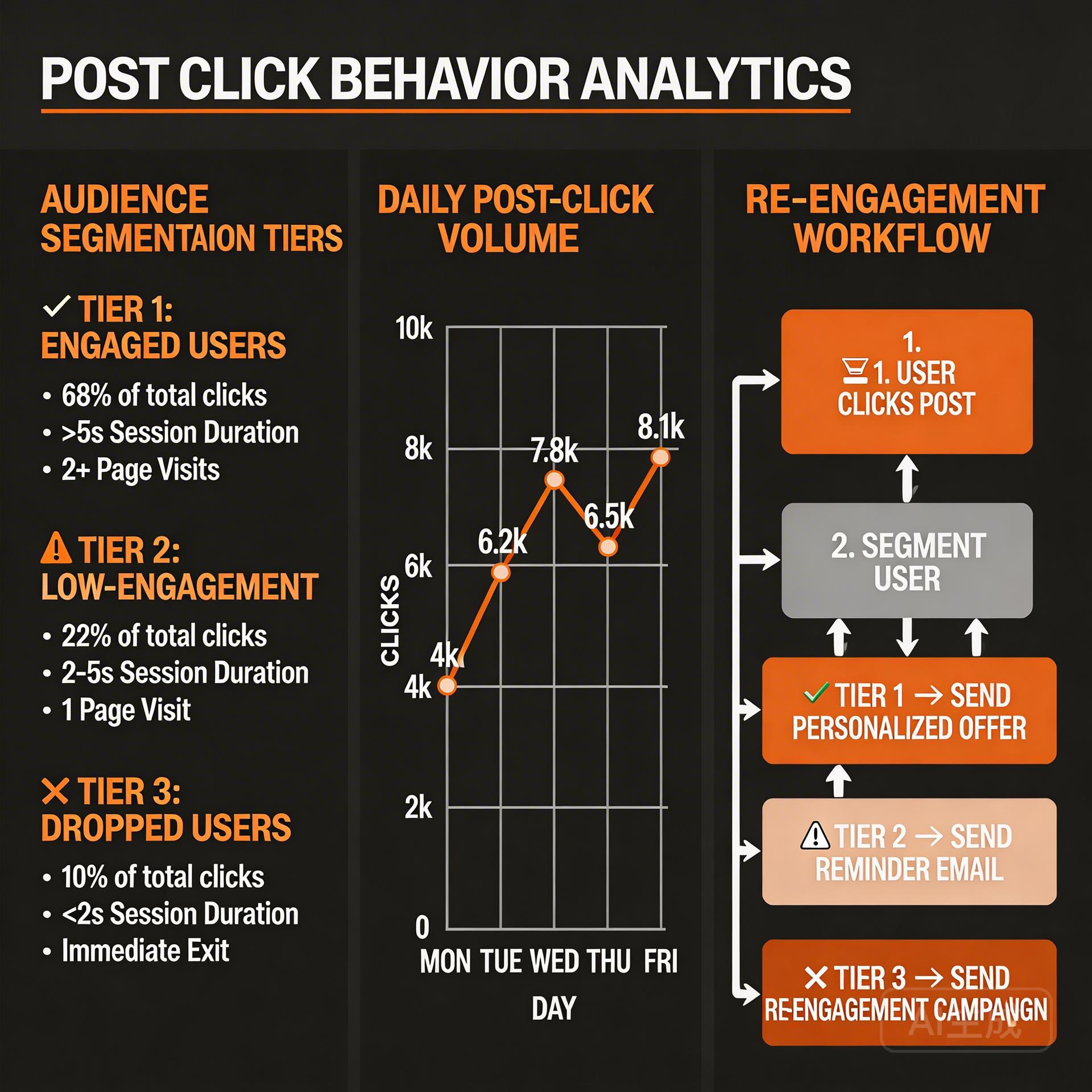
Effective social ads post-click re-engagement in 2026 combines platform-native signals with off-platform touchpoints to bring qualified dropoffs back into the funnel within the optimal re-engagement window (typically 24–72 hours).
Step 1: Build Behavioral Re-Engagement Audiences from Post-Click Events
The first step is instrumenting your landing pages to capture granular exit signals as Custom Audience events:
- Scroll depth reached (25%, 50%, 75%) — fire as separate pixel events
- Time on page thresholds (30s, 60s, 90s) — differentiate browsers from readers
- Video play percentage (50%+, 75%+) for video-heavy landing pages
- CTA interaction (hover or tap on button without click) — the highest-intent signal before conversion
These granular events let you build Custom Audiences segmented by how deep into the post-click experience each user traveled — creating a tiered re-engagement list ranked by conversion probability.
Step 2: Deploy Sequenced Re-Engagement Ads Within 48 Hours
The re-engagement window shrinks fast. Users who don’t see a re-engagement touchpoint within 48 hours of their initial click show 60% lower re-conversion rates than those reached within the first day. Use your granular post-click event audiences to trigger:
- For CTA-hovered users: Direct offer ads with stripped-down friction (one CTA, zero distractions)
- For mid-funnel dropoffs: Testimonial or social proof format — address what stopped them
- For early bounces: Reformatted creative with a different angle or a shorter-form landing page
Step 3: Use Email or Browser Notification Re-Engagement for Non-Paid Touchpoints
If your product collects email addresses or browser notification permissions at any point in the funnel, use these channels in the re-engagement sequence. A two-touch approach — paid social re-engagement ad followed by a behavior-triggered email within 24 hours — consistently outperforms single-channel re-engagement by 40–65% on conversion rate.
Automated re-engagement tools like DeepClick can coordinate these touchpoints across channels, triggering re-engagement sequences from post-click behavioral signals without manual audience management for each campaign.
Post-Click Re-Engagement for AI Social Apps and Mobile Games
AI social app and mobile game campaigns face specific post-click re-engagement challenges that standard e-commerce frameworks don’t address:
AI Social App Post-Click Challenges
- High initial intent (curiosity-driven clicks) with low immediate conversion — users need social proof before registering
- App store redirect friction — if your funnel routes through the app store, re-engagement must target store-abandoners separately from landing page dropoffs
- Day-1 retention as a re-engagement goal — users who install but don’t engage within 24 hours have 80%+ churn probability; re-engagement ads focused on “start your first session” outperform generic install campaigns
Mobile Game Post-Click Challenges
- Install-to-play gap: Users who installed but haven’t played their first session respond well to creative that emphasizes gameplay hooks, not download prompts
- Lapsed players vs new dropoffs: Segment your re-engagement between users who never converted and players who were active but churned — they need entirely different creative and value propositions
- BC (Battle-Cards/Competitive) game re-engagement: Limited-time events and competitive milestones are the highest-performing re-engagement hooks for BC-category mobile games
For a complete breakdown of how to optimize the post-click experience from ad to conversion, see our Facebook Ads Conversion Rate Optimization guide — which covers full-funnel CVR tactics with benchmark data for 2026.
Measuring Re-Engagement ROI: The Metrics That Matter
| Metric | What to Track | 2026 Benchmark |
|---|---|---|
| Re-engagement click rate | Clicks on re-engagement ad from post-click audience | 3–8% (vs 1–2% cold CTR) |
| Re-conversion rate | Conversions / users re-engaged | 8–18% from mid-funnel dropoffs |
| Cost per re-conversion | Re-engagement spend / conversions recovered | 30–60% below primary CPA |
| Re-engagement window | Time from first click to re-engagement conversion | 80% within 72 hours |
Re-engagement campaigns typically recover 12–22% of post-click dropoffs when executed with proper audience segmentation and timing. At scale, this recovery directly reduces blended CPA and improves platform-reported ROAS — without increasing acquisition spend.
Quick-Start Re-Engagement Setup: 4 Steps
- Add granular scroll-depth and time-on-page pixel events to all landing pages receiving paid social traffic
- Build Custom Audiences for each behavioral tier: CTA-hover, 75%+ scroll, 30s+ time on page
- Create a re-engagement campaign targeting these audiences with sequenced creative (proof → offer → incentive)
- Set frequency cap at 3–4 per week per user and refresh creative every 10–14 days to prevent fatigue
Stop losing conversions after the click.
DeepClick helps Meta advertisers fix post-click drop-offs and improve CVR by 30%+ through automated re-engagement and post-click link optimization.
 DeepAds
留下评论