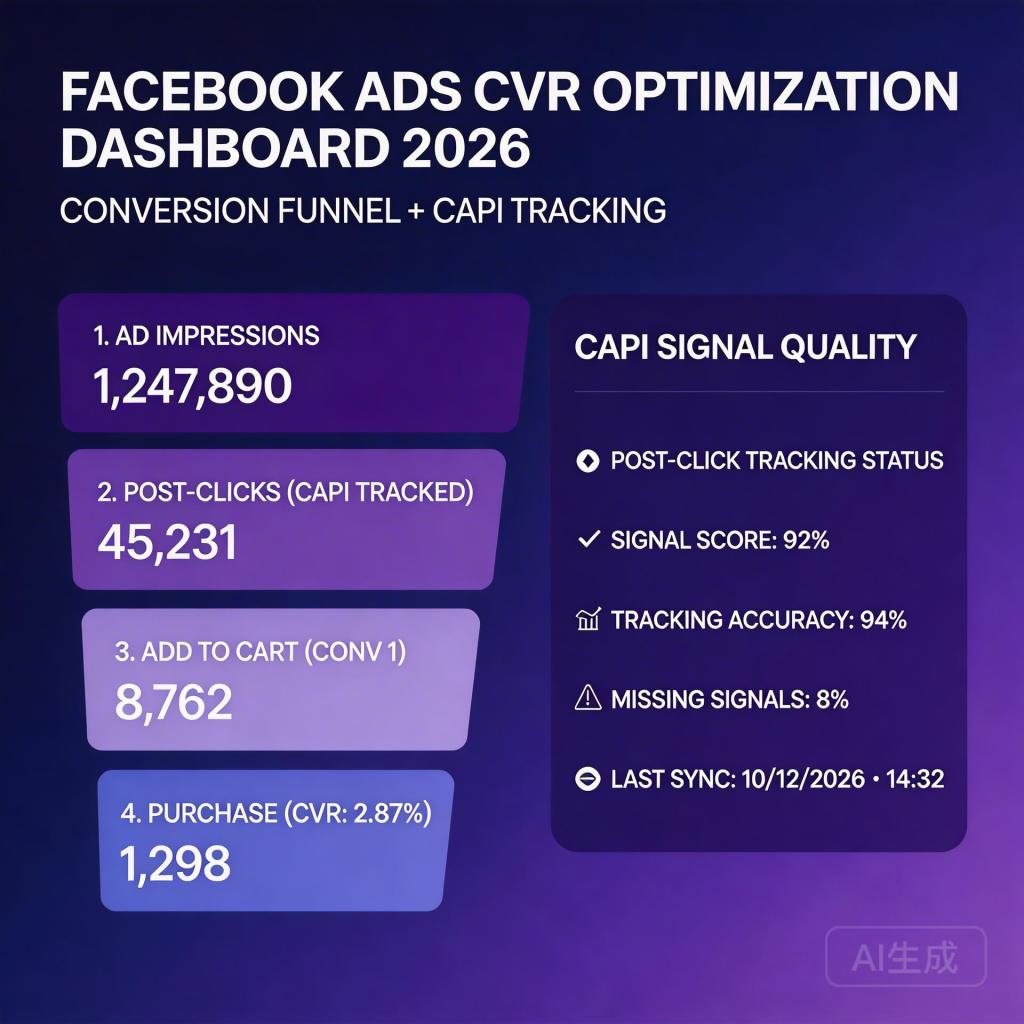
Facebook Ads conversion rate optimization has always been a moving target — but 2026 brought a series of platform changes that broke most existing CVR playbooks. Meta’s Adaptive Ranking Model (ARM), the attribution overhaul that now counts only genuine link clicks, and Google PMax’s expansion into overlapping audience pools have fundamentally changed what it means to “optimize” a Facebook Ads campaign for conversions.
This is the updated 2026 edition of our complete Facebook Ads CVR optimization guide, incorporating everything that’s changed and what to do about it.
→ If you’re already looking for a fix, Book a Free Demo and our team will audit your post-click funnel for free.
Why Facebook Ads CVR Optimization in 2026 Starts After the Click
Most Facebook Ads optimization guides focus on what happens before the click: creative, targeting, bidding, campaign structure. That optimization layer matters — but in 2026, the primary reason campaigns underperform on CVR is what happens after the click, not before it.
Here’s why the post-click layer has become so critical:
- Meta’s ARM feeds on post-click signals: The Adaptive Ranking Model now uses scroll depth, time on page, and micro-conversion events to score your ad’s quality. Poor post-click performance suppresses delivery at the algorithm level before you even see the CVR data.
- Click-through attribution now counts only link clicks: The denominator for your CVR calculation shrank significantly in 2026. Accounts that weren’t tracking this change saw apparent CVR drops of 15–25% — but the real conversion numbers were unchanged. What changed was the measurement accuracy.
- Conversion signal quality determines campaign optimization direction: Every event you fire (PageView, Lead, Purchase) teaches Meta who to target next. If your Conversions API is incomplete or your event match quality is below 7.0, you’re training Meta’s algorithm on a biased dataset — and it will find you more of the wrong users.
The 5-Layer Facebook Ads CVR Optimization Framework
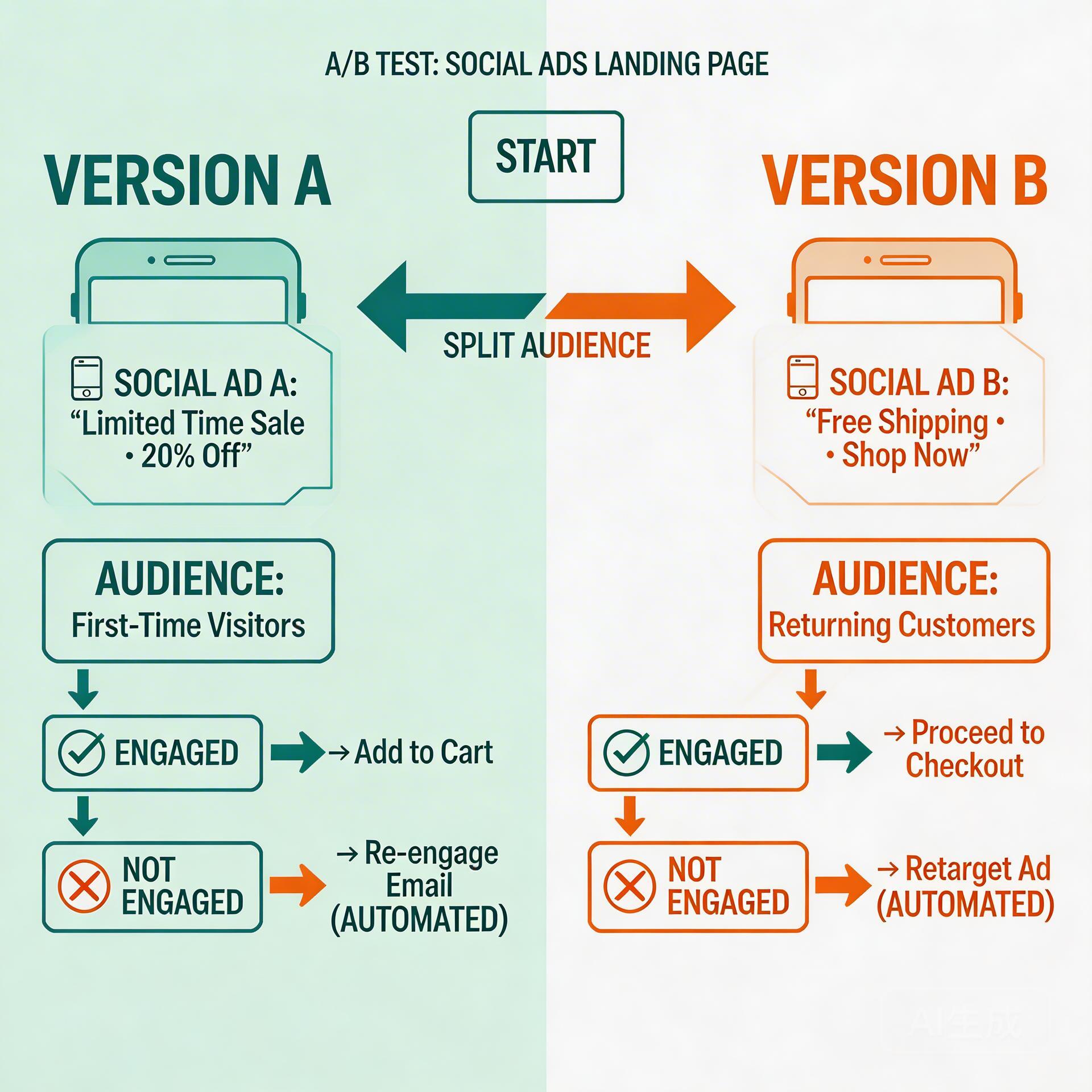
CVR optimization requires working through five sequential layers, each of which can be limiting your overall conversion rate independently.
Layer 1: Signal Infrastructure (CAPI + Event Quality)
Before any creative or audience optimization, audit your conversion signal infrastructure. In Google Analytics 4 terms, this is like checking that your tracking is firing correctly before interpreting your data. In Meta’s ecosystem, this means:
- Server-side Conversions API events for all critical conversions (Lead, Purchase, Trial)
- Event deduplication between browser pixel and CAPI
- Event Match Quality (EMQ) score ≥ 7.0 for your primary conversion event
- Conversion window aligned with your actual purchase cycle (not defaulting to 7-day click)
Without this layer, every other optimization effort is undermined. You’re optimizing with incomplete information — and Meta is delivering ads based on corrupted learning.
Layer 2: Landing Page Post-Click Experience
The landing page is where clicks either become conversions or become wasted spend. In 2026, the most impactful landing page variables are:
Message match: Every element of your ad (headline, visual, offer) must have a direct counterpart on your landing page. A mismatch between what the ad promises and what the page delivers increases bounce rates and suppresses ARM scores.
Load speed on mobile: Target LCP under 2.5 seconds on mid-range Android devices. A 1-second delay reduces conversions by 7% (Google/Deloitte). For social ads, where traffic is almost entirely mobile, this is non-negotiable.
Single conversion path: Remove all navigation menus, footer links, and competing CTAs. One page, one offer, one conversion action. Complete guide to Facebook Ads post-click experience optimization →
Layer 3: Audience-to-Landing-Page Match
Different audience segments arrive with different intent levels and different objections. A Lookalike 1% audience based on purchasers is in a different mindset than a broad interest-based audience who’s seeing your brand for the first time. Serving both the same landing page means you’re under-converting one or both.
The optimal approach is to segment landing pages by audience intent:
- Cold traffic (broad/interest/lookalike): Awareness-to-consideration LP — builds category relevance, captures email/phone, offers a low-commitment first step
- Warm traffic (retargeting, engagers): Consideration-to-decision LP — emphasizes social proof, addresses objections, pushes direct CTA
- Hot traffic (cart abandoners, trial non-starters): Decision LP — urgency, personalization, single frictionless CTA
Layer 4: Creative-to-LP Pairing and Testing
The winning combination of ad + landing page is rarely the best-performing ad paired with the best-performing landing page. They’re a system — and they need to be tested together.
A high-energy video creative that shows a product demo will outperform on a landing page that continues the demo story, but underperform on a generic features page. A testimonial-driven static ad will convert better on a testimonial-heavy landing page than on a product specification page.
Creative-to-LP pairing tests consistently produce 20–40% CVR improvements over unmatched combinations — with no change in audience, budget, or bidding. Full guide to Facebook Ads split testing landing pages →
Layer 5: Re-Engagement Automation
The fifth layer — and the one most advertisers skip entirely — is automated re-engagement for post-click abandoners. Regardless of how well you optimize the first four layers, 60–80% of users will leave without converting on their first visit. Without a re-engagement system, you’re leaving that entire segment permanently on the table.
Effective re-engagement for social ad traffic:
- Immediate trigger (0–2 hours): Personalized follow-up tied to the specific ad they clicked (use UTM parameters to identify the ad creative and match the re-engagement message)
- Mid-window nurture (day 2–4): Proof-of-concept content — user reviews, case studies, or product demo that answers the objection most likely to have caused abandonment
- Recovery offer (day 5–7): For consideration-stage products, a time-limited incentive (free trial extension, welcome discount) can recover 15–25% of abandoned sessions
Google PMax and Facebook Ads: How Channel Overlap Affects CVR
In 2026, most performance advertisers are running both Facebook Ads and Google PMax campaigns targeting similar audiences. Understanding how these channels interact is essential for CVR optimization:
PMax captures lower-funnel intent that Facebook generates: A user who sees your Facebook ad but doesn’t click might later search for your brand or product on Google — and convert through a PMax Search placement. This makes Facebook’s CVR appear low but its actual funnel contribution high.
PMax retargeting competes with Facebook retargeting: Users who clicked your Facebook ad are also being retargeted by PMax’s Display and YouTube assets. If both channels are running generic retargeting creative, you’re duplicating effort. Consider coordinating your messaging — use Meta for story-driven retargeting, Google PMax for intent-capture retargeting.
Landing page quality affects both channels’ performance: Your landing page is a shared asset. Improving it for Facebook traffic also improves PMax conversion rates (and vice versa). The post-click audit should be a channel-agnostic exercise. PMax landing page conversion rate optimization for social ads →
Vertical CVR Benchmarks: AI Apps and Mobile Games
CVR benchmarks vary widely by vertical. Understanding where you stand is prerequisite to knowing how much room for improvement exists.
AI companion and dating apps: Cold traffic LP CVR: 2–5%; warm traffic (retargeting): 8–15%; re-engaged post-click: 15–25%. If your cold traffic CVR is below 2%, the problem is likely message match or landing page trust signals. AI App post-click funnel optimization guide →
BC mobile games: Install page CVR: 15–30% (PWA/app store deep link); first-deposit conversion: 3–8% of installs. If install CVR is high but deposit rate is low, the re-engagement layer is the primary lever. If install CVR is low, the ad-to-LP message match or load speed is the bottleneck.
The Post-Click CVR Audit: A Step-by-Step Process
Running a structured CVR audit takes 2–3 hours and typically identifies 3–5 actionable improvements that can deliver 20–40% CVR gains:
- Baseline measurement: Establish current CVR by campaign, by audience segment, and by landing page variant. Segment by device type (iOS vs Android, mobile vs desktop).
- Signal quality audit: Check CAPI setup, EMQ scores, deduplication, and event coverage. Fix any issues before proceeding.
- Landing page audit: Run PageSpeed Insights on your top 3 LPs. Check message match against your top ad creatives. Review session recordings for top-500-user cohorts.
- Audience-LP alignment check: Map each audience segment to its landing page. Identify mismatches where cold traffic goes to decision-stage pages or vice versa.
- Re-engagement audit: Check what happens to users who leave without converting. If there’s no automated follow-up sequence, implement one before making any other changes — it delivers the fastest ROI improvement of any post-click optimization.
Building a CVR Optimization Calendar
CVR optimization is not a one-time project — it requires a systematic review cadence:
- Weekly: Monitor CVR by campaign and audience segment for anomalies (>10% week-over-week change)
- Monthly: Review creative-to-LP pairing performance and rotate low-performing pairs; update social proof elements on landing pages
- Quarterly: Full post-click audit (signal quality, LP speed, audience-LP alignment, re-engagement automation review)
- Annually: Rebuild your landing page variants from scratch using the latest micro-conversion data and updated audience segments
Stop losing conversions after the click.
DeepClick helps Meta advertisers fix post-click drop-offs and improve CVR by 30%+ through automated re-engagement and post-click link optimization.
Common Facebook Ads CVR Mistakes That Drain Budget in 2026
After analyzing hundreds of post-click funnels across AI apps, mobile games, and subscription products, these are the mistakes that consistently drain CVR:
- Optimizing for link clicks instead of conversions: Campaigns optimized for clicks find users who click frequently but convert rarely. Always optimize for the furthest down-funnel event that has ≥50 events/week.
- Using the homepage as a landing page: Homepages are designed for exploration, not conversion. Every Meta click needs a dedicated landing page with no navigation menu.
- Testing creative in isolation: Ad creative and landing page must be tested as a pair. The winning combination is not necessarily the best individual ad or landing page.
- Ignoring mobile load speed: A landing page that loads in 4 seconds on mobile will lose 25%+ of visitors before they even see the offer. This is often the single biggest CVR fix available.
- No re-engagement system: 70–80% of users who click your ad leave without converting. Without an automated follow-up, you’re permanently discarding the majority of your advertising investment.
- Identical landing pages for all audience stages: Cold audiences and retargeting audiences have different needs and objections. Serving them the same LP is a guaranteed sub-optimal CVR for at least one segment.
- Weak or generic social proof: “Customers love us” underperforms “4.8 stars from 8,200 verified purchases” by 3–5x. Specificity is the difference between proof that converts and proof that’s ignored.
Future-Proofing Your CVR Optimization Stack
Meta’s algorithm will keep evolving. The principles of post-click CVR optimization remain stable even as tactics shift:
First-party data is your competitive moat: As third-party tracking degrades (iOS ATT, privacy regulations), advertisers with rich first-party data — collected through optimized landing pages that capture emails, phone numbers, and behavioral signals — will maintain optimization accuracy while competitors fly blind.
Post-click quality is a permanent signal input: ARM and similar quality scoring systems will only become more sophisticated. Landing page quality, user engagement depth, and post-click conversion speed will remain direct inputs into ad delivery quality scores.
Automation handles the repetitive, humans handle the strategic: Re-engagement sequences, dynamic LP personalization, and event-triggered nurture flows can be fully automated. The human optimization work — audience-LP mapping, creative strategy, CVR testing frameworks — is where the competitive advantage lies.
Conversion Rate Optimization by Campaign Objective: A Practical Breakdown
The CVR optimization strategy changes depending on which Meta campaign objective you’re using. Here’s how to think about optimization for each major objective:
Conversions Objective (Maximize Conversions / Cost Per Result)
This is the standard objective for direct-response campaigns. The algorithm optimizes for your nominated conversion event, so the quality of that event — and the volume of it — directly determines delivery quality. Best practices: ensure ≥50 conversions per week on your target event, use cost cap bidding (not lowest cost) to prevent runaway spend when CVR drops, and monitor cost per conversion daily rather than weekly.
Advantage+ Shopping Campaigns
For e-commerce and subscription products, Advantage+ Shopping automates placement, targeting, and creative serving across Meta’s inventory. CVR optimization for ASC is almost entirely post-click: the algorithm handles the pre-click optimization. Your levers are landing page quality, product catalog feed optimization, and CAPI signal quality. Weak post-click performance in ASC reduces the algorithm’s ability to find high-converting users because it relies on conversion feedback to learn.
Lead Generation Objective
Lead Gen campaigns (both native Meta forms and traffic-to-landing-page) have distinct CVR dynamics. Native lead forms have higher form completion rates (lower friction) but often produce lower-quality leads because users submit without leaving Meta’s environment. Traffic-to-LP lead gen has lower form completion but typically produces better quality leads who’ve engaged with your brand. The CVR optimization question here is not just “how many leads” but “how many leads-to-sales” — and that requires tracking the full funnel.
App Install Campaigns (Meta for Apps)
App install CVR optimization involves both the ad-to-app-store step and the install-to-registration step. Common optimization priorities: ensure deep link tracking so you can attribute in-app events back to specific creatives; optimize for “purchase” or “subscription” events, not “installs,” for better user quality; and build re-engagement campaigns for users who install but don’t complete the registration within 48 hours.
How to Use Meta’s Conversion Insights Tool to Drive CVR Improvements
Meta’s Conversion Insights tool (in Ads Manager → Campaigns → Breakdown → Conversion) provides granular data on which stages of your funnel are leaking conversions. In 2026, it also shows the impact of iOS attribution limitations on your funnel measurement, helping you distinguish between real CVR drops and measurement gaps.
Key use cases for Conversion Insights in CVR optimization:
- Funnel stage analysis: Compare how many users proceed from click → landing page view → initiate checkout → purchase. Each drop-off percentage identifies which optimization layer to prioritize next.
- Audience comparison: View CVR by audience segment side-by-side to identify which segments are over- or under-converting relative to spend. Reallocate budget to high-CVR segments.
- Attribution window comparison: The tool lets you compare 1-day, 7-day, and 28-day click windows plus view-through windows. Understanding which window most accurately reflects your actual customer journey helps you set the right optimization signal for your campaigns.
- Cross-channel comparison: See how Meta’s contribution to conversions compares against your own GA4 data. The gap reveals view-through attribution vs. actual click-driven conversions.
Integrating DeepClick With Your CVR Optimization Stack
DeepClick is designed to close the gap between Meta’s campaign optimization and your actual conversion outcomes. The platform provides three capabilities that map directly to the five-layer CVR framework described above:
Post-click link optimization: DeepClick’s link layer sits between your Meta ad and your landing page, enabling dynamic routing (matching landing page variant to ad set audience), UTM-aware personalization (showing users landing page content that matches the ad they clicked), and performance tracking at the click level — not just the session level.
Automated re-engagement sequences: DeepClick builds re-engagement campaigns automatically from post-click abandonment data, triggered by specific behaviors (scroll depth, form abandonment, CTA hover without click) rather than simple session time. This produces re-engagement messages that address the actual objection rather than generic “come back” messaging.
CVR analytics by audience and ad: The analytics layer breaks CVR down by audience segment, ad creative, and landing page variant — giving you the cross-dimensional view that Meta’s native reports don’t provide. This is how you identify which creative-to-LP combinations to scale and which to replace.
Teams using DeepClick across all three layers report 30%+ CVR improvements within 60 days, primarily from re-engagement recovery and landing page routing improvements.
 DeepAds
留下评论