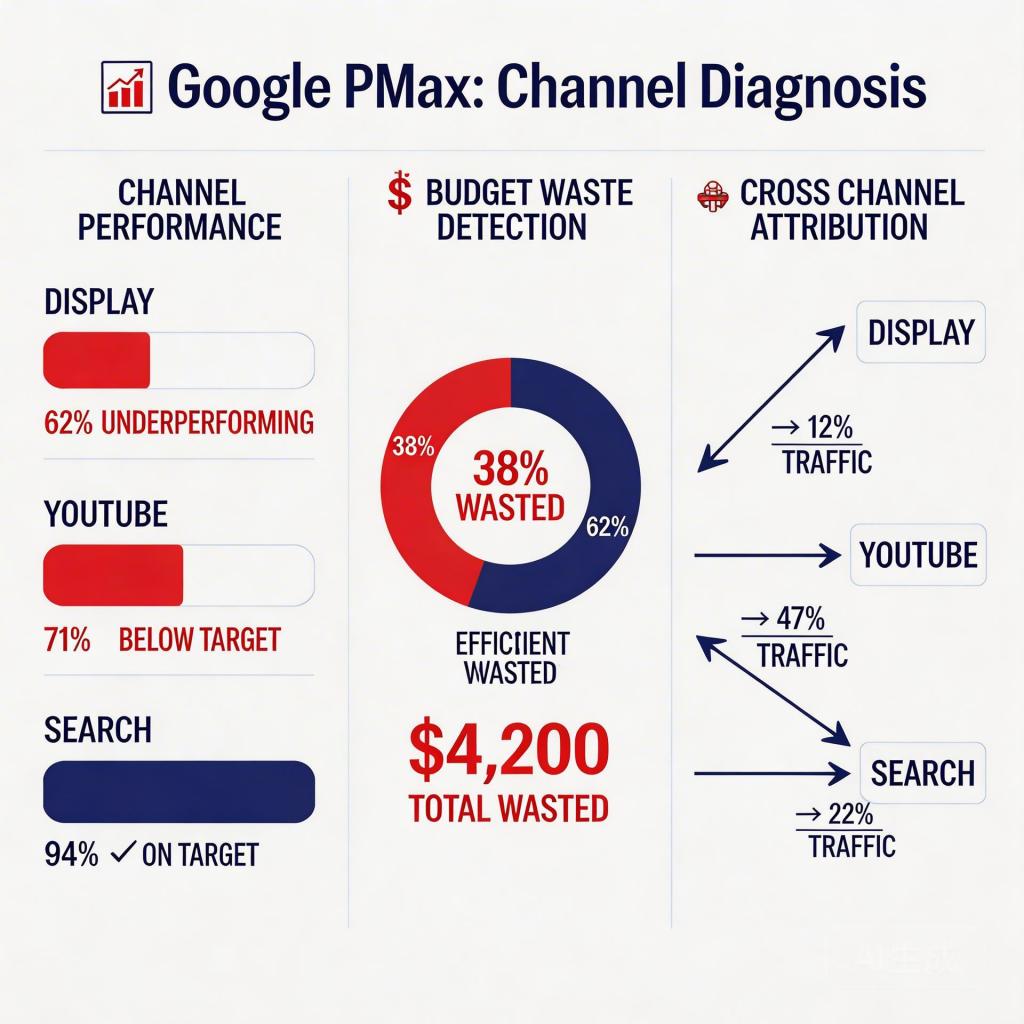
Your Google PMax campaign is reporting solid ROAS numbers. But when you look at your actual sales pipeline, the numbers don’t match — or they do match, but only because PMax is capturing conversions that would have happened anyway through branded search. In 2026, the most expensive hidden cost in many performance advertising accounts is PMax budget quietly allocating to channels that deliver low-quality post-click traffic.
→ If you’re already looking for a fix, Book a Free Demo and our team will audit your post-click funnel for free.
What an “Underperforming PMax Channel” Actually Means
A PMax channel is underperforming when it’s receiving budget allocation that’s disproportionate to the quality of post-click conversions it generates. This is different from a channel that simply has lower conversion rates — it’s about the relationship between spend, traffic quality, and actual conversion outcomes.
The three most common underperforming PMax channel patterns:
- Display overallocation: PMax’s algorithm is finding “cheap” CPM inventory on the Display Network that technically fires your conversion pixel — but via accidental clicks, low-intent audiences, or view-through attributions that inflate conversion reporting without corresponding revenue. Your Display spend grows because the algorithm sees “conversions,” but your actual revenue doesn’t scale.
- YouTube at wrong funnel stage: YouTube inventory is allocated for awareness and consideration, but your conversion setup rewards bottom-of-funnel actions. PMax burns YouTube budget reaching users who aren’t ready to convert, fires a view-through conversion attribution when they later purchase elsewhere, and reports strong ROAS. In reality, you’ve paid for impressions, not conversions.
- Discovery/Gmail in B2B or high-consideration products: Discovery ads can work for impulse or low-consideration products but underperform severely for products requiring extended evaluation. PMax will continue allocating to Discovery if the conversion signal quality is weak enough that it can’t distinguish intent quality between channels.
The Post-Click CVR Diagnosis for Social Ads Running Alongside PMax
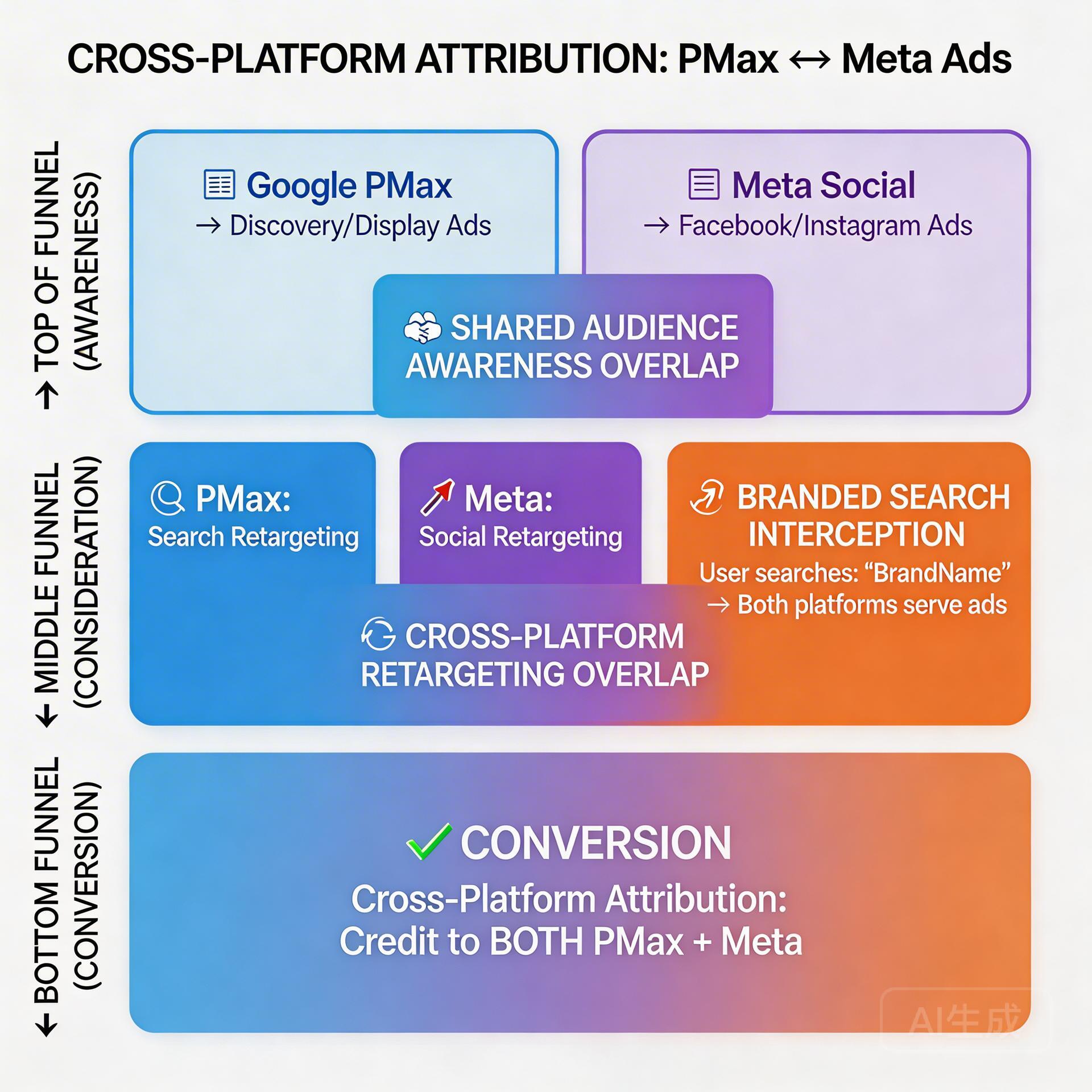
For advertisers running social ads (Meta, TikTok) alongside Google PMax, the channel cross-contamination issue is particularly acute. PMax will absorb a significant portion of your Meta-driven intent:
A user who clicks your Meta ad, visits your landing page, doesn’t convert, and then searches for your brand 48 hours later will convert through PMax’s Search placement. PMax claims the conversion; your Meta campaign appears inefficient. Your CPA on Meta rises; you reduce Meta budget; PMax gets more budget; but PMax’s performance then plateaus because it’s lost the Meta touchpoints that were driving branded search intent.
This cross-channel pattern is invisible to either platform’s native reporting. The fix requires unified attribution — combining your GA4 data (which captures the click path more accurately) with Meta’s Conversion Insights and PMax’s Attribution reports to reconstruct the actual multi-touch journey. PMax landing page CVR and post-click drop-off analysis →
How to Identify Which PMax Channels Are Underperforming Your Social Ads
Step 1: Cross-Reference PMax Conversion Volume with Revenue
Pull your PMax campaign’s attributed conversions for the past 30 days. Cross-reference against actual revenue or leads in your CRM for the same period. If the ratio of attributed conversions to actual outcomes is below 70%, you have a significant view-through attribution or accidental-click problem. The gap is almost always concentrated in Display and YouTube channels.
Step 2: Analyze Your Asset Group Impression-to-Conversion Ratio by Asset Type
In Google Ads, go to your PMax campaign → Asset Groups. Look at which asset types (image ads, video ads, text-based responsive search) are generating the most impressions but lowest conversions. Asset types with high impression share but low conversion share are your underperforming channels — the algorithm is serving them extensively but they’re not closing the loop.
Step 3: Compare PMax Performance During Peak Social Ad Days
Run a simple analysis: on days when your Meta ads have peak spend and high CTR, does your PMax conversion rate rise disproportionately (suggesting PMax is capturing Meta-driven intent via branded search)? This correlation, if present, quantifies how much of your PMax revenue is actually Meta-generated intent that PMax is intercepting at the bottom of the funnel.
Step 4: Check Branded vs Non-Branded Conversion Split in PMax
Use Google Ads search term reports (available via PMax’s Search Terms insight) to see what proportion of your PMax Search conversions come from branded queries. If branded search is responsible for 40%+ of your PMax conversions, you’re essentially paying PMax rates for traffic that would find you organically. Separate branded keywords into a dedicated Standard Search campaign with lower bids to reclaim that margin.
Fixing Underperforming PMax Channels: The Post-Click Solution
The direct fix for underperforming PMax channels is not channel exclusion (Google doesn’t allow explicit channel exclusions in PMax) — it’s improving post-click performance so the algorithm learns which traffic sources actually convert.
The mechanism: when your landing page delivers strong CVR signals for traffic from specific PMax channel types, the algorithm allocates more budget to those channels. When post-click CVR is weak for Display or YouTube traffic, the algorithm — if your conversion signal quality is high enough to distinguish — eventually reduces allocation to those lower-converting sources.
Practical steps to improve the feedback loop:
- Create channel-aware landing page variants: Tag your PMax traffic with UTM parameters that identify channel type (utm_medium=display, utm_medium=youtube). Route that traffic to landing pages calibrated for the appropriate intent stage. PMax social ads landing page optimization →
- Improve conversion signal quality: Ensure your CAPI/GA4 conversion signals have high match quality. Weak signal quality prevents the algorithm from distinguishing between channels that drive real conversions and channels that drive attribution inflation.
- Add audience signals for your actual converters: Upload your CRM purchaser list as an audience signal. This gives PMax a directional reference point for user quality, reducing accidental optimization toward lookalike audiences that look good in the signals but don’t actually buy.
- Implement post-click re-engagement for PMax visitors: Users who arrive from PMax Display or YouTube and don’t convert are frequently high-intent users in consideration mode. A re-engagement sequence that fires within 2 hours can capture 15–25% of them — improving your reported PMax CVR and teaching the algorithm that this traffic type can convert. AI App post-click funnel optimization guide →
The Connection Between PMax Channel Efficiency and Social Ads ROI
Fixing your PMax channel efficiency problem doesn’t just improve PMax ROAS — it improves the ROI of your entire paid media stack, including your social ads. Here’s why:
When PMax stops absorbing branded search intent that was generated by your Meta campaigns, your Meta CVR data becomes more accurate — and Meta’s algorithm can optimize more effectively. The result: Meta delivers higher-intent traffic (because the algorithm’s learning signal is cleaner), PMax closes more truly incremental conversions, and your blended CPA drops.
This is the system-level benefit of unified post-click optimization: improvements in one channel’s post-click performance improve signal quality across your entire paid media ecosystem. For a complete framework on cross-channel post-click optimization for social and search, see our updated Facebook Ads CVR Optimization Complete Guide 2026.
5 Immediate Fixes for Underperforming PMax Channels
- Cross-reference attributed conversions against CRM revenue data — a 30%+ gap indicates attribution inflation requiring investigation
- Analyze asset group impression-to-conversion ratios to identify which asset types (image vs video vs text) are driving impressions without corresponding conversions
- Segment branded vs non-branded search conversions in PMax; consider separating branded into a Standard Search campaign
- Create UTM-tagged channel-aware landing pages for Display and YouTube traffic to improve post-click CVR for these lower-intent sources
- Implement automated re-engagement for PMax visitors who don’t convert — recovering 15–25% of Display/YouTube traffic through a timed follow-up sequence improves both reported CVR and algorithm learning
PMax Channel Efficiency Benchmarks for Social Advertisers
For context on what “efficient” looks like in well-optimized PMax campaigns running alongside social ads, here are 2026 benchmarks for the AI app and mobile gaming verticals:
- Search share of PMax conversions: 50–65% in mature, well-optimized accounts. Below 40% suggests Display or YouTube overallocation.
- Branded search share of PMax conversions: Below 25% in accounts with strong non-brand performance. Above 35% suggests PMax is over-relying on capturing social-ad-generated intent.
- Display CTR: 0.08–0.18%. Consistently above 0.25% on Display suggests accidental click placements worth investigating.
- Cross-channel conversion lag (Meta click to PMax conversion): Typically 2–5 days for mobile apps; 5–10 days for subscription products. Patterns outside this range may indicate view-through attribution or click fraud.
- Post-click landing page CVR for PMax Search traffic: Should be within 20% of your best Meta retargeting CVR, since Search traffic arrives with similar or higher intent. A large gap indicates landing page optimization lag for PMax-specific traffic.
Run this benchmark comparison quarterly to catch channel efficiency drift before it compounds into significant wasted spend.
When to Involve Your Agency or In-House PMax Specialist
The PMax channel efficiency audit described above can be run independently by any performance marketing manager with access to Google Ads and GA4. However, certain patterns warrant escalation to a specialist or platform support:
- Conversion data is inconsistent across tools (GA4, Meta Attribution, Google Ads all show different numbers for the same period) — this usually indicates a tagging or event deduplication issue that requires technical investigation
- PMax performance dropped sharply after adding Meta remarketing campaigns — may indicate audience overlap causing bid competition or attribution conflict
- PMax ROAS looks great in-platform but incrementality tests show minimal lift — the brand-capturing vs. incremental-conversion diagnosis requires controlled experiment design
Most channel efficiency issues, however, are diagnosable and fixable with the three-step audit process above — without external help, and usually within a few hours of focused analysis.
Stop losing conversions after the click.
DeepClick helps Meta advertisers fix post-click drop-offs and improve CVR by 30%+ through automated re-engagement and post-click link optimization.
 DeepAds
留下评论