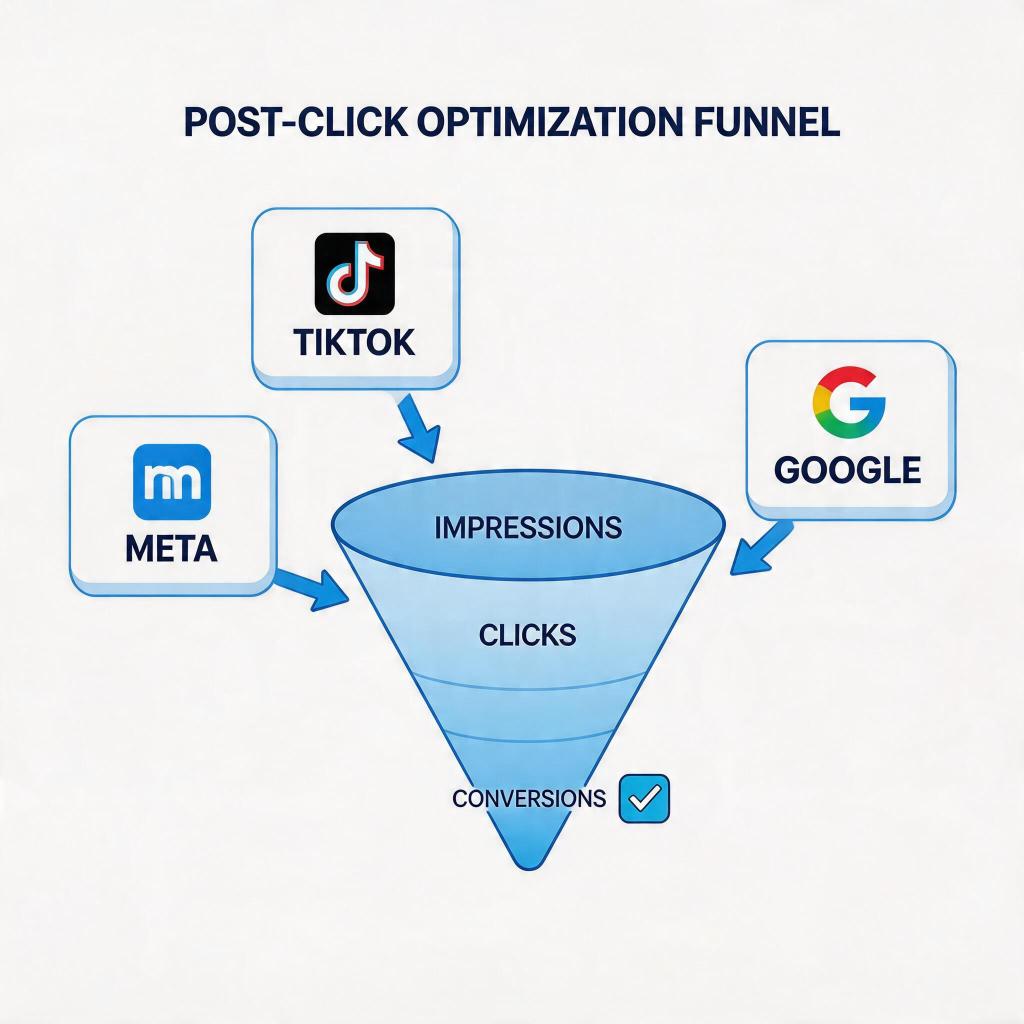
When Meta banned law firm advertisements across its ad network earlier this year, it sent a shockwave through the performance marketing ecosystem. For advertisers who’d built their entire user acquisition engine on Meta’s targeting and attribution infrastructure, the message was unambiguous: platform risk is not theoretical — it’s operational. Combined with ongoing controversy around Advantage+ automated bidding and tightening audit policies that are squeezing AI social apps and game BC advertisers especially hard, 2026 is shaping up to be the year smart advertisers start treating post-click optimization as a core infrastructure layer — not a nice-to-have.
Book a free demo to see how DeepClick delivers platform-neutral CVR optimization across Meta, TikTok, and beyond.
Two Crises Converging: Audit Tightening + Bidding Environment Deterioration
Meta’s enforcement actions in 2025–2026 have been aggressive and, from an advertiser perspective, often opaque. The law firm ad ban was the most visible example, but it’s not an outlier. Meta has simultaneously escalated its content policy enforcement for AI social apps and game BC (broadcast) products — categories that sit in genuinely gray regulatory territory across multiple markets. Advertisers in these verticals are seeing:
- Higher ad account suspension rates, sometimes with no clear explanation
- Retroactive policy applied to creative that was previously approved
- Advantage+ campaigns that consistently overspend daily budgets while delivering lower-quality users
- Attribution windows being shortened without corresponding performance improvements
The Advantage+ controversy deserves particular attention. Meta’s automated bidding suite was marketed as a way to optimize for conversion value, but many advertisers have reported the opposite: Advantage+ is optimizing for volume, not value. Advertisers are paying for installs that don’t convert, and the lack of granular control makes it nearly impossible to diagnose why. When your entire media buying strategy is wrapped inside a black-box algorithm you can’t inspect or override, you’re not running a performance marketing campaign — you’re hoping.

What Platform Dependency Actually Costs You
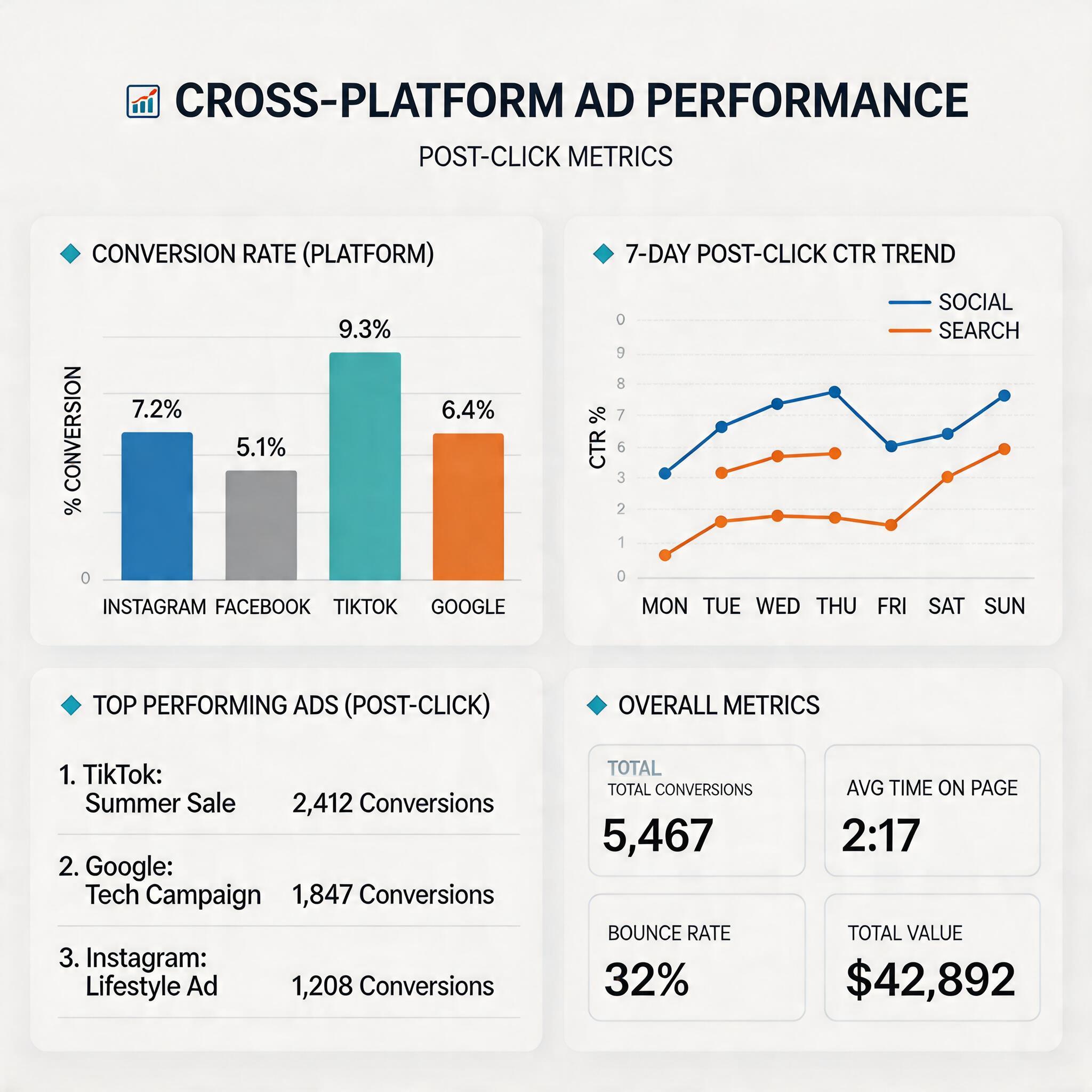
The real danger of platform dependency isn’t that Meta might ban your account — it’s that your conversion funnel is entirely dependent on infrastructure you don’t control. When you look at your conversion data, you’re seeing the combined result of pre-click decisions (audience, creative, bidding) and post-click decisions (landing page experience, load speed, personalization, offer matching). If you’re only optimizing the pre-click half, you’re leaving massive CVR on the table — and you’re also building a single point of failure.
Here’s the math most advertisers never run: If your landing page converts at 3% and you could push that to 5% through systematic post-click optimization, you’ve effectively increased your media efficiency by 67% — without spending an additional dollar on media. That’s not a small gain. For AI social apps spending $50K/month on Meta, a 2-percentage-point CVR improvement is worth roughly $33K/month in recovered value. For game BC advertisers running at scale, the number is even larger.
The problem is that most advertisers treat post-click as an afterthought — a developer tweak here, an A/B test there. Real post-click optimization requires a systematic approach: real-time offer matching, dynamic landing page optimization, speed optimization across CDN edge networks, and behavioral signal processing to personalize the post-click experience. That’s a significant infrastructure investment to build in-house.
The Case for Platform-Neutral Optimization
This is where the strategic argument for post-click optimization gets interesting. When your CVR optimization layer sits after the platform click — independent of which platform generated that click — you create a meaningful asymmetry in your favor. You become less sensitive to:
- Platform attribution model changes (window shifts, view-through adjustments)
- Algorithmic bidding unpredictability (Advantage+ performance swings)
- Policy enforcement variability (the law firm ban scenario)
- Competitive bidding pressure in any single auction
DeepClick’s post-click optimization layer works the same way regardless of whether the click came from Meta, TikTok, Google, or any other traffic source. The optimization decisions — which offer to show, which landing page variant to serve, how to personalize the experience — are driven by post-click signals: device type, geolocation, referral source, time of day, behavioral patterns. These signals are platform-independent by design.
This is fundamentally different from pixel-based optimization, which lives inside the platform’s ecosystem and is subject to platform rules, API limitations, and data latency. DeepClick’s approach processes post-click events directly, often within milliseconds of the click, enabling real-time decisioning that pixel-based approaches simply can’t match.
Multi-Platform Diversification: Strategy, Not Just Distribution
Advertisers who’ve learned from the Meta law firm ban have started thinking about multi-platform diversification not as a media mix strategy, but as an operational resilience strategy. The goal isn’t to simply spread spend across TikTok, Google, and Meta — it’s to build a conversion infrastructure that doesn’t depend on any single platform’s policies, attribution model, or algorithmic behavior.
Practically, this means:
- Owning your post-click layer — not relying on platform-native landing page solutions
- Decoupling attribution from optimization — using multi-touch attribution for reporting, but post-click signals for real-time optimization decisions
- Building channel-agnostic creative frameworks — creative that performs across platforms, not optimized for any single platform’s creative policies
- Running post-click optimization across all traffic sources simultaneously — so every channel benefits from the same conversion infrastructure
The most sophisticated AI social app advertisers in 2026 are running this playbook. They treat Meta and TikTok as traffic sources, not conversion partners. They measure each platform on the quality of its traffic — not on its ability to convert that traffic. The conversion happens on their infrastructure, with their optimization logic, under their control.
How DeepClick Fits Into Your Platform Risk Strategy
DeepClick is built specifically for advertisers who need a reliable, platform-neutral post-click optimization layer. For AI social apps and game BC advertisers running across Meta and TikTok, DeepClick provides:
- Real-time post-click decisioning: Offer matching and landing page optimization within milliseconds of click receipt
- Multi-channel coverage: Unified optimization across Meta, TikTok, Google, and other major traffic sources
- Behavioral signal processing: Device, geo, time, and referral-based personalization without relying on platform pixels
- CVR analytics: Visibility into exactly where post-click conversions are being lost, by channel and by traffic source
When you run DeepClick alongside your existing Meta and TikTok campaigns, you immediately decouple your conversion performance from platform-level variability. A Meta Advantage+ algorithm that’s overspending on low-quality installs still delivers clicks — and DeepClick’s post-click layer filters, personalizes, and optimizes the post-click experience for those clicks. The platform’s black box stops being your bottleneck.
The Risk You Can’t Afford to Ignore
Platform risk in paid media is accelerating, not diminishing. Meta’s enforcement actions in 2025–2026 have demonstrated that even large, compliant advertisers are not immune to policy shifts that can wipe out months of performance data, disrupt campaign continuity, and destroy ROAS projections overnight. The Advantage+ automated bidding suite adds a second layer of risk: algorithmic unpredictability that sits inside your media buying infrastructure and is nearly impossible to audit.
The answer isn’t to reduce Meta spend — it’s to reduce Meta dependency. These are not the same thing. You can continue to run significant Meta campaigns while simultaneously building conversion infrastructure that doesn’t depend on Meta’s platform, policies, or algorithms. The advertisers who will win in 2026 are the ones who understand this distinction and act on it now.
Post-click optimization isn’t a hedge against platform risk. It’s the foundation of a resilient, scalable paid media operation that performs consistently regardless of what any single platform decides to do next.
Ready to make your post-click layer platform-neutral?
DeepClick delivers real-time CVR optimization across Meta, TikTok, and every major traffic source — so your conversion performance doesn’t depend on any single platform’s policies or algorithms.
This article is part of DeepClick’s Facebook Ads Conversion Rate Optimization series. Related reading: Why Platform Diversification Demands a Post-Click Optimization Layer in 2026 and Meta Ads: Click-Through vs. Engage-Through Attribution in 2026.
 DeepAds
留下评论