
TikTok’s 2026 algorithm overhaul is quietly dismantling the playbook that social advertisers relied on for the past three years. The platform has shifted from a pure engagement-and-reach model to an SEO-first discovery architecture — meaning organic content discoverability now shapes which paid ads get amplified, how audiences are primed before they click, and ultimately how well your post-click funnel performs. Advertisers who keep optimizing only for the click are watching CVR (conversion rate) drop even as CPM holds steady. The fix is not a better creative. The fix is a better post-click path.
→ Curious how return links work? See DeepClick in 1 minute — no review required, more impressions per click.
What TikTok’s SEO-First Algorithm Actually Changed in 2026
Before mid-2025, TikTok’s For You Page (FYP) algorithm operated primarily on behavioral signals: watch time, replays, shares, and comment velocity. Paid ads were distributed largely independently of organic content performance. That separation is gone.
The 2026 update introduced three structural changes that directly affect social ad performance:
1. Keyword-Intent Matching Across Paid and Organic
TikTok now uses search query data and in-video keyword signals to co-rank paid and organic content in the same discovery surfaces. If a user searches “best skincare routine under $30,” TikTok surfaces both organic videos and paid ads that match that intent. Ads that lack keyword alignment in their copy, overlay text, or landing page metadata are being systematically deprioritized in these blended surfaces.
2. Post-Click Engagement as a Quality Signal
The algorithm now reads post-click engagement data — specifically, whether users who click an ad return to TikTok quickly (a negative signal) or stay on the landing page long enough to indicate genuine interest. Short dwell time after click is now factored into ad quality scores, which directly influences delivery priority and effective CPM. Internal TikTok data cited in early 2026 advertiser reports noted up to a 22% increase in CPM for ads showing poor post-click engagement patterns.
3. Organic Seeding Requirements for Paid Amplification
TikTok’s new “Spark Ads Plus” feature, launched in Q1 2026, requires advertisers to connect paid campaigns to organic posts with minimum engagement thresholds before unlocking the top-tier “Premium Discovery” placement. Brands with no organic presence on TikTok now face a structural ceiling on paid reach.
Why the Algorithm Shift Breaks Your Current Conversion Funnel
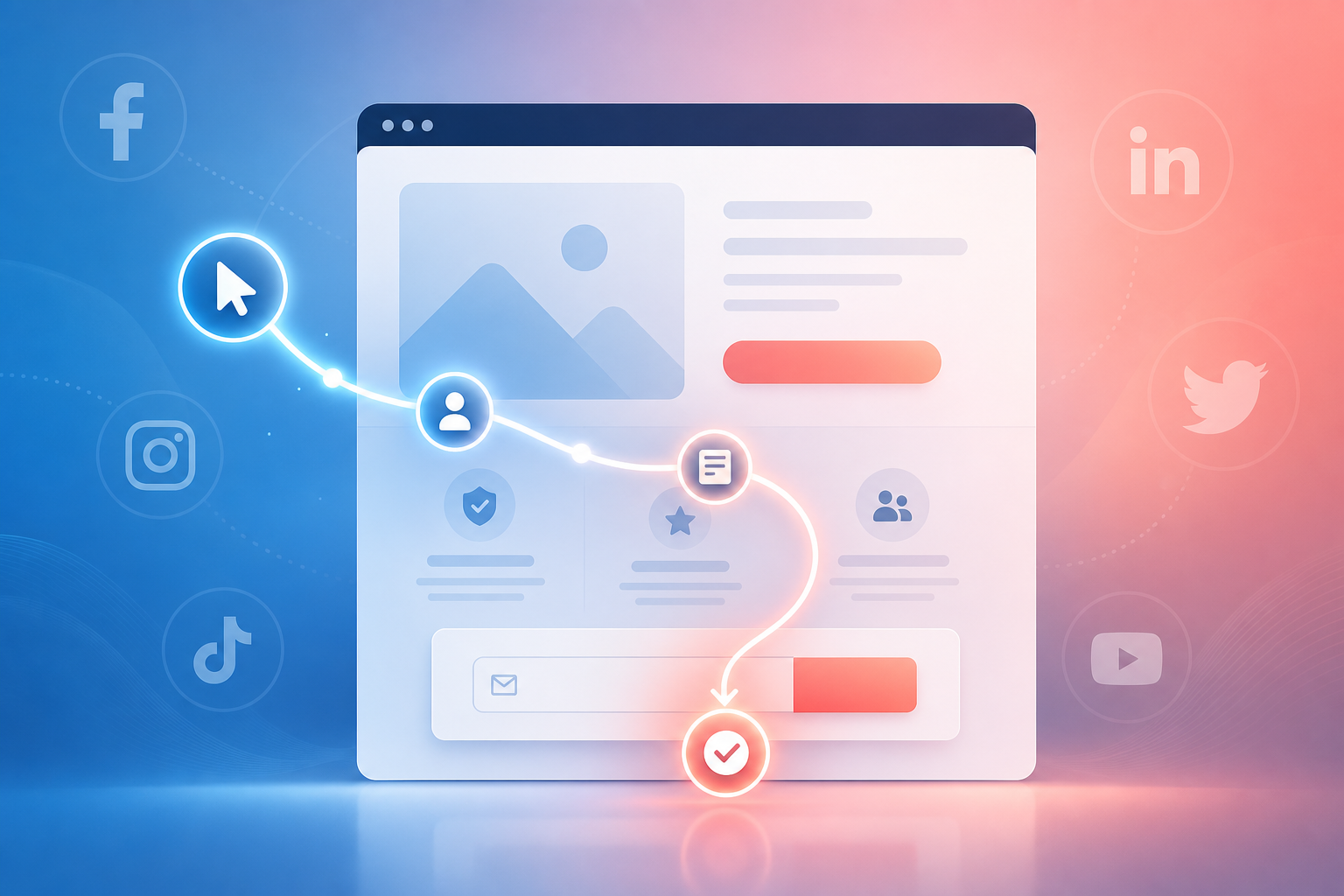
The traditional social ad funnel was built on a clean handoff: paid ad → click → landing page → conversion. TikTok’s SEO-first model fractures that handoff in several ways that most advertisers have not yet addressed.
Audience Temperature Has Changed
Under the old model, paid ads interrupted cold audiences. Under the SEO-first model, many users who see your ad have already encountered your brand through organic content or search. This means they arrive at your landing page with higher intent but also higher expectations. A generic landing page that would have converted a cold audience at 2.5% may now convert a warm SEO-primed audience at only 3.1% — far below the 6–9% rates that intent-matched landing pages can achieve.
A 2025 study by AppsFlyer tracking 1,200 social ad campaigns found that campaigns with intent-matched post-click pages outperformed generic landing pages by 3.8x on return on ad spend (ROAS). As TikTok pushes more intent-qualified traffic through its SEO surfaces, the gap between generic and optimized post-click paths will only widen.
Ad Review Friction Creates Dead Zones in the Funnel
When advertisers try to rapidly iterate their landing pages to match new intent signals, they face a compounding problem: every material change to a linked landing page can trigger re-review. In a fast-moving SEO environment where search intent shifts weekly, waiting 24–72 hours for ad review while your optimized page sits idle is a direct revenue leak. This is where Meta Advantage+ ad review changes offer a useful parallel — the same principle of reducing review-gate friction applies to TikTok’s paid ecosystem.
The Bounce-Back Problem
If users click your TikTok ad and immediately bounce back to the app, TikTok interprets this as a negative quality signal and reduces your ad delivery priority. Yet most advertisers’ landing pages are optimized for desktop traffic patterns, not mobile-first TikTok users who expect instant, visually coherent experiences. The average mobile landing page load time is 4.8 seconds (Google, 2025); TikTok users’ tolerance for slow pages is significantly lower given the platform’s native speed.
4 Post-Click Optimization Strategies for the SEO-First TikTok Era
The following four strategies address the specific post-click failure modes introduced by TikTok’s 2026 algorithm. Each includes concrete operational steps.
Strategy 1: Build Intent-Matched Landing Pages for TikTok’s SEO Traffic Segments
Stop sending all TikTok ad traffic to a single landing page. TikTok’s SEO-first algorithm segments your audience by search intent before they click. Your post-click path should reflect that segmentation.
Step 1: Pull your TikTok Ads Manager audience insights and identify the top 3–5 search keyword clusters driving clicks to your ads. TikTok’s 2026 Creative Center now surfaces this data under “Keyword Attribution” in campaign analytics.
Step 2: Create dedicated landing page variants for each keyword cluster. The page headline, hero image, and primary CTA should directly mirror the intent of that keyword cluster. For example, if a cluster centers on “price comparison,” lead with your pricing table, not a generic product overview.
Step 3: Use UTM parameters at the keyword cluster level (not just the campaign level) to route users to the correct variant. Set up a simple redirect layer — this avoids triggering new ad review for each variant since the ad itself is pointing to a stable URL.
Step 4: Measure time-on-page and scroll depth for each variant. TikTok’s post-click quality score correlates with dwell time, so even a 30-second improvement in average session length can materially improve your ad delivery score.
Strategy 2: Use Return Link Technology to Recover Clicks Without Re-Review
One of the most costly side effects of TikTok’s new quality scoring is that advertisers who pause ads to update landing pages lose delivery momentum and ad account history. The answer is to decouple the ad creative from the landing page iteration cycle using return link architecture.
Return links (as implemented by tools like DeepClick) allow a single ad click to generate multiple no-review impressions on updated landing pages. This means you can update your post-click page to match new TikTok SEO keyword signals without going back through ad review, and without losing the delivery momentum you’ve built.
Step 1: Identify your highest-volume TikTok ad sets — these are the ones where delivery interruption is most costly.
Step 2: Implement a return link layer between the ad click and your primary landing page. The return link acts as a stable URL that passes traffic through to whatever variant you designate, insulating your ad from review re-triggers.
Step 3: Update the downstream landing page as frequently as TikTok’s SEO keyword signals require — daily if needed — without touching the ad or the return link URL. You maintain continuous delivery while optimizing the conversion path in real time.
This approach directly addresses the 22% CPM inflation TikTok applies to poor post-click engagement: by keeping your landing page aligned with current SEO intent signals, you continuously improve post-click dwell time and protect your delivery score. For a related framework on structuring this for Facebook ads conversion rate optimization, the same principle of insulating ad creative from landing page iteration applies cross-platform.
Strategy 3: Optimize for TikTok’s Mobile-First Post-Click Experience
TikTok’s post-click quality signal is heavily weighted toward mobile engagement metrics. Landing pages built for desktop conversion flows are systematically underperforming on TikTok traffic.
Step 1: Audit your current TikTok landing pages on a real mobile device (not Chrome DevTools mobile emulation). Test scroll behavior, CTA tap target size, and form fill experience. Common failures: tap targets under 44px, forms requiring more than 3 fields, and CTAs placed below the fold on smaller screens.
Step 2: Implement a content-first mobile layout. For TikTok traffic specifically, the first 3 seconds of the landing page experience must communicate the core value proposition visually — before any text-heavy sections. Use a short video loop or animated hero that mirrors the TikTok creative to create continuity between the ad and the post-click experience.
Step 3: Reduce landing page load time to under 2 seconds on a 4G connection. Use a CDN, compress all images to WebP format, and defer non-critical JavaScript. Google’s Core Web Vitals LCP (Largest Contentful Paint) should be under 1.5 seconds for TikTok traffic, which is more performance-sensitive than typical search traffic.
Step 4: Add a sticky CTA bar that remains visible as users scroll. TikTok users are accustomed to always-visible interaction elements (the TikTok like/share bar). A sticky CTA mirrors this UX pattern and reduces drop-off before conversion.
Strategy 4: Align Organic TikTok Content with Your Paid Post-Click Journey
TikTok’s Spark Ads Plus requirement means that your organic content is now a prerequisite for accessing premium paid placements. But organic content also plays a direct role in warming your post-click audience.
Step 1: Map your top-performing organic TikTok posts (by saves and shares, not just views) to the intent clusters in your paid campaigns. Organic content that generates saves indicates high-intent research behavior — users saving for later are much closer to conversion than users who simply watch.
Step 2: Create a content bridge: your organic posts should seed the same value proposition that your paid landing page delivers. If your paid campaign is targeting users interested in “email marketing tools under $50/month,” your organic content in the two weeks before a campaign launch should address that exact use case — not just broad awareness.
Step 3: Use TikTok’s Creator Marketplace to identify micro-influencers (10K–100K followers) whose audiences overlap with your paid campaign targeting. Brief them on your post-click value proposition and ask them to create organic content that mirrors your landing page messaging. This creates pre-click familiarity that dramatically improves landing page conversion rates for primed users.
This strategy connects directly to how AI ad creative labeling is changing content matching — as AI-driven systems get better at aligning ad creative with landing page content, the brands that build organic-to-paid narrative coherence will see compounding benefits.
Action Checklist and Summary
TikTok’s 2026 SEO-first algorithm shift is not a creative challenge — it is a post-click infrastructure challenge. Advertisers who win in this new environment will be those who rebuild their conversion funnels around three core principles: intent-matching at every stage, insulation from review-gate friction, and mobile-first post-click experiences that signal quality to TikTok’s delivery algorithm.
Here is your immediate action checklist:
- Audit your post-click dwell time in TikTok Ads Manager using the new “Post-Click Engagement” report (available in Campaign Analytics as of Q1 2026). Any ad set showing average dwell time under 45 seconds is flagged for immediate optimization.
- Segment your landing pages by intent cluster — not by ad set or campaign. Use TikTok’s Keyword Attribution data to identify the top 3 intent clusters driving your current paid traffic and create matched page variants.
- Implement a return link layer on your highest-volume ad sets to decouple creative review cycles from landing page iteration speed. This is the single highest-leverage change you can make to protect delivery momentum during rapid page optimization.
- Run a mobile experience audit on your top 3 TikTok landing pages. Time the load speed on a 4G connection, test the CTA tap targets, and verify that the first-screen visual immediately reinforces the ad creative.
- Align your organic content calendar to seed intent for your upcoming paid campaigns. Publish 3–5 organic posts per campaign theme in the 2 weeks before launch, targeting the same keyword clusters your ads will target.
- Set up Spark Ads Plus eligibility for your top 3 campaign themes by ensuring you have at least one organic post per theme with minimum 500 saves. This unlocks Premium Discovery placement and removes the ceiling on paid reach.
The window to act is narrow. As more advertisers recognize that TikTok’s new algorithm rewards post-click quality over pure creative velocity, the post-click optimization gap between leaders and laggards will become a durable competitive moat. Build your funnel infrastructure now, before the cost of inaction shows up in your Q3 ROAS reports.
One ad click, multiple no-review impressions — that’s the DeepClick return link.
DeepClick helps Meta advertisers recover lost clicks with Ad Fallback Pages (+10-20% clicks), reduce ad complaints by 80%, and unlock 5-15% more conversions — without going through ad review again.
 DeepAds
留下评论