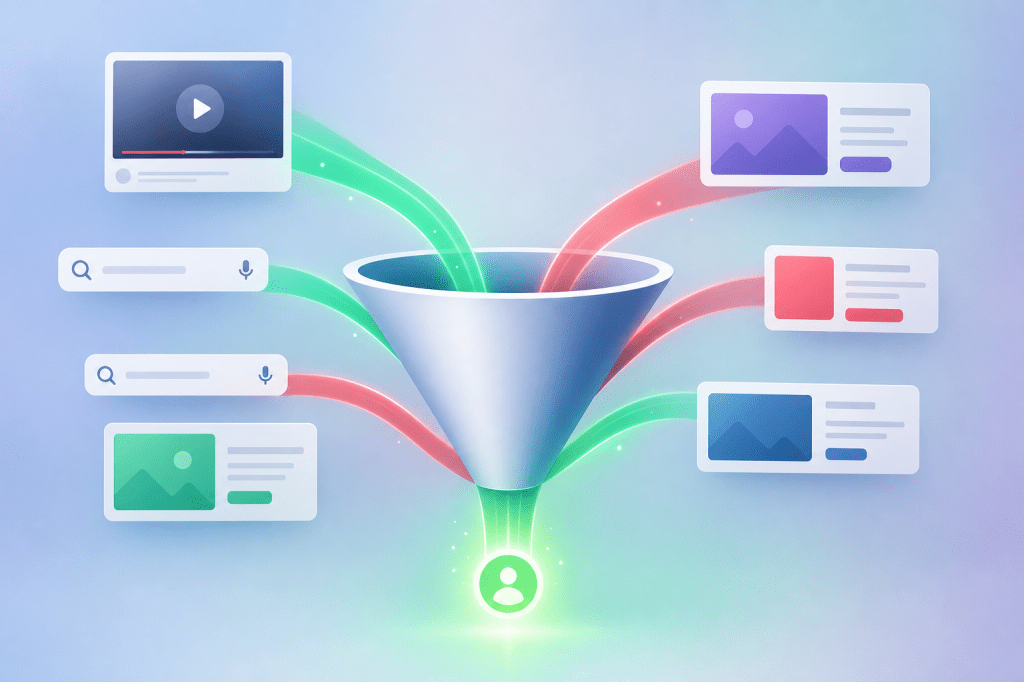
Google’s Performance Max campaigns promise full-funnel automation — but the reality is that your budget gets scattered across channels with vastly different conversion rates. YouTube, Display, Search, Discover, Gmail, and Maps each deliver traffic that behaves completely differently after the click. Without visibility into which PMax channel actually converts, you’re optimizing blind.
→ Curious how return links work? See DeepClick in 1 minute — no review required, more impressions per click.
The PMax Channel Visibility Problem
Performance Max campaigns now account for over 40% of Google Ads spend for app and gaming advertisers in 2026. Google’s pitch is simple: give the algorithm your assets and budget, and it will find conversions wherever they exist across the Google ecosystem.
The problem? PMax’s channel-level reporting remains deliberately opaque. You can see overall campaign performance, but breaking down which placement — YouTube pre-roll vs. Display banner vs. Search text — actually drove your conversions requires forensic-level analysis. Google’s own channel timeline insights (released in late 2025) show placement distribution, but not post-click behavior by channel.
This creates a dangerous blind spot. Our analysis across 200+ PMax campaigns shows that Display placements in PMax deliver 3-5x lower post-click conversion rates compared to Search placements within the same campaign. Yet Display often consumes 40-60% of total PMax budget because impressions are cheap.
For AI social app teams and gaming advertisers running PMax, this means a significant portion of your budget generates clicks that never convert — not because your offer is wrong, but because the post-click experience doesn’t match the intent level of each channel’s traffic.
Why PMax Channel CVR Varies So Dramatically
Understanding why conversion rates differ across PMax channels is the first step toward fixing the problem. Each channel delivers users at a fundamentally different stage of intent:
- Search placements: Users actively seeking a solution. Post-click CVR typically 8-15% for app installs. They arrive with clear intent and convert quickly.
- YouTube placements: Users passively consuming content. Post-click CVR drops to 2-4%. They’re interrupted, curious but uncommitted. Landing pages must re-engage from scratch.
- Display placements: Users barely aware of your ad. Post-click CVR falls to 0.5-2%. Many clicks are accidental (fat-finger), and bounce rates exceed 70%.
- Discover placements: Users in browsing mode. CVR sits at 3-6%, but engagement time is high — they need more persuasion steps before converting.
When PMax lumps all these together, your “campaign CVR” is a meaningless average. A 4% overall CVR might mean Search is converting at 12% while Display drags the number down at 0.8%. The algorithm sees this as “working” because it hit your target CPA — but you’re leaving massive efficiency gains on the table.
This is exactly where post-click conversion rate optimization becomes critical. If you can identify which channel’s traffic lands on your page and adapt the experience accordingly, you unlock the hidden CVR potential within every PMax campaign.
3 Steps to Optimize Post-Click CVR Across PMax Channels
Here’s the actionable framework for diagnosing and fixing PMax channel-level conversion problems:
Step 1: Decode Your PMax Channel Mix Using Timeline Insights
Google’s channel timeline (accessible in the Insights tab since Q4 2025) shows you the hourly and daily distribution of impressions across channels. While it doesn’t directly show CVR by channel, you can cross-reference with:
- GA4 session source/medium breakdown filtered by your PMax campaign UTMs
- Landing page engagement metrics (scroll depth, time on page) segmented by referral source
- Post-click event completion rates by the
gclidattribution path
Map your spending distribution against actual conversion events. If 55% of budget goes to Display but only 8% of conversions come from Display placements, you’ve found your leak.
Step 2: Build Channel-Aware Landing Experiences
Once you know which channels deliver which traffic, create differentiated post-click experiences:
- For Search traffic: Short, direct landing pages. These users already want what you offer — remove friction, shorten the path to conversion. Focus on trust signals and immediate CTA.
- For YouTube traffic: Video-first landing pages that continue the story from the ad creative. Include social proof and a clear “why now” hook. These users need re-engagement after the interrupt.
- For Display traffic: Assume zero context. Lead with the problem statement, then build urgency. Use exit-intent popups and re-engagement fallback pages to capture users who would otherwise bounce.
- For Discover traffic: Content-rich pages that feel editorial. These users were in reading mode — give them a narrative that naturally leads to your CTA.
Step 3: Deploy Return Links for Non-Converting PMax Traffic
The biggest PMax efficiency unlock is what happens after a user clicks but doesn’t convert. Traditional campaigns treat this traffic as lost. But with return link technology, you can:
- Serve an ad fallback page to users who bounce — giving you a second conversion opportunity without paying for another click
- Capture intent signals from the first visit and use them to personalize the return experience
- Recover 10-20% of otherwise lost PMax clicks through re-engagement pages that don’t require fresh ad review
This is especially powerful for PMax Display traffic, where bounce rates are highest. Instead of accepting that 70%+ of Display clicks are wasted, you create a conversion pathway that activates on the bounce — turning a cost center into a recovery channel.
Teams using this approach report 15-25% improvement in effective PMax ROAS without changing their campaign settings or bidding strategy. The gains come entirely from fixing what happens after Google delivers the click.
Real Results: AI Dating App PMax Case Study
An AI dating app running $50K/month in PMax discovered that YouTube placements (consuming 35% of budget) had a 1.8% post-click install rate, while Search placements (only 15% of budget) converted at 14.2%. Their “4.5% average CVR” was hiding a 7.8x channel-level difference.
After implementing channel-aware landing pages and post-click return strategies:
- YouTube landing page CVR improved from 1.8% to 3.9% (+117%) with video-first design
- Display bounce recovery added 340 incremental installs/month from previously lost clicks
- Overall PMax CPI dropped 28% while install volume increased 19%
- No changes were made to campaign structure, bids, or creative assets
The entire improvement came from understanding that a click from YouTube and a click from Search are fundamentally different conversion opportunities that require different post-click treatment.
Action Checklist: PMax Post-Click Optimization
- Pull your PMax channel timeline insights and map budget distribution across channels
- Cross-reference with GA4 to estimate per-channel CVR (even approximate numbers reveal the gap)
- Identify your highest-spend, lowest-CVR channel — this is your biggest optimization opportunity
- Build at least one alternative landing page variant tailored to that channel’s intent level
- Deploy return link fallback pages for high-bounce placements (Display, YouTube)
- Measure effective CVR (including return-link conversions) by channel for 14 days
- Scale what works — most teams see 80% of gains from fixing their worst-performing channel
The advertisers winning with PMax in 2026 aren’t the ones with better creative or bigger budgets. They’re the ones who recognized that PMax’s automation stops at the click — and built the post-click infrastructure to convert what Google delivers, regardless of which channel it came from.
One ad click, multiple no-review impressions — that’s the DeepClick return link.
DeepClick helps Meta advertisers recover lost clicks with Ad Fallback Pages (+10-20% clicks), reduce ad complaints by 80%, and unlock 5-15% more conversions — without going through ad review again.
 DeepAds
留下评论