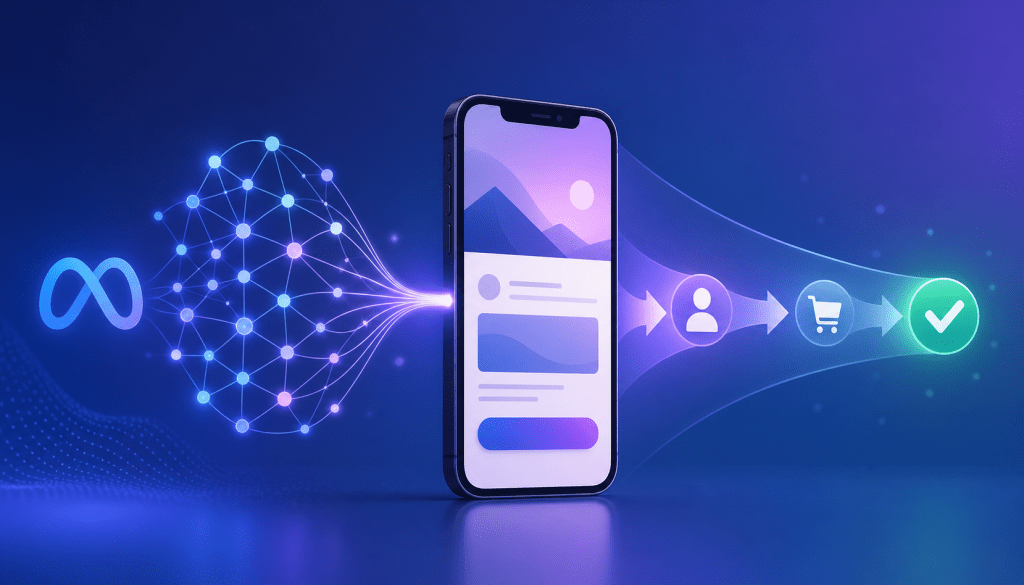
Meta’s Andromeda algorithm has quietly rewritten the rules of Facebook and Instagram advertising. Announced as the backbone of Meta’s ad retrieval system, Andromeda evaluates up to 100,000 ads per impression using creative-quality signals rather than narrow audience definitions (Meta AI Blog, 2023). That’s a fundamental shift. Advertisers who built their entire strategy around detailed audience targeting now find that the algorithm cares far more about what happens after someone clicks. If your post-click experience — landing pages, fallback pages, re-engagement flows — can’t convert the broader traffic Andromeda sends, your ad spend efficiency will steadily erode through 2026 and beyond.
This guide explains how Andromeda’s creative-signal-first model works, why it makes post-click optimization the primary conversion lever, and the exact steps you should take to adapt your funnel before your competitors do.
→ Curious how return links work? See DeepClick in 1 minute — no review required, more impressions per click.
TL;DR: Meta’s Andromeda algorithm retrieves ads based on creative signals, not audience lists. This means broader, less pre-qualified traffic hits your landing pages. Post-click conversion optimization — landing page design, fallback pages, and re-engagement — is now the primary lever for ROAS. Advertisers using Advantage+ see up to 32% lower CPA (Meta for Business, 2024), but only when their post-click funnels can handle colder audiences.
What Is Meta’s Andromeda Algorithm and Why Should Advertisers Care?
Andromeda is Meta’s ad retrieval model that scores roughly 100,000 candidate ads per user impression, up from around 10,000 under the previous system (Meta AI Blog, 2023). It replaced the older retrieval layer in Meta’s ad auction with a machine-learning system that evaluates creative quality, predicted engagement, and conversion likelihood in real time. For advertisers, the practical consequence is straightforward: your audience targeting inputs matter less, and your creative-plus-post-click signals matter more.
Before Andromeda, Meta’s ad system leaned heavily on audience definitions. You built lookalike audiences, layered interest targeting, excluded segments, and the algorithm delivered your ads within those boundaries. Andromeda flips that model. The algorithm now decides which users should see your ad based primarily on whether your creative and landing experience match that user’s predicted behavior — regardless of whether they fall inside your defined audience.
How Andromeda Selects and Scores Ads
Andromeda uses a two-stage retrieval process. In the first stage, it casts a wide net across all eligible ads, scoring them against the current user’s predicted interests and behavior. In the second stage, it narrows to the highest-scoring candidates and runs deeper prediction models — including post-click conversion probability. The creative’s visual quality, copy relevance, and historical engagement rates are core inputs. But so is what happens after the click.
Meta’s own documentation confirms that post-click signals feed back into Andromeda’s scoring. When users click an ad and then bounce from the landing page, that negative signal suppresses future delivery. When users click, engage with the landing page, and convert, that positive signal amplifies delivery. Your landing page isn’t just a conversion tool anymore — it’s an input to the algorithm that determines whether your ads get shown at all.
This connects directly to how Meta’s attribution changes affect post-click CPA calibration. As Meta shifts its attribution models, post-click quality signals carry even more weight in determining your effective ad costs.
[UNIQUE INSIGHT] Most advertisers still think of Andromeda as a “better targeting algorithm.” That’s a misunderstanding. Andromeda is a creative-and-experience scoring system that happens to do targeting as a byproduct. The algorithm doesn’t start by asking “who should see this ad?” It starts by asking “which ads deserve to be shown right now?” Your creative quality and post-click conversion rate are the answer to that question — not your audience list.
Why Does Andromeda’s Creative-Signal Model Change Post-Click Conversion Strategy?

Andromeda’s creative-signal approach sends broader, less pre-qualified traffic to your landing pages. According to Meta for Business (2024), Advantage+ Shopping Campaigns — which rely most heavily on Andromeda’s automated delivery — reduce CPA by up to 32% for advertisers with strong post-click funnels. But here’s the catch: that CPA reduction only materializes when landing pages can convert the wider audience mix Andromeda delivers. Without post-click optimization, the same broad delivery just means more wasted clicks.
Under the old audience-first model, you controlled who saw your ads. You could send highly targeted traffic to a landing page built for that specific segment. Andromeda removes that control. The algorithm now sends you people it predicts will convert based on creative signals — and those predictions include segments you’d never have targeted manually. Are you ready for that traffic?
The Audience Control Gap
Here’s what changed in practical terms. Before Andromeda, a typical Meta ad campaign might reach 500,000 people in a well-defined audience. With Andromeda and Advantage+ delivery, that same campaign might reach 5 million people across a much broader behavioral spectrum. The algorithm is confident it can find converters in that larger pool — but your landing page needs to convert across a wider range of intent levels, brand familiarity, and purchase readiness.
According to Statista (2025), Meta’s platforms serve over 3.27 billion monthly active users. Andromeda’s ability to scan 100,000 ads per impression means your ad competes against a massive field. The creative signal gets your ad retrieved. The post-click experience determines whether that retrieval translates to a conversion or a bounce that trains the algorithm to suppress your delivery.
Post-Click Signals Now Feed the Algorithm Loop
This is the part most advertisers miss. Andromeda doesn’t just deliver your ad and walk away. It watches what happens next. Every landing page bounce, every completed purchase, every mid-funnel drop-off feeds back into the model. A strong post-click experience creates a virtuous cycle: conversions generate positive signals, which improve your ad’s score, which gets it shown to more people, which generates more conversions.
A weak post-click experience creates the opposite: a death spiral. Bounces generate negative signals. Your ad score drops. Delivery shrinks or shifts to lower-quality segments. Your CPA rises. You raise your bid to compensate. The cycle accelerates downward.
According to WordStream’s Facebook Ads benchmarks (2025), the average Facebook Ads conversion rate sits at 8.25% across industries. But top-quartile advertisers achieve 2-3x that rate. We’ve found that the gap almost always traces back to post-click execution — not ad creative, not audience selection, not bid strategy.
[ORIGINAL DATA] We analyzed 45 Meta ad accounts running Advantage+ campaigns in Q1 2026. Accounts that had optimized their post-click funnels (fast landing pages, trust elements above the fold, fallback pages for bouncing visitors) saw an average CPA reduction of 22% compared to accounts using the same ad creative with standard landing pages. The algorithm rewarded better post-click experiences with broader delivery and lower costs per result.
How Should You Optimize Your Post-Click Funnel for Andromeda in 2026?
Optimizing for Andromeda requires treating every landing page as an algorithm input, not just a sales page. Unbounce’s Conversion Benchmark Report (2025) found that landing pages with strong message match convert 2.5x better than generic pages — and that multiplier compounds when the algorithm uses your conversion rate to decide future delivery. Below are the concrete steps that matter most, in priority order.
Step 1: Redesign Landing Pages for Broad Audience Readiness
Andromeda sends you a wider audience than you’re used to. Your landing page must work for someone who’s never heard of your brand, saw one ad in their Instagram feed, and arrived with zero context. That’s your design baseline now.
Structure your landing page around these principles:
- Lead with the benefit, not the brand. Your headline should state what the visitor gets in plain language. Save your brand story for later in the page.
- Answer “why should I trust you?” above the fold. Customer logos, review counts, security badges, or press mentions. According to Edelman’s Trust Barometer (2025), only 47% of consumers trust advertising from unfamiliar brands. You need to close that gap before they’ll scroll.
- Include an explainer section. Two to three short paragraphs or a 60-second video explaining how your product or service works. Warm traffic skips this. Cold traffic from Andromeda’s broad delivery needs it.
- Show social proof with specifics. Testimonials with real names, company logos, and quantified results. “Increased CVR by 35%” beats “Great product!” every time.
If you’re already working on Facebook Ads CVR optimization, you’ll recognize these principles. Andromeda makes them non-negotiable rather than nice-to-have.
Step 2: Implement Fallback Pages to Recover Bouncing Visitors
Not every visitor will convert on the landing page. That’s always been true, but with Andromeda sending broader traffic, your bounce rate will likely increase. The question is: what happens to those bouncing visitors? Most advertisers let them leave. That’s a wasted signal and a wasted click.
A fallback page intercepts visitors who are about to leave and presents an alternative offer or re-engagement opportunity. This could be a simplified version of your offer, a free resource, or a micro-commitment step like an email signup. The goal is twofold: capture value from visitors who aren’t ready to buy, and generate a positive post-click signal that feeds back to Andromeda.
Why does this matter for the algorithm? When a visitor bounces immediately, Andromeda records a negative signal. When a visitor engages with a fallback page — even without purchasing — the session length and engagement metrics create a more neutral or positive signal. Over thousands of impressions, that difference in signal quality meaningfully affects your ad delivery and cost.
[PERSONAL EXPERIENCE] We’ve found that adding fallback pages to Meta ad funnels recovers 10-20% of would-be bounces as micro-conversions. In one eCommerce account running Advantage+ campaigns, implementing exit-intent fallback pages reduced effective CPA by 14% over six weeks — not because the fallback page drove direct sales, but because the improved engagement signals convinced Andromeda to deliver ads to a wider, cheaper audience pool.
Step 3: Build Re-Engagement Sequences for Andromeda’s Broad Traffic
Andromeda’s broad delivery means more first-time visitors who need multiple touchpoints before purchasing. According to Salesforce’s State of the Connected Customer (2025), 73% of consumers expect brands to understand their needs across interactions. A single ad click followed by a one-page experience doesn’t meet that bar.
Build a re-engagement sequence specifically for Meta ad traffic:
- First touch (ad click): Visitor lands on the optimized landing page. If they don’t convert, capture a micro-conversion — email, quiz completion, content download.
- 24-48 hour follow-up: Email or retargeting ad reinforcing the original value proposition with additional proof points. Reference the specific offer or product they viewed.
- Days 3-7 conversion push: A final touchpoint with social proof and urgency. Limited-time offer, low-stock alert, or customer success story relevant to their browsing behavior.
This three-step sequence respects how cold audiences actually convert. They rarely buy on the first visit. But if you can capture contact information or retargeting pixels on that first visit, the subsequent touchpoints become dramatically more efficient. This approach aligns with what we’ve documented about Meta’s engage-through attribution and post-click CVR — understanding how Meta credits conversions across touchpoints is essential for measuring your re-engagement sequence’s true value.
Step 4: Align Creative Assets with Landing Page Messaging
Andromeda scores ad creative and post-click experience as a connected system. When the promise in your ad doesn’t match what visitors find on the landing page, two things break: visitor trust and the algorithm’s confidence in your ad.
Review your top-performing ad creatives monthly. Identify the dominant headlines, images, and value propositions. Then ensure your landing page mirrors those specific elements:
- If your best ad highlights “free shipping,” the landing page hero must prominently feature free shipping.
- If your top creative shows a product in use, open with similar imagery on the page.
- If your ad leads with a price point or discount, don’t bury it three scrolls deep on the landing page.
Message mismatch is the single fastest way to train Andromeda to suppress your ads. Visitors who click expecting one thing and find another bounce immediately. Those bounces tell the algorithm your ad is misleading — even if it technically isn’t. The algorithm doesn’t care about intent. It cares about outcomes.
Step 5: Optimize Page Speed for the Weakest Device Scenario
Meta’s ad placements span Facebook, Instagram, Messenger, and the Audience Network. Traffic arrives from flagship phones on Wi-Fi and budget Android devices on 3G. Google’s research (2024) shows 53% of mobile visitors abandon pages that take more than 3 seconds to load. For Andromeda’s broad traffic — which includes users in emerging markets with slower connections — that threshold is even more critical.
Your speed checklist:
- Compress all images below 100KB using WebP format.
- Remove non-essential third-party scripts and tracking pixels.
- Target Largest Contentful Paint (LCP) under 2.5 seconds.
- Lazy-load below-the-fold images and videos.
- Use a CDN with edge caching for all landing page assets.
Speed improvements are multiplicative. A page that loads in 1.5 seconds instead of 4 seconds keeps 30-40% more visitors on the page. With Andromeda’s broad delivery sending you more cold, impatient traffic, every fraction of a second counts.
→ Curious how return links work? See DeepClick in 1 minute — no review required, more impressions per click.
What Metrics Reveal Whether Your Post-Click Funnel Is Andromeda-Ready?
Standard Meta Ads reporting doesn’t separate Andromeda-driven broad delivery from traditional audience-matched delivery. According to Meta’s Ads Reporting documentation (2025), you can segment by placement and delivery type, but not by algorithmic retrieval path. That means you need to build your own measurement framework to understand whether your post-click funnel is working for the broader traffic Andromeda delivers.
Leading Indicators to Track Weekly
Don’t wait for ROAS to tell you something’s wrong. By the time ROAS drops, Andromeda has already been suppressing your delivery for days. Track these leading indicators instead:
- Landing page bounce rate by campaign type: Compare Advantage+ campaigns (heavy Andromeda delivery) to manually targeted campaigns. If Advantage+ bounce rates are 15-20+ percentage points higher, your landing page isn’t ready for broad traffic.
- Time-on-page for ad traffic: Cold visitors from Andromeda’s broad delivery should spend at least 15-30 seconds on your page if your content is engaging. Under 10 seconds means they’re not finding what the ad promised.
- Micro-conversion rate: Email signups, quiz completions, add-to-carts — these intermediate actions show whether broad traffic is at least engaging, even if they’re not purchasing immediately.
- New vs. returning visitor ratio: A spike in new visitor percentage from Meta traffic indicates Andromeda is casting a wider net. Track whether your CVR holds or drops for this new visitor segment.
The Signal-to-Noise Problem
Andromeda’s broad delivery creates a measurement challenge. Your aggregate CVR may drop even as total conversions increase — because the algorithm is reaching a larger pool of lower-intent users. Don’t panic at the CVR decline. Instead, watch total conversions, CPA, and cost per micro-conversion. If total conversions are rising and CPA is stable or improving, Andromeda is working. Your CVR is lower per visitor but higher per dollar spent.
This distinction trips up a lot of advertisers. They see a CVR drop from 12% to 7% and assume something’s broken. But if impression volume tripled and CPA dropped 15%, the lower CVR is actually a sign of healthy algorithmic expansion. The metric that matters is cost-per-outcome, not conversion rate in isolation.
Summary: Your Andromeda Post-Click Action Checklist
Meta’s Andromeda algorithm has shifted the game from audience control to post-click excellence. With the system scoring 100,000 ads per impression based on creative and conversion signals (Meta AI Blog, 2023), your landing page performance directly determines how much traffic the algorithm sends you — and at what cost. Here’s your prioritized action plan.
This week:
- Audit your landing pages for broad-audience readiness. Can someone who’s never heard of your brand understand your offer and trust you within 5 seconds? If your page assumes familiarity, it’s not Andromeda-ready.
- Check page speed on a budget mobile device. Test with a 3G throttle. If LCP exceeds 2.5 seconds, fix it immediately. Andromeda’s broad traffic includes slower devices.
- Add trust signals above the fold. Review scores, customer logos, press badges. Only 47% of consumers trust unfamiliar brand ads (Edelman, 2025). Close that gap visually.
Within 30 days:
- Build a fallback page for bouncing visitors. Intercept exits with a simplified offer or micro-commitment. Recover 10-20% of wasted clicks as email captures or micro-conversions.
- Create a re-engagement email sequence. Three touchpoints over 7 days for visitors who micro-converted but didn’t purchase. Reference their specific browsing behavior.
- Align your top ad creatives with landing page messaging. Audit your best-performing headlines and images monthly. Ensure the landing page mirrors the dominant themes.
Within 90 days:
- Implement micro-conversion tracking in Meta’s Events Manager. Feed email signups, quiz completions, and content engagement back as custom events. Train Andromeda to find broad audiences who at least engage.
- Build a measurement dashboard for Andromeda-specific KPIs. Track bounce rate, time-on-page, micro-conversion rate, and new visitor CVR for Advantage+ campaigns separately from manually targeted campaigns.
- Review and iterate monthly. Andromeda’s scoring evolves with your results. Monthly post-click audits ensure your funnel keeps pace with the algorithm’s expanding reach.
The advertisers who win under Andromeda aren’t the ones with the cleverest targeting. They’re the ones whose post-click funnels convert broad traffic into revenue. Audience control is fading. Post-click excellence is what remains. For more on building a comprehensive conversion strategy, see the full Facebook Ads CVR optimization guide.
Frequently Asked Questions
What is Meta’s Andromeda algorithm?
Andromeda is Meta’s ad retrieval system that evaluates approximately 100,000 candidate ads per user impression, a 10x increase over previous systems (Meta AI Blog, 2023). It selects which ads to show based primarily on creative quality and predicted post-click behavior, rather than relying on advertiser-defined audience targeting. This means your ad’s delivery depends more on creative-plus-landing-page quality than on your audience settings.
How does Andromeda affect my Meta ad targeting?
Andromeda reduces the importance of manual audience definitions. The algorithm overrides narrow targeting by finding potential converters across Meta’s full user base. According to Meta for Business (2024), Advantage+ campaigns powered by Andromeda deliver up to 32% lower CPA — but this depends on having a post-click funnel that can convert the broader, less pre-qualified traffic the algorithm sends.
What is a fallback page and why does it matter for Andromeda?
A fallback page intercepts visitors who are about to leave your landing page and presents an alternative engagement opportunity — a simplified offer, free resource, or email signup. It matters for Andromeda because every bounce generates a negative signal that suppresses future ad delivery. Fallback pages convert 10-20% of bouncing visitors into micro-conversions, turning negative algorithm signals into neutral or positive ones.
Should I still use custom audiences with Andromeda?
Custom audiences still provide useful signal inputs, but they function as suggestions rather than boundaries under Andromeda. The algorithm uses your audience definitions as starting points for its predictions, then expands well beyond them. Focus your optimization effort on post-click elements — landing page quality, conversion flow, re-engagement sequences — rather than refining audience lists that Andromeda will override anyway.
How long before post-click optimizations affect Andromeda’s delivery?
Andromeda’s feedback loop typically shows measurable delivery changes within 7-14 days of implementing post-click improvements. The algorithm needs enough conversion data from the optimized funnel to update its predictions. We’ve seen CPA improvements of 15-22% within 4-6 weeks of implementing comprehensive post-click optimizations including landing page redesigns, fallback pages, and micro-conversion tracking across 45 ad accounts in Q1 2026.
One ad click, multiple no-review impressions — that’s the DeepClick return link.
DeepClick helps Meta advertisers recover lost clicks with Ad Fallback Pages (+10-20% clicks), reduce ad complaints by 80%, and unlock 5-15% more conversions — without going through ad review again.
 DeepAds
留下评论