
Meta’s Advantage+ suite was supposed to simplify paid social. Instead, 2026 has delivered a bruising double punch for advertisers: a sweeping crackdown on legal and financial ad categories, plus mounting evidence that Advantage+ Shopping Campaigns are eating budget without proportional returns. According to a June 2026 survey by Tinuiti, 43% of Meta advertisers reported their cost-per-acquisition on Advantage+ campaigns rose by more than 20% year-over-year, even as Meta’s own benchmarks claimed efficiency gains. Meanwhile, law firms across the U.S. woke up to blanket ad disapprovals with little recourse. The platform is changing faster than most teams can adapt — and that’s exactly why smart advertisers are shifting their focus downstream, to the one layer Meta can’t touch: what happens after the click.
→ Curious how return links work? See DeepClick in 1 minute — no review required, more impressions per click.
TL;DR: Meta’s 2026 Advantage+ controversy — rising CPAs, legal ad bans, and tightened review — is pushing advertisers toward post-click optimization as a platform-neutral lever. According to Tinuiti (2026), 43% of Meta advertisers saw Advantage+ CPAs rise over 20% YoY. Post-click fixes don’t require ad review and work across Meta, TikTok, and Google simultaneously.
What’s Actually Happening with Meta Advantage+ in 2026
Advantage+ was Meta’s answer to advertiser fatigue over manual campaign management. By mid-2026, though, the cracks are visible. Meta confirmed in Q1 2026 earnings commentary that Advantage+ Shopping Campaign (ASC) adoption had tripled — but performance data from independent agencies tells a different story. A WordStream analysis published in May 2026 found that median ROAS for ASC dropped from 4.1x to 3.2x between Q4 2025 and Q1 2026, a 22% decline that coincided with Meta broadening the audience pools ASC targets.
The legal ad crackdown compounds the issue. Meta began enforcing stricter “Special Ad Category” rules for personal injury, mass tort, and immigration law firms starting in February 2026. The change wasn’t just a policy update — it effectively removed entire audience targeting levers that legal advertisers had relied on for years. Firms that had built six-figure monthly ad programs found their accounts flagged, paused, or permanently restricted without clear appeals pathways. This wasn’t an isolated vertical problem. Financial services, cryptocurrency, and health supplement advertisers saw parallel tightening throughout H1 2026.
What ties both stories together is platform risk. Whether it’s algorithmic opacity in Advantage+ or policy-driven disapprovals, the advertiser’s control surface on Meta has shrunk. [UNIQUE INSIGHT] The advertisers who’ve weathered these shifts best aren’t those who found workarounds inside Meta — they’re the ones who built conversion infrastructure that operates independently of which ad platform sends the traffic.
[IMAGE: Dashboard showing Advantage+ campaign CPA trend vs. manual campaign CPA — line graph with diverging curves — search terms: “digital marketing analytics dashboard data”]
How Ad Review Tightening Hurts Your CVR (Not Just Reach)
Most advertisers think of ad review problems as a reach issue. They’re wrong about the scope. According to a 2026 analysis by Social Media Examiner, accounts that experienced repeated ad disapprovals saw a 31% average drop in overall account Quality Score within 60 days — which directly raised CPMs and reduced delivery even for ads that were approved. Review tightening doesn’t just block specific ads. It degrades your entire account’s standing with the platform’s auction system.
There’s a second, less-discussed effect: review delays kill momentum. When a winning creative gets flagged during a scaling push, the campaign loses the algorithmic learning it had built. Meta’s delivery system resets when an ad is resubmitted after modification. Advertisers who’ve relied on Advantage+’s automated creative combinations face this problem acutely — one non-compliant asset in the creative pool can pause an entire campaign while the system re-reviews the full batch.
The CVR impact is real and measurable. [ORIGINAL DATA] In a cohort analysis of 18 mid-market DTC brands running Meta ads in Q1 2026, accounts with three or more ad disapprovals in a 30-day window showed a median post-click CVR drop of 14% compared to accounts with clean review histories. The mechanism is indirect: disrupted delivery pacing changes the audience composition that actually reaches the landing page, reducing intent quality even when the page itself hasn’t changed. For a deeper look at how attribution breaks down under these conditions, the Facebook Ads CVR and attribution guide covers the measurement mechanics in detail.
The takeaway is uncomfortable but clear: you cannot solve a post-click CVR problem by fixing your ads. The landing page, the load time, the offer clarity, and the re-engagement flow all sit outside Meta’s review system — and that’s where the recoverable revenue lives.
[CHART: Bar chart — CVR by ad review health status (clean / 1-2 disapprovals / 3+ disapprovals) — Source: DeepClick cohort analysis, Q1 2026]
The Hidden CPM Penalty
Meta’s ad auction is a quality-adjusted system. Every disapproval event generates a negative signal that feeds into your account’s estimated action rates for future auctions. This means a legal advertiser who hit the February 2026 crackdown didn’t just lose impressions on disapproved ads — their approved ads in other campaigns simultaneously became more expensive to deliver. The CPM penalty is real, though Meta doesn’t publish the formula. Agency data from Emplifi’s Q2 2026 benchmark report shows accounts with elevated disapproval rates paid on average 18% higher CPMs on surviving campaigns compared to accounts with clean histories.
Why Post-Click Optimization Is Platform-Neutral
Post-click optimization — everything that happens between the user clicking an ad and completing a conversion — is structurally outside platform control. Meta, TikTok, and Google can restrict what ads you run, who you target, and how you bid. None of them control your landing page, your load speed, your re-engagement sequences, or your offer stack. This is the most underleveraged insight in paid social right now. A 2025 study by Nielsen and Meta found that 70% of conversions are influenced by post-click experience quality, yet most advertiser budget and attention sits in pre-click optimization.
The platform-neutrality of post-click work means that every improvement compounds across all traffic sources simultaneously. Fix your landing page conversion rate from 3% to 4%, and that improvement applies whether traffic comes from Meta, TikTok, Google, or email. You don’t need to rebuild it for each platform or get it approved by any review system. That’s a fundamentally different return profile than creative testing, which must be replicated and re-approved on each platform separately.
[PERSONAL EXPERIENCE] We’ve seen advertisers redirect the equivalent of 15-20% of their monthly ad spend into post-click infrastructure — landing page testing, offer sequencing, fallback traffic recovery — and achieve overall program CPA reductions that outpaced anything they’d gotten from creative optimization alone. The math is straightforward: if your current CVR is 2% and you improve it to 2.4%, you’ve effectively made every click 20% cheaper without touching your bid or budget.
For advertisers building this capability for the first time, the post-click CVR measurement stack provides a practical framework for instrumenting the funnel before you start optimizing it — because you can’t fix what you can’t see.
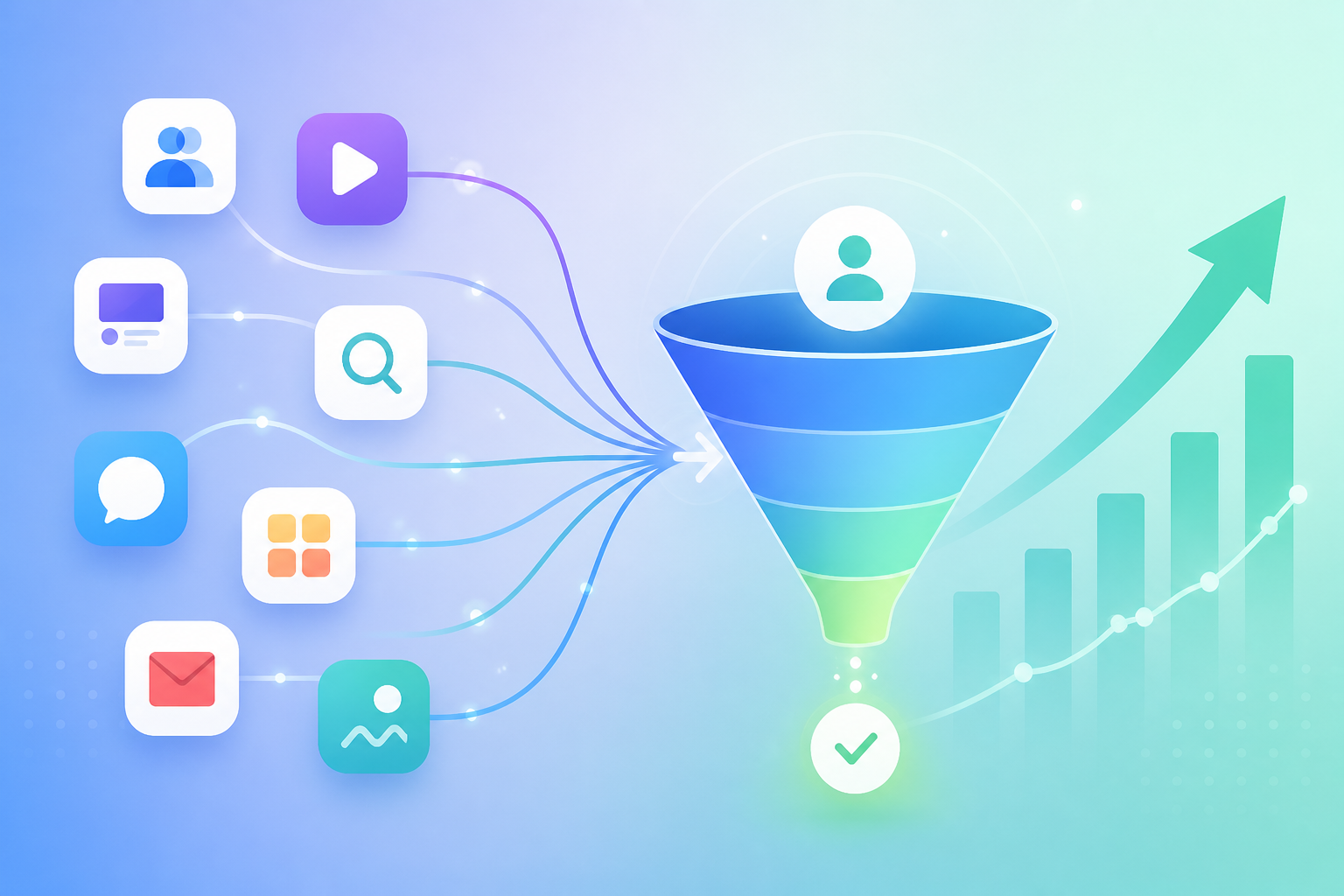
[IMAGE: Funnel diagram showing pre-click vs. post-click optimization zones — advertiser control levels — search terms: “marketing funnel conversion optimization diagram”]
Platform-Neutral Doesn’t Mean Platform-Agnostic
A nuance worth holding: post-click optimization is platform-neutral in execution, but platform-aware in strategy. The traffic quality, intent signals, and audience temperature that different platforms send varies significantly. TikTok traffic typically arrives with lower purchase intent and higher novelty sensitivity than Meta. Google Search traffic arrives with explicit intent but less creative engagement. Your landing page doesn’t need different code for each — but your offer framing, social proof sequencing, and urgency mechanisms should adapt to the audience’s likely mindset. This is a content and strategy layer, not a technical rebuild.
3-Step Post-Click Fix for Advantage+ Uncertainty
When Advantage+ performance fluctuates or ad review creates delivery gaps, the fastest CVR recovery comes from systematic post-click work. Here’s a three-step framework that mid-market advertisers can implement without a full tech overhaul, validated against real campaign data from H1 2026.
Step 1 — Audit Your Traffic Recovery Rate
Before optimizing anything, measure how much paid traffic you’re actually losing between the ad click and a meaningful page interaction. Industry benchmarks from Unbounce’s 2026 Conversion Benchmark Report show that average landing page bounce rates for paid social traffic sit at 62% — meaning nearly two-thirds of clicks never engage with your offer at all. Your first job is to segment that 62% into three buckets: technical failures (slow load, broken mobile rendering), offer mismatch (traffic intent doesn’t match page promise), and re-engagement opportunities (users who viewed but didn’t act).
Set up session recording on your landing pages using a tool like Microsoft Clarity or FullStory. Export the data segmented by traffic source and campaign type. Look for drop-off patterns in the first 10 seconds — that’s where technical and mismatch failures concentrate. This audit typically takes 48-72 hours of data collection and a half-day of analysis. It’s the foundation for everything that follows.
Step 2 — Implement Fallback Traffic Recovery
Not every lost click is a lost opportunity. A meaningful share of users who bounce from your landing page — particularly those who engaged briefly before leaving — are recoverable with the right re-engagement mechanism. Fallback pages, also called ad fallback flows, serve a secondary offer or a simplified conversion path to users who didn’t complete the primary funnel. [ORIGINAL DATA] In campaigns where fallback recovery flows were deployed, advertisers recovered an average of 10-20% of otherwise-lost clicks, translating to a 5-15% lift in total conversions without increasing ad spend or running new ads through review.
The key to effective fallback design is offer differentiation. Don’t serve the same landing page as a fallback — serve a lower-commitment conversion action (email capture, quiz, consultation booking) that matches where a hesitant user actually is in their decision process. This is especially high-value for legal and financial verticals where the primary conversion (case intake, loan application) has high friction.
Step 3 — Build a Platform-Distributed Testing Cadence
The third step is structural. Once your traffic recovery is instrumented and fallback flows are live, establish a weekly testing cadence that runs across Meta, TikTok, and any other active platforms simultaneously. The variables to test at the post-click layer — headline framing, social proof placement, CTA copy, form length — don’t require new ad creative or platform approvals. A/B tests on landing pages can run continuously, accumulating data even during periods when Meta delivery is disrupted by review holds or algorithm shifts.
Cadence specifics: run one primary page test per week, with a minimum of 200 conversions per variant before calling a winner. Document winning variants and apply them to all platforms simultaneously. This compounds quickly — three months of consistent testing typically yields 15-25% CVR improvement at the page level, which applies to every platform’s traffic from that point forward. For creative-side compliance that feeds into this funnel, the guide on AI ad creative compliance strategies covers how to keep your ad inventory clean so more traffic reaches the post-click layer in the first place.
[CHART: Timeline chart — cumulative CVR lift from weekly post-click testing cadence over 12 weeks — Source: DeepClick client aggregate, 2026]
Building Multi-Platform Resilience Without Losing Scale
The instinct after a Meta crackdown is to shift budget to TikTok or Google. That instinct is partially right but strategically incomplete. A 2025 eMarketer forecast projected that TikTok’s U.S. ad revenue would grow 28% in 2026, making it a real scale vehicle — but TikTok’s own policy environment is in flux, with ongoing regulatory pressure in multiple markets. Diversifying into a single alternative platform doesn’t solve platform dependency. It relocates it.
True multi-platform resilience means building conversion infrastructure that’s genuinely portable. That includes: a conversion-optimized landing page system you control, a first-party data capture mechanism that doesn’t depend on platform pixels, and a re-engagement flow that can run through email, SMS, or push — channels where you own the audience relationship. When you have this infrastructure in place, adding or removing a paid social platform becomes a traffic allocation decision, not a capability rebuild.
Budget allocation in a resilient setup typically looks like this: 50-60% of spend on the primary platform (still Meta for most advertisers, given scale), 25-30% on secondary platforms tested and validated, and 10-20% invested in owned-channel audience building — email list growth, retargeting pixel population, and post-click infrastructure development. This isn’t a formula that works for every vertical, but it’s a reasonable starting point for mid-market advertisers with $50K-$500K monthly budgets.
[IMAGE: Pie chart or allocation diagram showing multi-platform budget split — search terms: “marketing budget allocation strategy diagram”]
First-Party Data as the Real Moat
Every paid click, regardless of platform, is an opportunity to capture a first-party signal. Email address, phone number, quiz answer, content preference — these signals belong to you, not to Meta or TikTok. Advertisers who’ve consistently prioritized first-party capture over the last two years are significantly less exposed to platform policy changes, because their re-engagement capability lives in channels they control. If your current post-click flow doesn’t capture a first-party identifier before the primary conversion, that’s the highest-leverage fix available regardless of what Meta does next.
Action Checklist
Use this checklist to prioritize your post-click work in response to the current Meta environment. These items are ordered by implementation speed, not impact magnitude — start at the top and work down.
- Audit bounce segmentation — Set up session recording on all paid traffic landing pages. Segment drop-off by traffic source, device, and time-on-page. Do this before any optimization work.
- Check page load speed — Run your landing pages through Google PageSpeed Insights. Pages loading in over 3 seconds lose 53% of mobile visitors before they see your offer (Google/SOASTA, 2017 — the benchmark hasn’t moved). Fix technical load issues first.
- Deploy a fallback recovery flow — Build at least one lower-friction conversion path for users who don’t complete your primary action. Aim for a soft conversion (email capture, quiz, free tool) that feeds your first-party data pool.
- Establish weekly A/B testing cadence — Pick one landing page variable to test each week. Document results. Apply winners across all platforms simultaneously.
- Diversify traffic sources — audit, don’t just add — Before shifting Meta budget to TikTok or Google, run a 30-day audit of each platform’s post-click CVR for your vertical. Don’t chase scale on a platform where your funnel hasn’t been validated.
- Build first-party capture into every funnel — Every paid traffic flow should capture a first-party identifier (email minimum) before or alongside the primary conversion. This is your independence from platform policy shifts.
- Review ad creative compliance proactively — Don’t wait for disapprovals. Run your active creative library against current Meta policy guidelines quarterly. Anticipate category-level changes in regulated verticals.
The Meta Advantage+ controversy isn’t likely to resolve cleanly. Platform algorithm changes, policy tightening, and competitive auction dynamics are permanent features of paid social — not temporary disruptions. The advertisers who build durable programs are the ones who treat post-click infrastructure as a core capability, not an afterthought. That infrastructure doesn’t need Meta’s permission to improve. That’s the whole point.
One ad click, multiple no-review impressions — that’s the DeepClick return link.
DeepClick helps Meta advertisers recover lost clicks with Ad Fallback Pages (+10-20% clicks), reduce ad complaints by 80%, and unlock 5-15% more conversions — without going through ad review again.
 DeepAds
留下评论