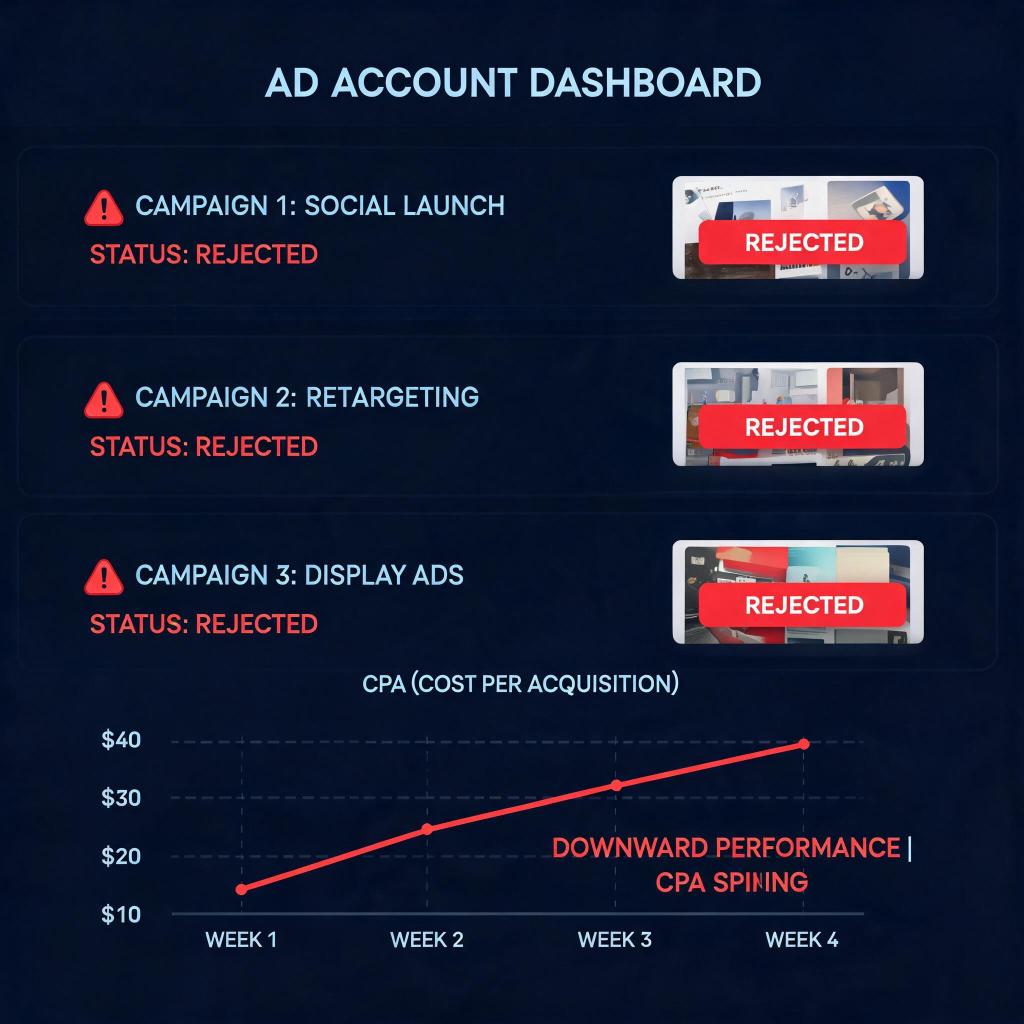
Meta’s ad review engine is running hotter than ever in 2026 — and advertisers in competitive verticals are feeling it. Law firms had their advertising privileges severely restricted after a broad policy sweep. Gaming apps are watching creative after creative get flagged under newly tightened gambling-adjacent guidelines. Social app teams are losing approved ads overnight with no warning and no clear path to reinstatement. At the same time, Advantage+ campaigns — once celebrated as Meta’s AI-powered performance unlock — are drawing sharp criticism for stripping advertisers of audience and placement control, often quietly expanding spend into segments that were never approved.
The common thread: platform dependency is no longer a quiet background risk. It is an active, daily operational hazard. Every impression you buy on Meta is underwritten by a review system and an algorithm that can change its rules faster than any account manager can respond.
The advertisers who are compounding gains in this environment share one thing in common: they stopped trying to out-maneuver platform policy, and instead invested in the one conversion layer Meta cannot touch — the post-click experience.
→ Curious how return links work? See DeepClick in 1 minute — no review required, more impressions per click.
What’s Happening: Meta’s Ad Review Crackdown + Advantage+ Issues
In early 2026, Meta made headlines when it began proactively restricting entire account categories from running ads. The most visible case involved legal services — specifically law firms running settlement and injury claims campaigns. Meta rolled out restrictions that effectively barred personal injury and mass tort advertisers from running new campaigns without pre-approval processes that, in many cases, never resolved. Accounts with years of clean spend history were swept up alongside genuinely bad actors.
But the crackdown extends well beyond law firms. Meta’s review engine has been reported to flag ads in these categories with increasing frequency in 2026:
- Gaming apps with any visual element that could be construed as a gambling reference — spinning wheels, cards, coins, dice imagery.
- Social and dating apps caught in overly broad “personal attributes” policy interpretations.
- Fintech and crypto products facing pre-clearance demands on previously approved formats.
- Health and wellness apps running before/after comparisons or outcome claims.
The review system’s error rate is a known pain point. Meta’s own Transparency Center data shows that a significant share of ad rejections are appealed and ultimately reversed — meaning the machine flags legitimate ads at a non-trivial rate. But “ultimately reversed” can mean days or weeks of dead spend and missed acquisition windows, with no SLA guarantee.
The Advantage+ Controversy
Overlaid on top of this is the growing frustration with Advantage+ Shopping Campaigns (ASC) and the broader Advantage+ suite. When Meta introduced these AI-driven campaign types, the pitch was simple: let the algorithm do the work and performance will improve. For many advertisers, particularly in e-commerce, that was true — at first.
In 2025 and into 2026, the criticisms have sharpened:
- Audience control erosion: Advantage+ campaigns routinely ignore manual audience exclusions, expanding into audiences that advertisers explicitly opted out of. Brand safety configurations and competitor exclusions are frequently overridden.
- Budget concentration risk: The algorithm funnels disproportionate spend toward retargeting pools (existing customers and website visitors), inflating reported ROAS while contributing zero incremental growth.
- Creative and placement opacity: Advertisers running Advantage+ Creative report that Meta is silently modifying ad assets — cropping images, altering copy emphasis, swapping CTAs — without surfacing those changes in standard reporting.
- Attribution pollution: Advantage+ campaigns mix prospecting and retargeting signals in ways that make it structurally difficult to attribute conversions accurately, even with third-party measurement tools.
The result is a platform environment where the advertiser has less control over who sees their ad, what version of the ad is served, how the budget is allocated, and whether the campaign continues to run at all. For teams running paid social as a primary acquisition channel, this is a structural vulnerability — not a temporary bug.
Why Platform Dependency Is a Risk
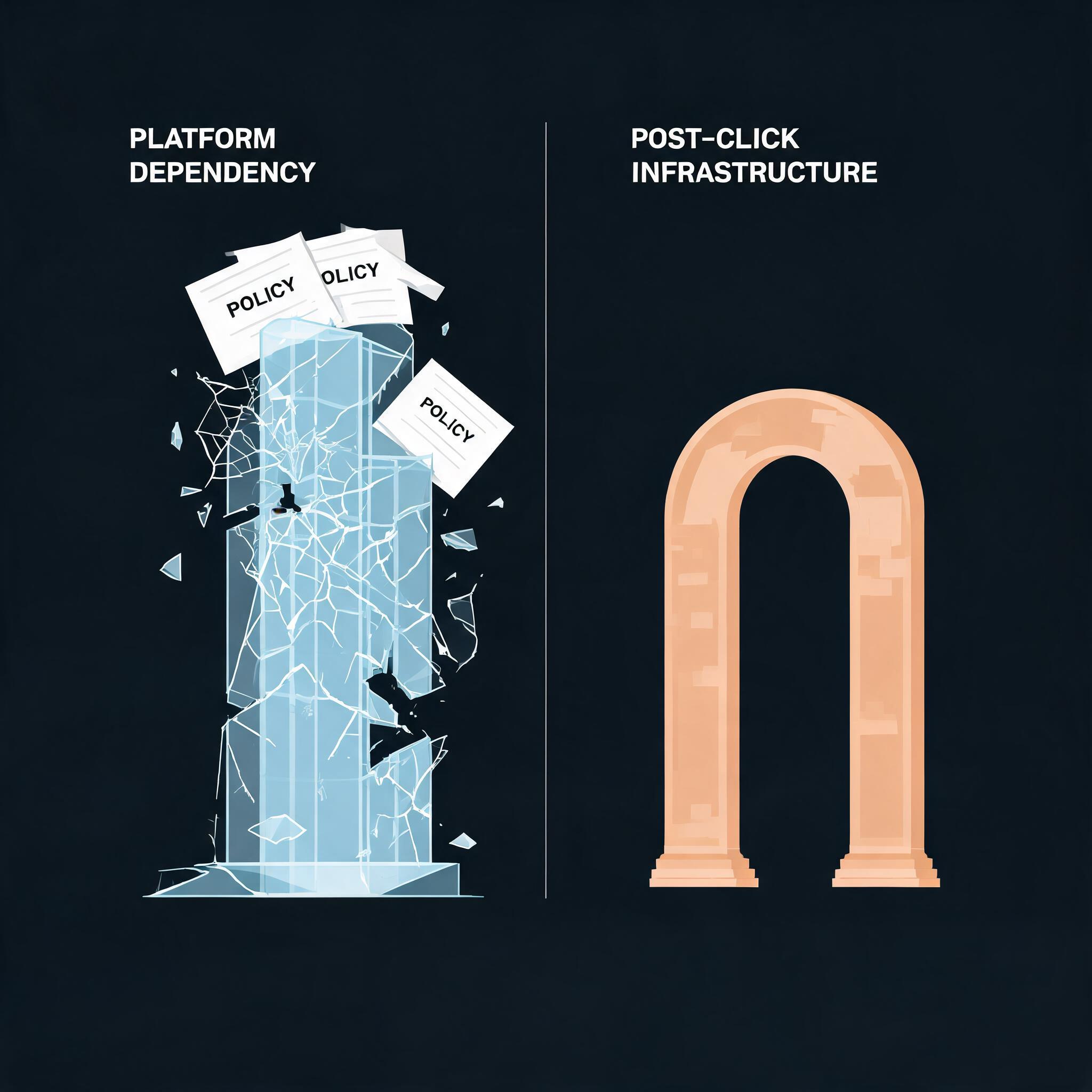
The Meta revenue concentration risk is not hypothetical. Consider what a mid-size gaming BC team with 80% of paid acquisition running through Meta experiences when a wave of creative rejections hits:
- Day 1-2: Top-performing creatives rejected. Spend delivery drops. CPA spikes as the algorithm reallocates to lower-performing assets.
- Day 3-5: Appeals submitted. No response or automated rejection. Team begins emergency creative production.
- Day 5-10: New creatives approved, but the learning phase resets. Performance takes another 7-14 days to restabilize. User acquisition for the period is 40-60% below forecast.
This is not a hypothetical scenario. It is the operating reality for dozens of mobile gaming and social app teams in 2026. Independent analysis from mobile marketing intelligence platforms estimated that in Q1 2026, gaming app advertisers experienced an average of 2.3 significant creative disruptions per account per month attributable to review volatility — each one requiring 5-8 days to fully recover.
The deeper structural risk is that platform dependency compounds with scale. The more you optimize for Meta’s specific signals — its pixel events, its audience definitions, its creative norms — the more brittle your acquisition stack becomes. You are not building a durable asset. You are building a highly tuned dependency on a single counterparty that can change the terms of engagement at any time.
The response from forward-thinking teams has two components: multi-platform diversification (adding TikTok, YouTube, and programmatic channels to reduce single-platform concentration) and, crucially, post-click optimization to extract maximum value from every click that does land — regardless of which platform sourced it.
For deeper reading on conversion measurement challenges across automated campaign types, the PMax channel CVR tracking optimization analysis provides a parallel framework for understanding how algorithmic campaign opacity affects conversion attribution across platforms.
Post-Click Optimization as a Platform-Neutral Lever
The post-click experience is the one conversion layer that exists entirely outside Meta’s review jurisdiction. Once a user clicks your ad and lands on your destination, Meta’s policy engine has no say in what happens next. Your landing page, your re-engagement mechanics, your fallback experiences — these are yours to own and optimize, and they compound across every traffic source you run.
This is not a consolation prize. Post-click optimization is where the most underinvested conversion leverage in mobile and social advertising sits. Industry benchmarks consistently show that landing page optimization alone accounts for 20-40% of total conversion rate improvement potential — yet the majority of performance teams spend 80% of their time in-platform, adjusting bids and swapping creatives, and only 20% on what happens after the click.
For teams looking to build a platform-neutral conversion architecture, here are the core steps:
Step 1: Audit Your Post-Click Drop-Off by Traffic Source
Before optimizing, you need a complete picture of where users disengage after clicking. Run a source-segmented funnel analysis that separates Meta traffic from other paid channels. Key metrics to examine:
- Click-to-landing-page load rate: What percentage of ad clicks result in a page load? On mobile, this is frequently 85-90% — the gap is almost always network latency and page speed. Every 100ms of additional load time reduces mobile conversion rates by approximately 1%.
- Landing-to-conversion rate (L2C): Of users who load the landing page, what percentage complete the target action (install, registration, deposit)? This is your primary optimization target.
- Re-engagement recovery rate: Of users who bounce from the initial landing experience, what percentage can be re-engaged via return link or fallback mechanisms?
For a structured approach to diagnosing conversion drop-off in automated campaign environments, the PMax channel conversion drop-off diagnosis framework — while developed in a Google context — applies directly to Meta Advantage+ traffic with the same opacity challenges.
Step 2: Build Platform-Neutral Landing Page Infrastructure
A platform-neutral landing page is one that converts well regardless of which ad platform sourced the click. It does not depend on Meta Pixel data for personalization (since that data is increasingly unreliable post-iOS 14+). It performs on mobile-first, low-bandwidth connections. It has a single clear primary action and a fallback secondary action for users who are not ready to convert on the first visit.
Specific optimizations that consistently drive measurable improvement:
- Above-the-fold load time under 2.5 seconds on 4G: This is the threshold above which bounce rates increase sharply for mobile gaming and social app traffic. Use server-side rendering or pre-rendered static pages where possible.
- Social proof calibrated to the traffic source’s user profile: Gaming BC audiences respond strongly to peer testimonials and win/outcome showcases. Social app audiences respond to community size signals and “people like you” framing. These should be tested per channel segment.
- One primary CTA with high-contrast visual treatment: A/B test button copy iteratively. Data from mobile app install campaigns consistently shows “Play Now” outperforming “Download” by 8-12% for casual gaming, while “Join Free” outperforms “Sign Up” for social apps by a similar margin.
- Ad Fallback Pages for users who click but face app store friction: App store redirect failures, device incompatibilities, and region restrictions silently kill 5-10% of clicks before users ever see your app listing. A fallback page captures these users and provides alternative conversion paths.
Step 3: Implement Return Link Re-Engagement
The return link mechanic is the most underutilized post-click tool in mobile advertising. Here is the core concept: a user clicks your Meta ad, lands on your destination, does not convert on the first session — and then later, without any additional ad spend, receives a re-engagement trigger that brings them back.
Return links allow you to generate multiple impressions and re-engagement events from a single ad click — all outside of Meta’s review system, all without additional CPM spend. For advertisers who have been squeezed by rising Meta CPMs (which increased an average of 17% year-over-year in H2 2025 for gaming and social verticals), the effective CPA reduction from return link re-engagement is significant.
Measured outcomes from return link implementations typically include:
- 10-20% additional clicks recovered from users who bounced on first landing
- 80% reduction in ad complaints (because re-engaged users have higher intent and lower friction at conversion)
- 5-15% incremental conversion lift attributable specifically to return link touchpoints
These gains stack across all your traffic sources — not just Meta. Every channel that drives clicks benefits from post-click re-engagement infrastructure.
Step 4: Multi-Platform Diversification with Shared Post-Click Infrastructure
The strategic response to Meta platform risk is not to abandon Meta — it is to reduce concentration while ensuring your conversion infrastructure works uniformly across all platforms. TikTok Ads, YouTube/Google UAC, and programmatic DSPs all send traffic to your landing pages. If those pages are optimized for Meta’s creative norms and pixel signals, you are not actually diversified — you have a Meta-dependent conversion layer even when the traffic source is TikTok.
Build landing pages that are channel-agnostic: fast, clear, mobile-first, with fallback paths and return link infrastructure that captures re-engagement independent of where the initial click originated. This is the architecture that survives platform policy changes, algorithm updates, and review crackdowns.
For a comprehensive foundation on building this conversion infrastructure for Facebook/Meta traffic specifically, the Facebook ads conversion rate optimization guide covers the full framework from creative-to-landing-page alignment through post-click re-engagement sequencing.
Action Checklist
Use this checklist to audit your current exposure to Meta platform risk and identify immediate post-click optimization opportunities:
- Calculate your Meta revenue concentration. What percentage of paid acquisition spend, sessions, and conversions flows through Meta? If it is above 60%, you have a structural risk that requires active mitigation — not just contingency planning.
- Audit your last 90 days of ad rejections. How many creatives were rejected? What categories were flagged? How long did the average rejection-to-reinstatement cycle take? This gives you your baseline disruption cost and tells you which creative categories need the most risk-mitigation work.
- Map your post-click funnel by source. Separate Meta Advantage+ traffic from manual campaign traffic and from non-Meta sources. If your landing page L2C rate differs by more than 15 percentage points between sources, you have a landing page personalization gap that is bleeding conversion on your most volatile traffic source.
- Identify your fallback page coverage. Do you have fallback destination pages for users who encounter app store redirect failures? If not, you are silently losing 5-10% of paid clicks with no recovery mechanism.
- Evaluate return link implementation. Are you capturing re-engagement potential from non-converting first-session visitors? If you are not running any return link or re-engagement mechanic, you are leaving the highest-intent segment of your audience on the table after spending money to acquire the initial click.
- Stress-test your acquisition plan against a 30-day Meta outage scenario. If Meta ad delivery dropped to zero tomorrow, what would your week-one, month-one acquisition response look like? If the answer is “we don’t have one,” your platform dependency risk is existential, not just operational.
- Review Advantage+ campaign audience leakage. Pull your ASC audience breakdown and compare actual reach against your intended target definition. If more than 20% of impressions are landing outside your defined audience parameters, you are funding audience drift — and your ROAS reporting is likely inflated.
One ad click, multiple no-review impressions — that’s the DeepClick return link.
DeepClick helps Meta advertisers recover lost clicks with Ad Fallback Pages (+10-20% clicks), reduce ad complaints by 80%, and unlock 5-15% more conversions — without going through ad review again.
 DeepAds
留下评论