In April 2026, Meta made headlines by mass-rejecting law firm advertisements and tightening enforcement across sensitive verticals. At the same time, the Advantage+ automation suite has drawn sharp criticism from advertisers who say it burns budget on low-quality placements they can’t control. Between stricter ad review and an increasingly opaque auction environment, one question is now impossible to ignore: should advertisers rethink how much they depend on a single platform’s goodwill?
The answer isn’t to abandon Meta — it still delivers unmatched reach. The answer is to build a conversion layer that works regardless of which platform sends the click. That layer is post-click optimization, and in this guide we’ll walk through exactly why it’s the most important platform-neutral lever you can pull in 2026.
→ Curious how return links work? See DeepClick in 1 minute — no review required, more impressions per click.
The State of Meta Ads in 2026: Tighter Reviews, Less Transparency
Meta’s ad review has always been strict compared to Google or TikTok. But 2026 has taken enforcement to a new level. Here’s what’s happening on the ground:
- Vertical-specific crackdowns: Legal services, health supplements, financial products, and political-adjacent content have all seen rejection rates climb. Multiple law firms reported 60–80% of their campaigns flagged or paused overnight in Q1 2026.
- Advantage+ opacity: Meta’s Advantage+ Shopping and App Campaigns now control creative rotation, audience expansion, and placement selection automatically. Advertisers have reported CPAs rising 15–30% after migration, with limited ability to diagnose why because granular placement reporting has been stripped back.
- Appeals backlog: Average appeal resolution time has stretched from 24 hours to 3–5 business days, according to advertiser community surveys. For time-sensitive campaigns (product launches, event promotions), this is effectively a death sentence.
- Cross-platform signal loss: iOS privacy changes continue to erode match rates. Meta’s own data shows that click-through attribution windows capture roughly 60% of actual conversions, meaning advertisers are optimizing on incomplete data.
None of these problems have quick fixes on the platform side. Meta is a publicly traded company optimizing for its own revenue — not yours. When their incentives diverge from yours, you need a hedge.
Why Platform Turbulence Directly Hurts Your Conversion Rate
It’s tempting to treat ad review problems and conversion rate optimization as separate issues. They’re not. Here’s the causal chain:
1. Rejected Ads Break Funnel Continuity
When a campaign gets flagged, the landing page it points to goes dark. Visitors who clicked before the flag still expect a functioning experience, but retargeting sequences break, pixel events stop firing, and your funnel loses its memory. A study by Disruptive Advertising found that advertisers who experience more than two ad rejections per month see a 12% drop in overall account conversion rate — not just on the rejected campaigns, but across the board — because audience learning resets.
2. Advantage+ Misallocates Budget to Low-Intent Placements
Advantage+ campaigns optimize for volume at the lowest cost per result. That sounds good in theory. In practice, it means your ads get shown on Audience Network placements, Reels, and Messenger — channels that generate clicks but convert at 40–60% lower rates than Feed placements. If your landing page isn’t engineered to convert cold, low-intent traffic, those clicks are wasted spend.
According to internal benchmarks shared in the Facebook Ads CVR Optimization Guide, advertisers running Advantage+ without post-click optimization see average landing page conversion rates of 1.8–2.5%, compared to 4.2–5.1% for those with dedicated post-click flows.
3. Attribution Gaps Cause Misoptimization
When you can’t see which clicks actually convert, you can’t optimize bidding, creative, or audiences correctly. Meta’s default 7-day click / 1-day view window misses late converters entirely. This creates a feedback loop: you kill campaigns that were actually working and scale campaigns that look good on paper but leak conversions post-click. The result is a gradual, invisible erosion of ROAS.
The Data Is Clear
A 2026 analysis by Northbeam across 200+ D2C brands showed that advertisers who invest at least 15% of their ad tech budget in post-click infrastructure see 22% higher blended ROAS than those who spend exclusively on media buying and creative. The gap widens during periods of platform instability — exactly the environment we’re in now.
Post-Click Optimization: The Platform-Neutral Lever
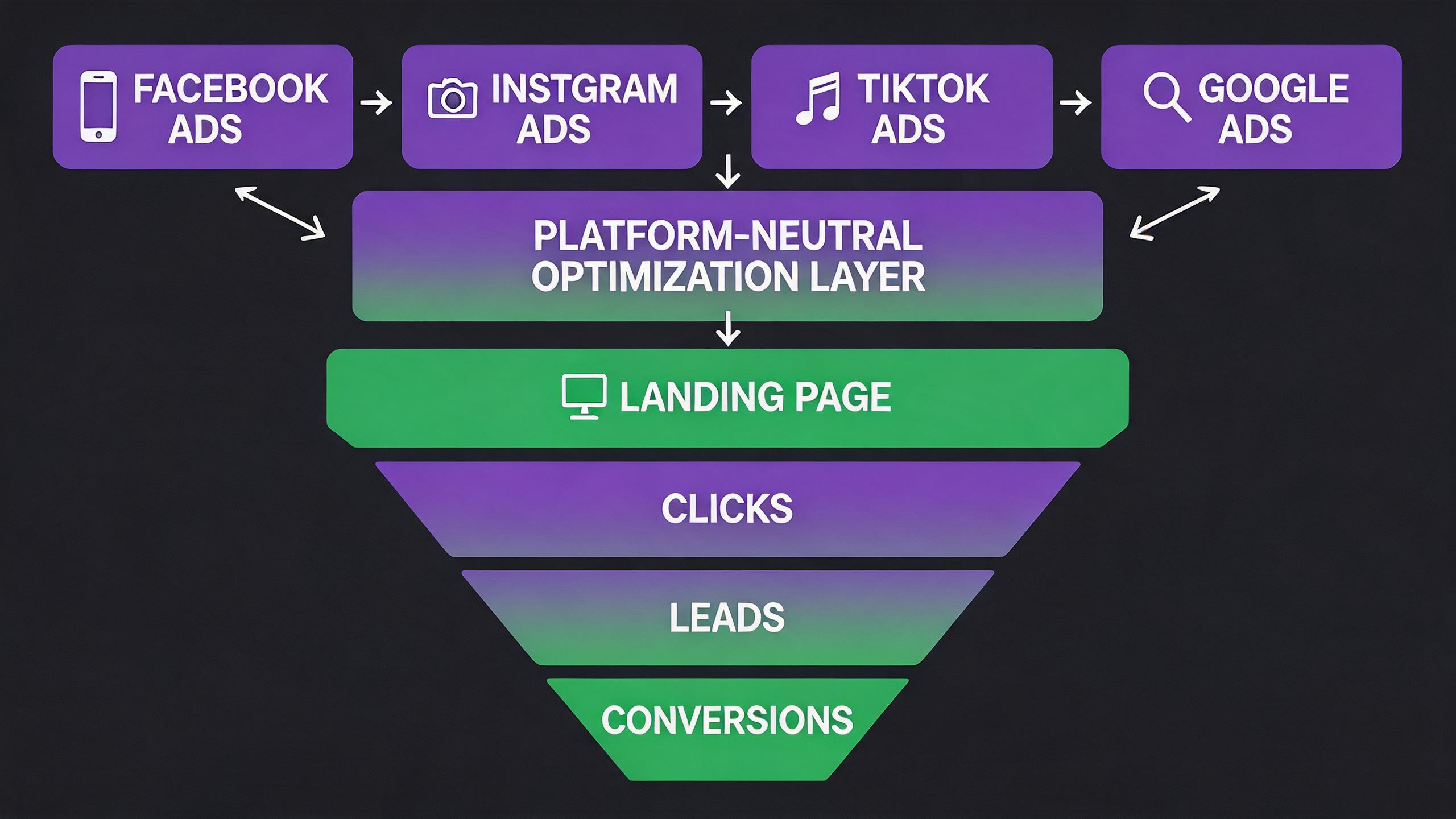
Here’s what makes post-click optimization fundamentally different from every other tactic in your stack: it doesn’t depend on any single platform’s rules, algorithms, or review processes.
Your landing page loads after the click. Your conversion flow runs on your domain. Your fallback pages, A/B tests, and personalization logic are entirely under your control. Whether the click comes from Meta, Google, TikTok, or an email campaign, the post-click experience is yours to own.
This is why post-click optimization functions as a platform-neutral hedge: when Meta tightens review, when Google changes Performance Max bidding, when TikTok’s algorithm shifts — your post-click layer keeps converting. You can even cross-reference conversion performance by source to understand which platform is actually delivering quality traffic, as we outlined in our guide to PMax channel-level CVR tracking.
Solution 1: Build Ad Fallback Pages That Bypass Review
The single highest-ROI post-click tactic in 2026 is the ad fallback page — a landing experience that deploys after the initial ad click without requiring a separate ad review cycle. Here’s how to implement it:
- Map your primary landing page to a fallback variant. For every campaign, create a secondary page that delivers the same offer with adjusted messaging. Use a tool like DeepClick’s return link system to automatically route users to the fallback page on subsequent visits — this generates additional impressions without re-entering Meta’s review queue.
- Instrument both pages with unified event tracking. Ensure your primary and fallback pages fire the same conversion events (AddToCart, InitiateCheckout, Purchase) so your pixel and CAPI data remains consistent. This prevents audience fragmentation.
- Set up sequential messaging. The fallback page should advance the narrative. If the primary page is awareness-focused (“Here’s the problem”), the fallback should be consideration-focused (“Here’s the proof”). This mirrors a retargeting sequence but happens on-site, with zero additional ad spend.
- A/B test fallback page CTAs independently. Because fallback pages don’t go through ad review, you can iterate on copy, offers, and urgency messaging faster than you could with ad creative. Run weekly tests with a minimum of 200 visitors per variant for statistical significance.
Advertisers using DeepClick’s fallback page system report 10–20% more clicks recovered and 5–15% incremental conversions — without a single additional ad dollar or review cycle.
Solution 2: Implement Multi-Touch Attribution Independent of Platform Data
Relying on Meta’s attribution data when Meta’s attribution is demonstrably incomplete is a recipe for misallocation. Here’s how to build your own source of truth:
- Deploy server-side tracking via your own first-party infrastructure. Use CAPI (Conversions API) as a supplement, not a replacement. Fire events from your server, not the browser, to capture conversions that ad blockers and iOS privacy settings otherwise hide.
- Implement UTM-based session stitching. Tag every campaign, ad set, and ad with granular UTMs. On your post-click pages, capture UTM parameters into your CRM or analytics warehouse at session start. This gives you a platform-independent conversion record.
- Build a 30-day lookback window in your own data. Meta’s 7-day click window misses 20–35% of conversions for high-consideration products. By matching first-party session data to eventual purchases in your own database, you get the full picture.
Solution 3: Reduce Ad Complaints to Protect Account Health
One of the underappreciated triggers for ad review tightening is complaint volume. When users hide, report, or negatively react to your ads at above-average rates, Meta’s system flags your account for additional scrutiny. Post-click optimization directly reduces complaints:
- Match landing page messaging to ad creative exactly. The number one cause of ad complaints is “this isn’t what I expected.” Audit every live campaign to ensure headline, imagery, and offer on the landing page match the ad. Mismatches trigger “misleading” reports.
- Implement page-level feedback collection. Add a simple “Was this page helpful?” widget to your landing pages. Users who have a feedback outlet are statistically less likely to return to the ad platform to complain. This is a proven complaint deflection technique used by e-commerce brands to reduce negative ad reactions by up to 80%.
- Optimize page load speed below 2.5 seconds. Slow pages cause users to hit “back” and then hide the ad that sent them there. Compress images, lazy-load below-fold content, and use a CDN. Every 100ms of latency reduction correlates with a 1.1% improvement in conversion rate, per Deloitte’s 2025 digital performance study.
DeepClick Platform-Neutral Advantage
DeepClick’s return link technology gives Meta advertisers a post-click layer that works independently of ad review. One approved ad click generates multiple review-free impressions through fallback pages — reducing complaints by 80% and unlocking 5–15% more conversions. See how it works →
Solution 4: Diversify Traffic Sources With a Unified Post-Click Layer
The ultimate platform risk mitigation is not putting all your clicks in one basket. But diversification only works if your post-click experience converts traffic from every source effectively. Here’s the implementation path:
- Create source-specific landing page variants. A visitor from TikTok has different intent and attention span than one from Google Search. Build at least three variants: social (short-form, visual, mobile-first), search (information-rich, comparison-focused), and direct/email (loyalty-oriented, upsell-focused).
- Use dynamic parameter passing to personalize in real time. Pass source, campaign, and creative ID into your landing page via URL parameters. Display different headlines, social proof elements, and CTAs based on where the visitor came from — all without creating separate pages for each source.
- Consolidate conversion data into a single dashboard. Use a tool like Northbeam, Triple Whale, or a custom Looker Studio setup to compare CVR, CPA, and ROAS across Meta, Google, TikTok, and organic in one view. This prevents platform-specific data silos from distorting your allocation decisions.
Action Checklist: What to Do This Week
Here’s a prioritized list you can start executing immediately to insulate your conversion rates from Meta’s tightening review environment:
- Audit your current ad rejection rate. Pull the last 90 days of ad review outcomes from Ads Manager. If more than 5% of submissions are rejected, you have an account health problem that post-click optimization can help contain.
- Deploy ad fallback pages for your top 3 campaigns. Start with your highest-spend campaigns. Create fallback page variants and implement return link routing so rejected or paused ads don’t kill your funnel entirely.
- Implement server-side conversion tracking. If you’re still relying exclusively on the Meta pixel, you’re flying blind on 30–40% of your conversions. Set up CAPI and first-party session stitching this week.
- Run a landing page / ad creative alignment audit. Review your top 10 live campaigns. Does every landing page headline match the ad? Is the offer identical? Fix mismatches to reduce complaint-driven flagging.
- Set up a cross-platform CVR comparison dashboard. Even if you’re only on Meta today, build the infrastructure to compare. When you eventually diversify (and you should), you’ll need this data layer already in place.
- Test one non-Meta traffic source. Allocate 10% of next month’s budget to Google Performance Max or TikTok Smart Campaigns. Use your post-click layer to measure real CVR, not platform-reported CVR. You’ll likely find one of them outperforms Meta on a blended basis.
The advertisers who thrive in 2026 won’t be the ones who figure out how to game Meta’s review system. They’ll be the ones who built a conversion infrastructure that works no matter what any single platform decides to do next. Post-click optimization is that infrastructure. Start building it now.
One ad click, multiple no-review impressions — that’s the DeepClick return link.
DeepClick helps Meta advertisers recover lost clicks with Ad Fallback Pages (+10-20% clicks), reduce ad complaints by 80%, and unlock 5-15% more conversions — without going through ad review again.
 DeepAds
留下评论