
Google’s decision to abandon the Privacy Sandbox in 2025 was supposed to preserve the open web. Instead, it handed even more attribution power to the walled gardens that already controlled most of the measurement stack. Meta, Google, and Apple now operate what industry insiders call the Attribution Cartel—a closed loop where each platform grades its own homework, inflated by the Halo Effect that credits upper-funnel impressions for conversions they barely influenced. For advertisers spending six or seven figures monthly, this is not a theoretical problem. It is a direct tax on ROAS accuracy.
→ Book a Free Demo — we will audit your post-click funnel for free.
What the Privacy Sandbox Deprecation Actually Changed
When Google confirmed in July 2025 that third-party cookies would remain in Chrome—effectively shelving the Topics API and Attribution Reporting API—many marketers celebrated. But the real winners were the platforms themselves. Without a browser-level, privacy-safe attribution standard, measurement defaults back to each platform’s proprietary model.
Here is what the data shows:
- Google Ads now attributes 15–30% more conversions via data-driven attribution (DDA) than last-click models on the same campaigns, according to internal benchmarks shared at Google Marketing Live 2025.
- Meta’s Conversions API (CAPI) claims a 20% lift in reported conversions compared to pixel-only setups, per Meta’s own case studies.
- Apple’s SKAdNetwork 5.0 still limits postback data to 128 conversion values, forcing advertisers to trust Apple’s aggregated view.
Each platform measures in its own silo. Cross-platform deduplication is left entirely to the advertiser—and most lack the infrastructure to do it properly. As Google Consent Mode V2 adds another layer of modeled conversions, the gap between reported and real performance widens further.
The Halo Effect: How Platforms Over-Credit Themselves
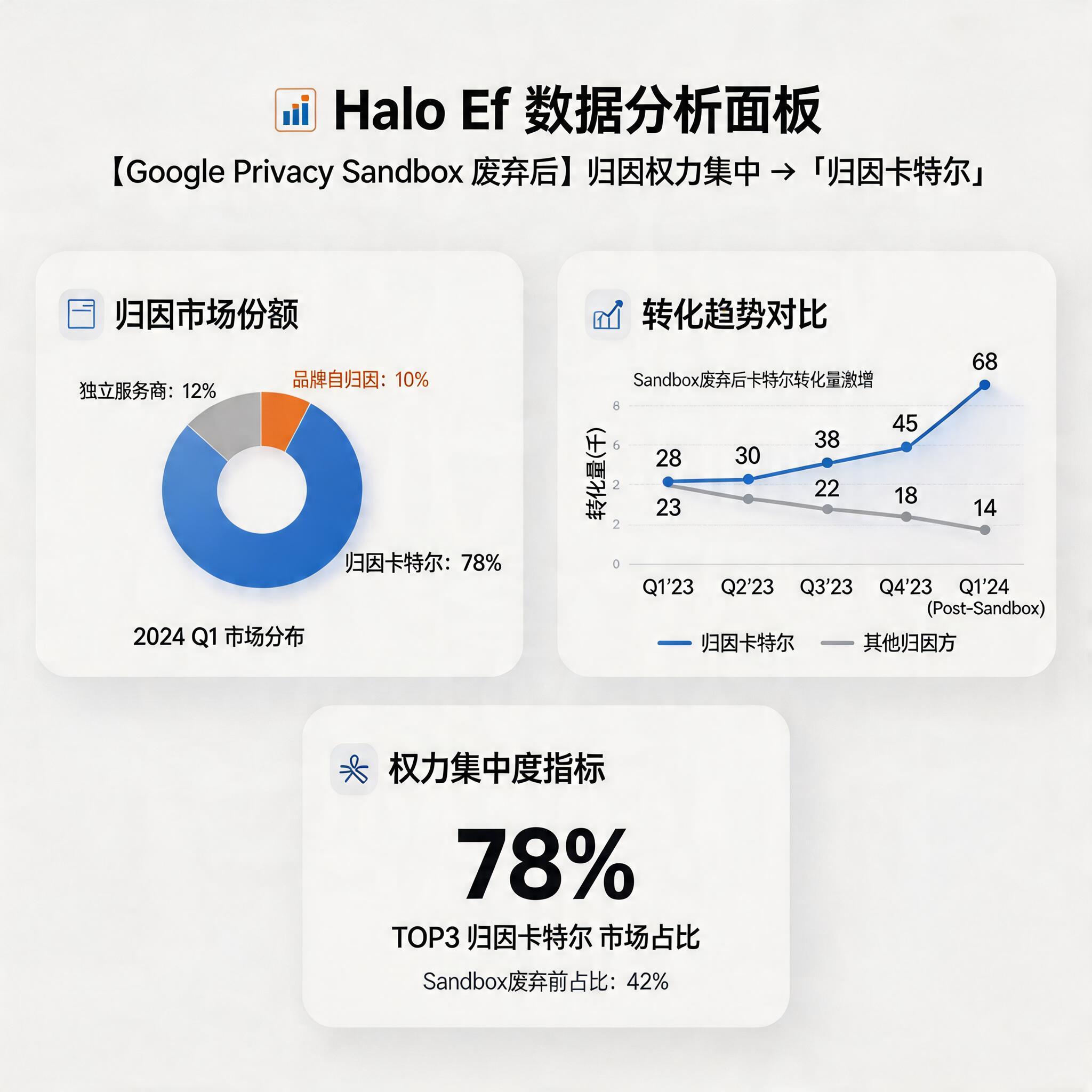
The Halo Effect in attribution is straightforward: a user sees a Meta impression, later searches on Google, clicks an ad, and converts. Both Meta (view-through) and Google (click-through) claim full credit. The advertiser’s dashboard shows two conversions for one sale.
Research from the Association of National Advertisers (ANA) found that platform-reported ROAS is overstated by an average of 2.6× compared to incrementality-tested results. A 2025 Measured study across 500+ brand-lift tests showed that 41% of Meta-reported conversions would have happened organically.
This overcounting is not a bug—it is the business model. Platforms that report higher ROAS attract larger budgets. When every walled garden inflates its numbers, the Attribution Cartel collectively convinces advertisers they are performing better than they are, while the real post-click experience—where conversions actually happen or die—goes unexamined.
The risk is especially acute for teams relying on a single platform’s reporting as their source of truth.
5 Actionable Steps to Break Free from the Attribution Cartel
1. Implement server-side conversion tracking you own. Deploy a first-party data pipeline that captures every post-click event—page load, form start, purchase—on your own infrastructure. Brands using server-side tracking see 12–18% more accurate conversion data compared to client-side pixels alone (Elevar, 2025 benchmark report). This is your ground truth, independent of any platform’s modeled data.
2. Run incrementality tests quarterly. Geo-holdout or ghost-bid experiments remain the gold standard. Allocate 5–10% of budget to dark-traffic tests on each major channel. A Nielsen study found that advertisers running regular incrementality tests reallocate an average of 23% of spend to higher-performing channels within two quarters.
3. Adopt a neutral post-click analytics layer. Use a platform-agnostic tool to measure what happens between the click and the conversion. This eliminates the Halo Effect by attributing revenue to the touchpoint that actually drove the action, not the one that happened to serve the last impression. When Google pushes AI-qualified leads into your funnel, you need independent verification of lead quality.
4. Deduplicate conversions across platforms weekly. Build or buy a cross-channel deduplication workflow. Match conversion events by timestamp, transaction ID, and user identifier. Advertisers who deduplicate consistently report 15–35% fewer total conversions than the sum of platform dashboards—meaning they stop paying for phantom ROAS.
5. Audit your billing and attribution alignment. Ensure you are not optimizing spend based on inflated platform numbers while your finance team reconciles against actual revenue. As Meta shifts to monthly invoicing and direct debit, misaligned attribution can mean you commit budget before verifying real returns.
Why Post-Click Measurement Is the Only Honest Signal
Pre-click metrics—impressions, clicks, CTR—are controlled by platforms. Post-click metrics—landing page engagement, funnel progression, actual purchases—are controlled by you. In a world where the Attribution Cartel grades its own performance, the post-click layer is the only neutral ground.
Advertisers who shift focus to post-click optimization typically discover that 40–60% of paid clicks never reach a meaningful engagement event (Google Analytics 4 benchmark data, 2025). Fixing that leaky funnel delivers more incremental revenue than any bid strategy change.
The Privacy Sandbox’s failure did not create the Attribution Cartel—it removed the last credible attempt to build a neutral alternative. The responsibility now falls on advertisers to build their own measurement independence, one server-side event at a time.
Stop losing conversions after the click.
 DeepAds
留下评论