
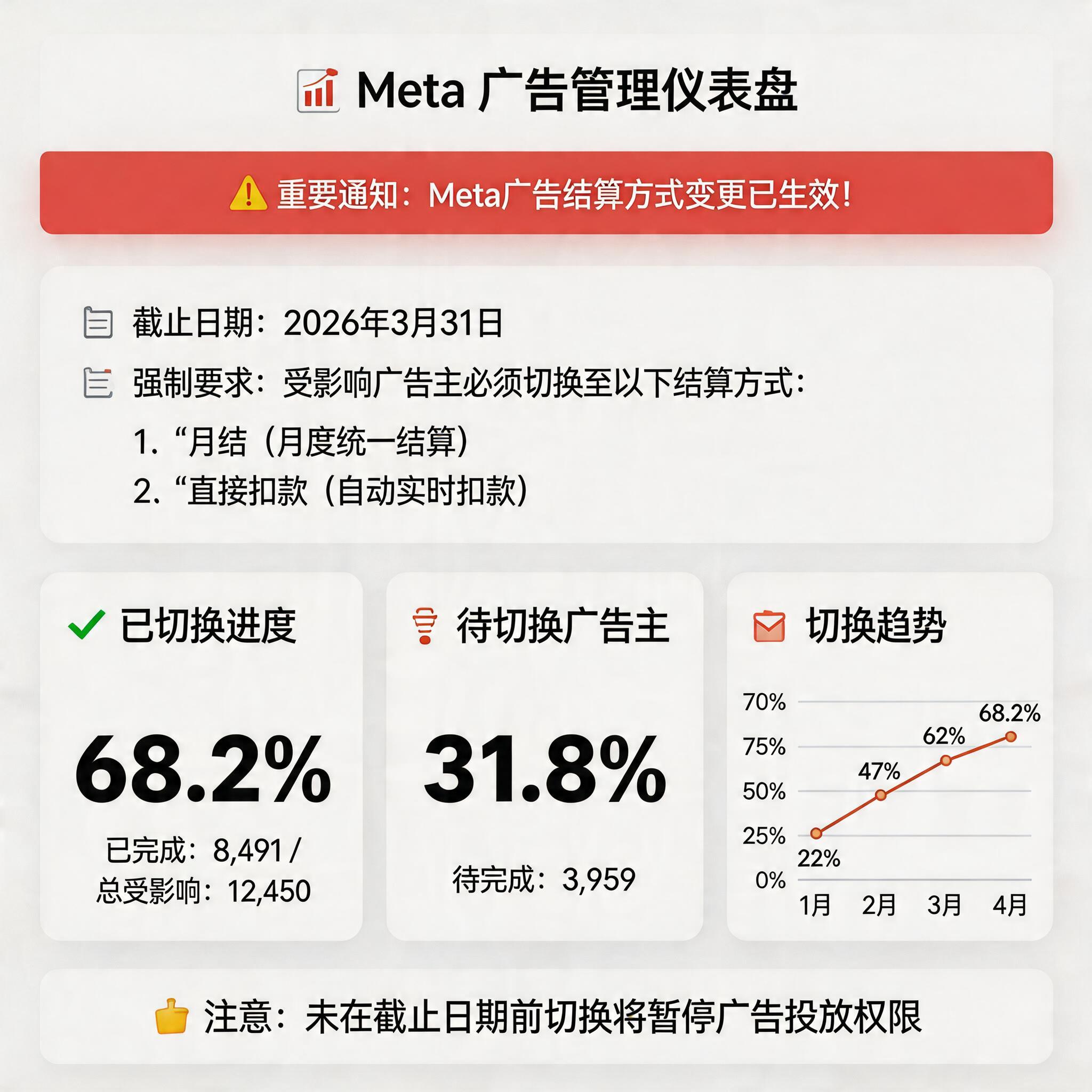
Meta has officially enforced its new ad billing policy: affected advertisers must transition to monthly invoicing or direct debit by March 31, 2026, or risk account suspension and ad delivery disruption. This change impacts thousands of advertisers globally—particularly those in regions where prepaid or manual payment methods were previously supported. If you run campaigns at scale, here’s exactly what changed, what you need to do, and how to protect your ad spend.
→ Book a Free Demo — we will audit your post-click funnel for free.
What Changed in Meta’s Ad Billing Policy
Starting in early 2026, Meta began notifying advertisers about a mandatory shift in how ad accounts are billed. The core change eliminates legacy billing methods—including manual bank transfers and prepaid balances—for qualifying ad accounts. Going forward, advertisers must use one of two approved billing methods:
- Monthly invoicing – available to advertisers who meet Meta’s credit threshold (typically $10,000+ in monthly spend).
- Direct debit (automatic payments) – linked to a bank account or supported payment method for automatic charges.
Meta confirmed that accounts failing to switch by March 31, 2026 may experience paused campaigns, restricted delivery, or temporary account holds. According to Meta’s Business Help Center, the policy applies to ad accounts in over 30 markets, with the largest impact in Asia-Pacific, Latin America, and parts of Europe.
Who Is Affected and How to Check Your Account
Not every advertiser is impacted. The billing change primarily targets accounts that currently use:
- Manual or prepaid payment methods
- Wire transfer or boleto-style payments
- Legacy billing arrangements set up before 2024
To check your status, navigate to Meta Business Suite → Billing & Payments → Payment Settings. If your account is affected, you’ll see a banner notification with a deadline to update your billing method. Meta has also sent email notifications to affected account administrators since January 2026.
Data from marketing analytics firm Varos suggests that approximately 15–20% of mid-market advertisers in affected regions were still using legacy billing methods as of Q1 2026. For these advertisers, failing to act could mean losing campaign momentum during critical spending periods.
Step 1: Audit Your Current Billing Setup Immediately
Log into every ad account you manage and verify the active payment method. If you operate through a Meta agency account or Business Manager with multiple ad accounts, check each one individually—billing settings are account-level, not organization-level.
Document which accounts use legacy methods and prioritize switching those with active campaigns first. Accounts with scheduled campaigns launching in April should be your top priority.
Step 2: Choose the Right Billing Method for Your Spend Level
Your choice between monthly invoicing and direct debit depends on your ad spend volume and cash flow preferences:
- Monthly invoicing is ideal for advertisers spending $10,000+ per month. It offers net-30 payment terms, giving you more control over cash flow. However, Meta requires a credit check and approval process that can take 5–10 business days.
- Direct debit works for any spend level. Charges are automatic, typically triggered when you hit your billing threshold or at the end of your billing period. Setup is instant but requires a verified bank account.
For advertisers managing large cross-border campaigns, monthly invoicing provides a cleaner paper trail for tax and compliance documentation. A 2025 Adweek survey found that 62% of enterprise advertisers preferred invoicing for this reason.
Step 3: Update Your Post-Click Tracking to Match New Billing Cycles
Billing changes often create blind spots in conversion attribution. When your billing cycle shifts, historical cost data in third-party tools can become misaligned with Meta’s reporting. This is especially critical if you’re already navigating cross-platform tracking changes like Google Consent Mode V2.
After updating your billing method, verify that:
- Your cost-per-acquisition (CPA) calculations reflect the new billing dates
- Automated rules based on spend thresholds are adjusted for the new payment cadence
- Any budget pacing tools account for the timing shift in charges
Misaligned billing and attribution data can inflate or deflate your reported ROAS by 10–15%, according to a 2025 analysis by Measured. Don’t let an administrative change distort your optimization decisions.
What Happens If You Miss the March 31 Deadline
Meta has stated that non-compliant accounts will face progressive enforcement:
- Warning phase – Banner alerts and email reminders (already active since January 2026)
- Delivery restriction – New campaigns cannot launch; existing campaigns may see reduced delivery
- Account hold – Full pause on all ad activity until billing is updated
Reactivation after an account hold typically takes 24–72 hours once a valid payment method is added. However, any campaigns paused during this period lose their learning phase progress, which can increase CPAs by 20–30% during the re-learning period.
Protect Your Ad Investment Beyond Billing Compliance
Billing disruptions are just one type of platform risk that can derail your Meta ad performance. Smart advertisers use moments like this to audit their entire funnel—from ad account health to post-click conversion infrastructure. The advertisers who recover fastest from policy changes are those with platform-neutral tracking and landing page systems that don’t depend on any single ad network’s tools.
Take 30 minutes this week to update your billing, then take another 30 to audit your post-click setup. The billing fix is mandatory. The funnel audit is what separates advertisers who survive policy changes from those who thrive through them.
Stop losing conversions after the click.
 DeepAds
留下评论