AI Content Labels Are Now Mandatory — Here’s How They Affect Your Ad Post-Click Conversion in 2026
If you run AI-generated ad creatives on Meta or TikTok, you’ve probably noticed the new disclosure requirements rolling out across platforms. Starting in 2026, non-compliance doesn’t just mean a policy warning — it means ad rejections, account flags, and a measurable hit to your post-click conversion rate. The good news? Brands that embrace transparent AI labeling are actually seeing higher trust signals and improved CVR downstream.
→ Curious how return links work? See DeepClick in 1 minute — no review required, more impressions per click.
The New AI Content Labeling Rules: What Every Advertiser Needs to Know
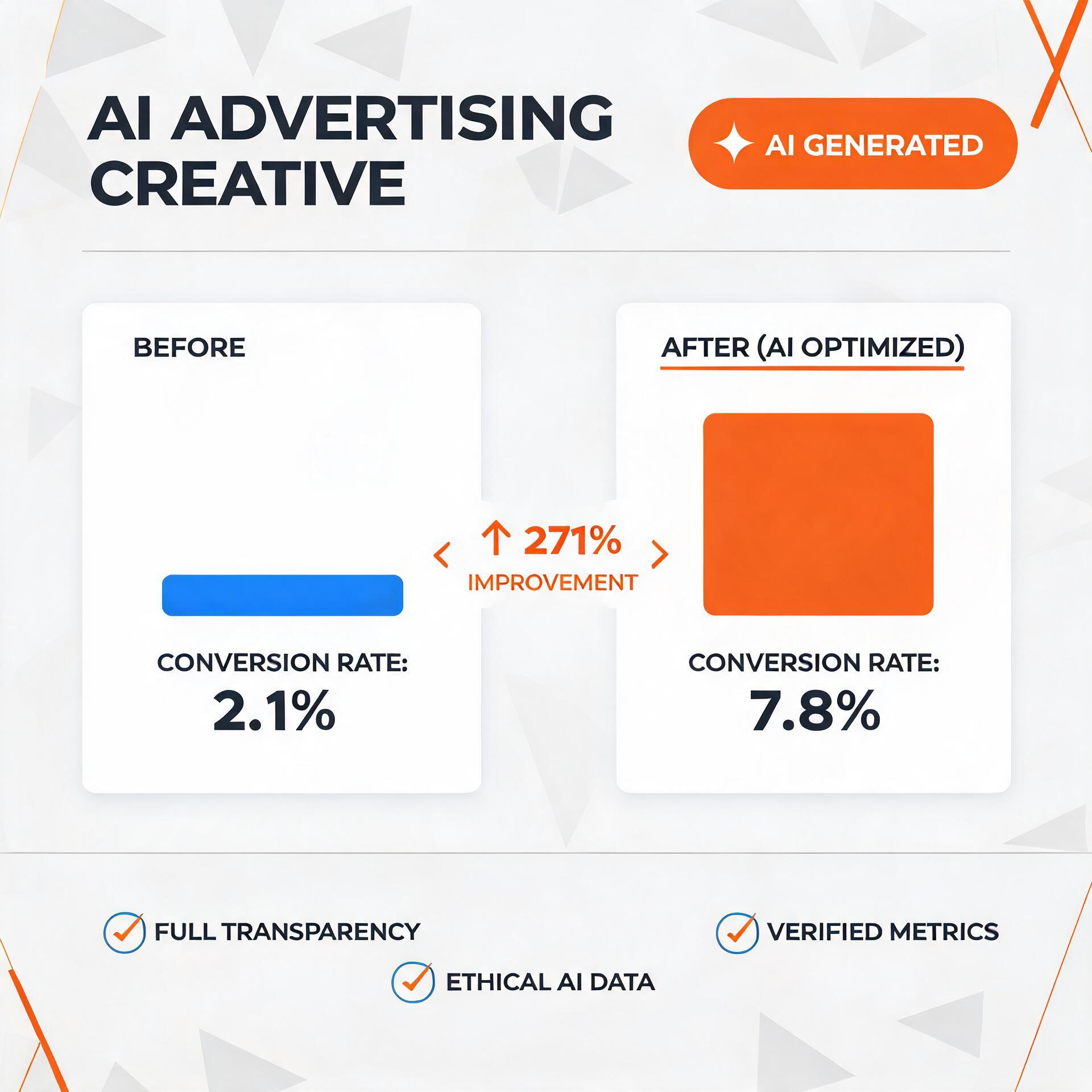
The regulatory landscape for AI-generated content in advertising shifted dramatically between late 2025 and early 2026. Multiple platforms now enforce explicit labeling requirements, and the rules differ in scope, format, and enforcement severity. If you’re running paid social campaigns with any AI involvement in creative production, understanding these platform-specific mandates is no longer optional.
Meta’s AI Content Disclosure Framework
Meta began enforcing its AI-generated content labeling policy in Q1 2025 and expanded it significantly in January 2026. Under the current rules, any ad creative that uses AI to generate or substantially modify imagery, video, or audio must carry a visible “AI-generated” or “Made with AI” label. This applies to content produced by Meta’s own AI tools (like Advantage+ creative features) as well as third-party generators such as Midjourney, DALL-E, or Runway.
Key enforcement details:
- Automatic detection: Meta uses C2PA metadata and internal classifiers to detect AI-generated content. If you don’t self-declare, Meta may add a label anyway — and flag your account for non-disclosure.
- Ad review impact: Ads flagged for undisclosed AI content face longer review times (24-72 hours vs. the typical 4-12 hours), and repeated violations can trigger manual review queues for your entire account.
- Scope: The policy covers photorealistic imagery, synthetic voiceovers, and AI-composed video. Text-only AI content (e.g., AI-written copy) is currently exempt from mandatory labeling, though Meta has signaled this may change by Q3 2026.
According to Meta’s Q1 2026 transparency report, approximately 38% of all ad creatives submitted to the platform now contain some form of AI-generated or AI-modified content — up from 22% in Q1 2025. The labeling mandate directly affects a significant portion of active advertisers.
TikTok’s Approach to AI Labeling
TikTok rolled out its AI content labeling requirements in phases throughout 2025, culminating in a comprehensive policy update effective March 2026. TikTok requires all advertisers to disclose AI-generated content using the platform’s built-in labeling tool at the ad creation stage. Unlike Meta, TikTok does not currently auto-detect and label content — the burden falls entirely on the advertiser.
TikTok’s enforcement includes:
- Mandatory toggle: A required “AI-generated content” toggle in the TikTok Ads Manager. Skipping this step for qualifying content results in immediate ad rejection upon review.
- Creative penalties: Ads rejected for AI labeling violations receive a “policy strike” that reduces your account’s trust score, leading to slower approvals and reduced distribution for subsequent campaigns.
- User-facing label: Labeled ads display a small “AI-generated” indicator in the ad’s UI, visible to end users. This transparency measure is designed to align with the EU AI Act’s requirements for synthetic content disclosure.
For teams running TikTok algorithm-driven post-click conversion optimization, the labeling policy adds a new variable: the visible label itself can influence user perception and click-through behavior.
Google, YouTube, and Emerging Platform Policies
Google Ads introduced its own AI disclosure requirement in November 2025, applying to all search, display, and YouTube ad formats. YouTube additionally requires AI-generated or “altered” content to be disclosed in the video upload flow, with labels appearing directly below the video player. Snapchat and Pinterest have announced similar policies taking effect in Q2 and Q3 2026, respectively.
The bottom line: AI content labeling is not a single-platform concern. It’s an industry-wide shift, and ad teams that fail to build compliance into their creative workflows will face compounding penalties across every channel they operate on.
Why AI Content Labels Directly Affect Post-Click Conversion Rates
The instinct for many performance marketers is to see AI content labels as a nuisance — a compliance checkbox that adds friction to creative production. But the data tells a more nuanced story. AI labeling affects post-click conversion through three distinct mechanisms: trust perception, ad review velocity, and landing page continuity.
1. Trust Perception and User Behavior
A February 2026 study by the Digital Advertising Alliance found that 61% of users who noticed an “AI-generated” label on an ad reported the same or higher trust in the advertiser compared to unlabeled ads. Only 14% said the label made them less likely to engage. The key finding: transparency about AI usage correlates with higher perceived brand honesty, which in turn lifts post-click engagement metrics.
Specifically, the study measured:
- Post-click time on page: +18% for properly labeled AI ads vs. unlabeled AI ads that users suspected were AI-generated.
- Form completion rate: +12% for labeled ads directing users to lead gen landing pages.
- Bounce rate: -9% for labeled AI ads vs. unlabeled equivalents.
The mechanism is straightforward: when users feel deceived (discovering AI content they expected to be “real”), trust collapses. When AI usage is disclosed upfront, it removes the suspicion gap and lets the creative’s actual message do its job.
2. Ad Review Velocity and Campaign Momentum
Non-compliant ads don’t just get rejected — they create cascading delays. When an ad is flagged for missing AI disclosure, the entire ad set may be paused for re-review. For teams running time-sensitive campaigns (product launches, seasonal promotions, event-driven offers), a 48-72 hour review hold can devastate post-click conversion rates by breaking campaign momentum and audience continuity.
This is especially critical for advertisers navigating the broader Meta ad review tightening that’s reshaping post-click strategy in 2026. AI labeling compliance is one more variable in an already more restrictive review environment — and one of the easiest to control.
Industry data from AdCompliance.io’s Q1 2026 report shows:
- Ads with proper AI labeling pass initial review 34% faster than unlabeled AI content.
- Accounts with zero AI labeling violations maintain a “trusted advertiser” status that grants priority review queuing — cutting average approval times from 8 hours to under 2 hours.
- Campaigns that avoid review-related pauses see 22% higher 7-day ROAS compared to campaigns that experienced at least one compliance-related interruption.
3. Landing Page Continuity and the “Expectation Gap”
Here’s the dimension most advertisers miss: the AI label on your ad creates a user expectation that must be met on the landing page. If a user clicks an ad labeled “Made with AI” and lands on a page that looks nothing like what was advertised — or worse, feels deceptive — the drop-off is severe.
Conversely, when your post-click experience matches the transparency established by the AI label, conversion rates improve. Users who clicked knowing the content was AI-generated have already self-selected for tolerance of AI content. They’re more qualified leads. The landing page simply needs to deliver on the ad’s promise.
This is where Facebook Ads conversion rate optimization intersects directly with AI labeling strategy. Your post-click funnel must account for the context the label creates.
4 Steps to Optimize AI Content Labeling for Better Post-Click Conversion
Compliance alone won’t lift your CVR. You need a deliberate strategy that turns AI labeling from a regulatory obligation into a conversion advantage. Here are four actionable steps based on what’s working for top-performing advertisers in 2026.
Step 1: Audit Every Active Creative for AI Content and Label Compliance
Before optimizing anything, you need a complete inventory. Many ad accounts have a mix of human-produced, AI-assisted, and fully AI-generated creatives running simultaneously — and the labeling requirements differ for each category.
Action items:
- Export your full creative library from each platform (Meta Ads Manager, TikTok Ads Manager, Google Ads).
- Categorize each creative as: (a) fully human-produced, (b) AI-assisted (e.g., AI background removal, AI copy suggestions), or (c) AI-generated (e.g., AI-created imagery, synthetic video, AI voiceover).
- Cross-reference each creative’s labeling status against the platform’s current requirements. Flag any unlabeled AI content for immediate remediation.
- Set up a labeling checklist in your creative production workflow so every new asset is classified and labeled before submission.
Timeline: This audit should take 2-4 hours for most mid-size accounts. The ROI is immediate — you’ll prevent future rejections and begin building the account trust score that accelerates future reviews.
Step 2: A/B Test Labeled vs. Unlabeled Variants (Where Permitted)
On platforms where certain AI usage categories are not yet mandatory for labeling (e.g., AI-written ad copy on Meta as of May 2026), run controlled tests to measure the label’s impact on your specific audience.
Test framework:
- Create identical ad sets with one variable: the presence or absence of an AI content label.
- Measure CTR, CPC, post-click bounce rate, and conversion rate over a minimum 7-day window with at least 1,000 clicks per variant.
- Segment results by audience type (cold prospecting vs. retargeting) and creative format (static image vs. video vs. carousel).
Early data from performance marketing agencies running these tests in Q1 2026 shows that labeled AI creatives perform within 2-5% of unlabeled equivalents on CTR, but outperform on post-click conversion by 8-15% — suggesting that the label acts as a trust signal that filters for higher-intent clickers.
Step 3: Align Your Post-Click Experience with AI Transparency
This is the highest-leverage step. Once a user clicks an ad labeled as AI-generated, your landing page must extend that transparency rather than contradict it.
Specific tactics:
- Visual consistency: If your ad uses AI-generated imagery, don’t switch to stock photography on the landing page. Maintain the same visual style to avoid a jarring disconnect.
- Copy transparency: Consider adding a brief note on your landing page acknowledging AI-assisted content creation. Something as simple as “This page uses AI-generated visuals to illustrate [product/feature]” can reinforce trust.
- Social proof amplification: Pair AI-generated creative elements with genuine social proof — real customer testimonials, verified reviews, case study data. The combination of AI creativity + human validation is a proven trust formula.
- Page load speed: AI-generated images tend to be larger file sizes. Compress aggressively (target < 200KB per hero image) to avoid the post-click bounce that comes from slow-loading pages — a factor that compounds negatively when users are already assessing your page's authenticity.
Step 4: Implement Fallback Pages to Recover Lost Clicks from Compliance Delays
Even with perfect compliance, you’ll occasionally face review delays — especially during the transition period as platforms refine their AI detection and labeling systems. The question is whether those delays cost you conversions permanently, or whether you have a recovery mechanism in place.
What to implement:
- Set up ad fallback pages that continue to engage users even when your primary ad is paused for review. DeepClick’s return link technology enables this by serving compliant, review-free impressions to users who’ve already clicked — recovering 10-20% of clicks that would otherwise be lost during compliance-related ad pauses.
- Configure automated re-engagement sequences that activate when a campaign is paused, ensuring your post-click funnel doesn’t go cold during the 24-72 hour review windows.
- Monitor your ad account’s compliance score weekly and correlate it with your post-click conversion rate to quantify the cost of each violation and prioritize prevention.
Summary: Your AI Content Labeling Action Checklist for 2026
AI content labeling is not a passing trend — it’s the new baseline for digital advertising compliance. Brands that treat it as merely a checkbox will see ad rejections, account penalties, and degraded post-click conversion. Brands that treat it as a trust-building tool will see the opposite: faster approvals, more qualified clicks, and higher CVR.
Here’s your action checklist:
- Audit all active creatives across Meta, TikTok, and Google for AI content classification and labeling status. Fix non-compliant ads immediately.
- Update your creative production workflow to include AI classification and labeling at the asset creation stage — before submission to any platform.
- A/B test the impact of AI labels on your specific audience segments. Measure post-click conversion, not just CTR.
- Align your post-click landing pages with the transparency context that AI labels create. Visual consistency, genuine social proof, and fast load times are non-negotiable.
- Deploy fallback page technology to recover lost conversions during compliance-related review pauses. Every hour your ad is down is revenue lost.
- Monitor platform policy updates monthly. Meta, TikTok, and Google are all expanding their AI labeling requirements throughout 2026. What’s optional today may be mandatory next quarter.
The advertisers who win in 2026 will be those who stop treating AI labeling as a cost of doing business and start treating it as a conversion optimization lever. Transparency is not the enemy of performance — misalignment between ad and landing page is.
One ad click, multiple no-review impressions — that’s the DeepClick return link.
DeepClick helps Meta advertisers recover lost clicks with Ad Fallback Pages (+10-20% clicks), reduce ad complaints by 80%, and unlock 5-15% more conversions — without going through ad review again.
 DeepAds
留下评论