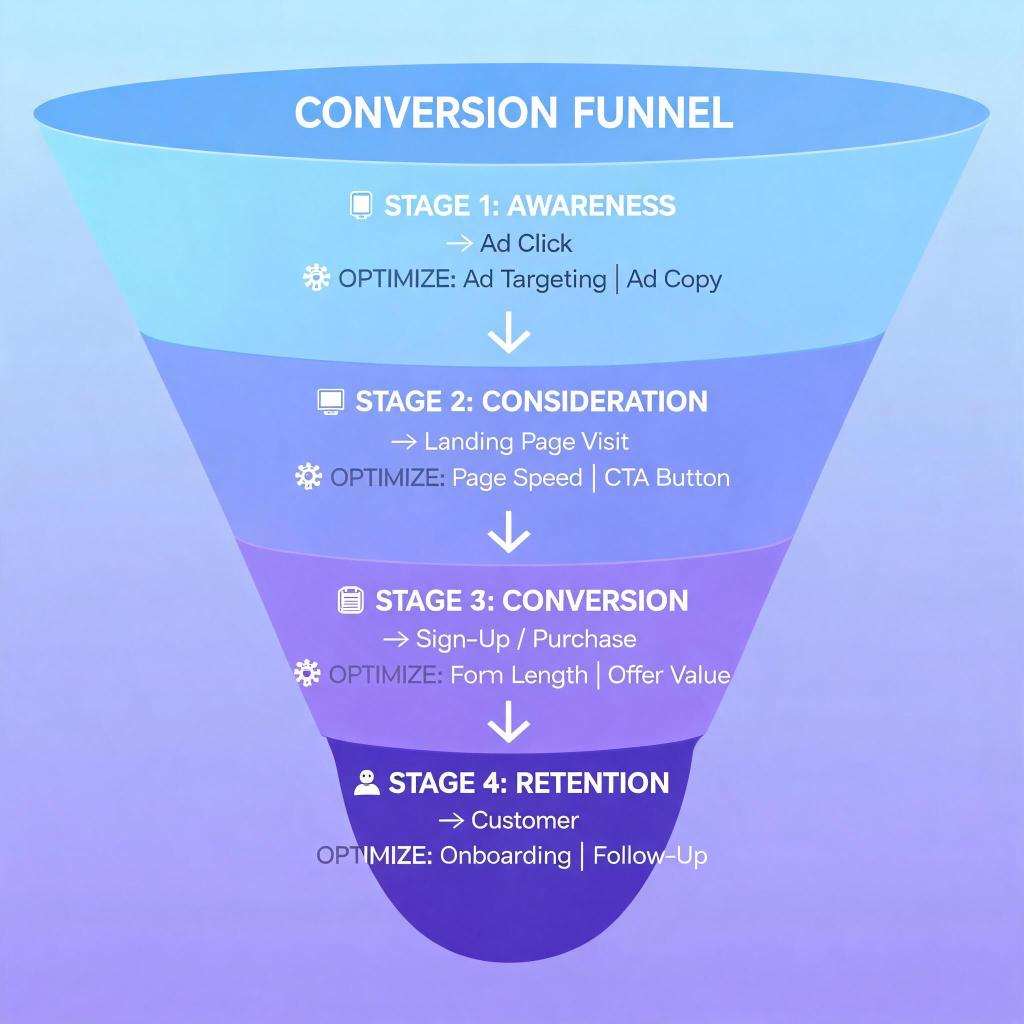
You are spending thousands on Facebook ads, getting clicks — but conversions stay flat. The gap between ad click and purchase completion is where most advertising budgets quietly die. In 2026, with rising CPMs, tightening platform policies, and evolving attribution models, fixing your post-click conversion funnel is no longer optional — it is the single highest-ROI investment you can make.
This guide covers every layer of Facebook ads conversion rate optimization: from landing page fundamentals to advanced attribution calibration, retargeting architecture, and first-party data strategy. Whether you run AI social apps, BC games, or any high-volume Meta campaign, these frameworks apply.
→ Curious how return links work? See DeepClick in 1 minute — no review required, more impressions per click.
Why Post-Click CVR Is the Highest-Leverage Metric in 2026
Meta reported average CPMs increased 18% year-over-year in Q1 2026. With every click costing more, the math is simple: doubling your conversion rate from 2% to 4% effectively halves your CPA without touching ad spend. Yet most advertisers still spend 90% of their optimization time on pre-click variables (creative, targeting, bidding) and neglect the landing page and post-click funnel entirely.
Key data points that frame the urgency:
- Average mobile landing page bounce rate after ad click: 53% (Google benchmark data)
- Median time-to-conversion for Meta ad traffic: 8.2 seconds on pages loading under 2s vs. 22+ seconds on 4s+ pages
- Advertisers using post-click optimization report 25-40% CVR improvement within 30 days
The conclusion is clear: if you are not actively optimizing what happens after the click, you are leaving the majority of your budget on the table. For a deeper look at how rising ad taxes compound this problem, see our analysis of Meta Digital Services Tax and post-click CVR impact.
Diagnosing Your Post-Click Funnel: Where Conversions Leak
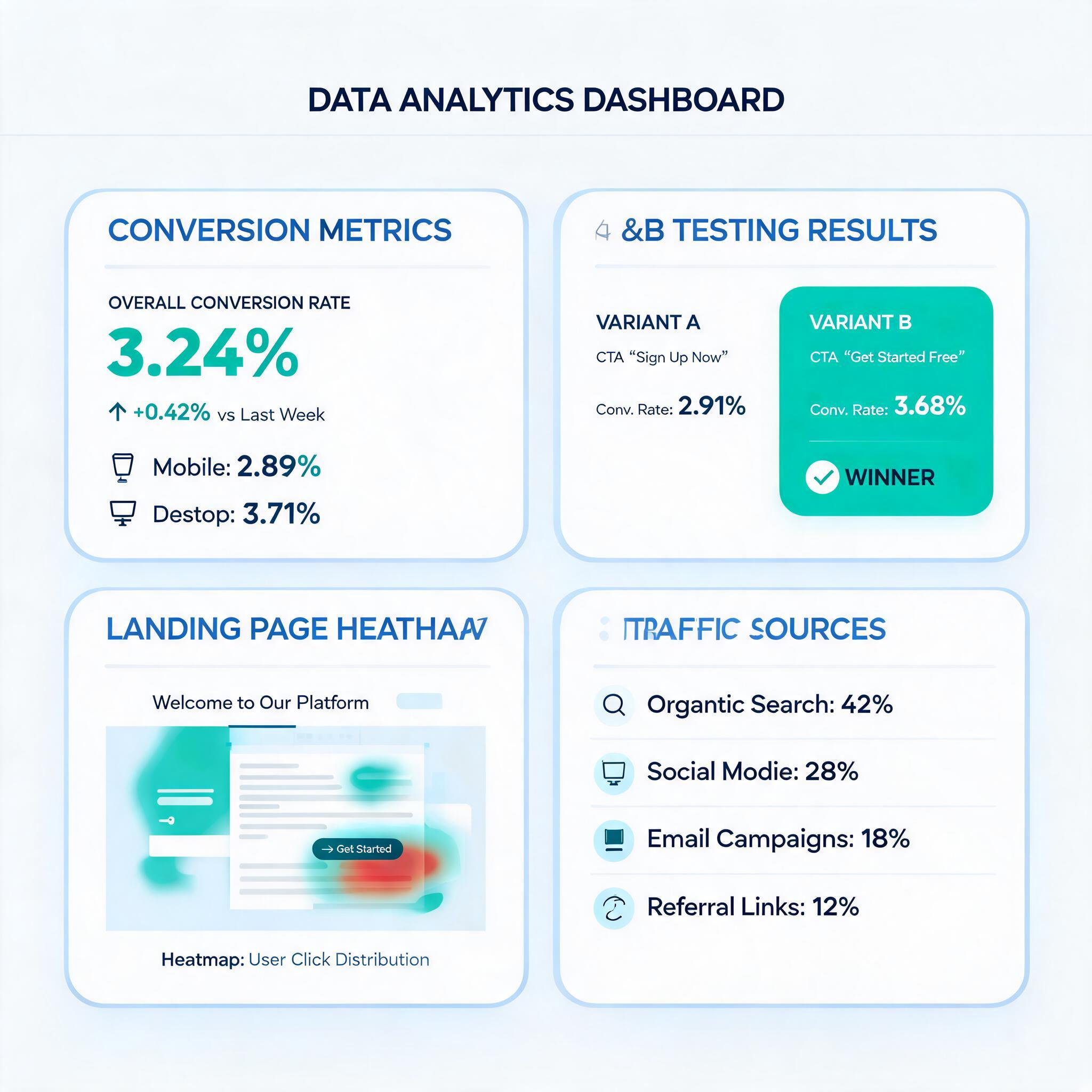
Before fixing anything, you need a clear map of where users drop off. The standard Facebook ads conversion funnel has five stages after the click:
- Page Load — Does the page render within 2 seconds on mobile?
- First Impression — Does above-the-fold content match the ad promise?
- Engagement — Do users scroll, interact, or bounce immediately?
- Intent Signal — Do users click a CTA, start a form, or add to cart?
- Conversion — Does the checkout/signup/install flow complete without friction?
Use Meta Events Manager combined with GA4 enhanced measurement to identify which stage loses the most users. Common patterns:
- High bounce, low scroll: Page load or message mismatch issue
- Good scroll, no CTA click: Weak value proposition or unclear next step
- CTA click but no conversion: Checkout friction, form length, or trust gap
For guidance on how measurement infrastructure affects this diagnosis, read our piece on why ad measurement drives post-click strategy in 2026.
Landing Page Speed and Mobile Experience
Page speed is the single most predictable conversion killer. Mobile users from Facebook ads have near-zero patience — they tapped an ad in a feed scroll and expect instant gratification.
Speed benchmarks for Facebook ad landing pages:
- Largest Contentful Paint (LCP): under 2.5 seconds
- First Input Delay (FID): under 100ms
- Cumulative Layout Shift (CLS): under 0.1
Tactical fixes that move the needle:
- Compress all images to WebP format, max 100KB per hero image
- Eliminate render-blocking JavaScript above the fold
- Use edge-cached CDN (Cloudflare, Fastly) with sub-50ms TTFB
- Implement critical CSS inlining for above-fold content
- Lazy-load everything below the viewport
Teams running Google PMax alongside Meta campaigns should note that PMax channel-level CVR differences often trace back to the same page speed issues affecting Meta traffic.
Creative-to-Landing Page Message Match
Message match — the alignment between ad creative and landing page headline — is the second most common CVR killer after speed. When a user sees an ad promising “50% off AI dating premium” and lands on a generic homepage, cognitive dissonance triggers immediate bounce.
Message match framework:
- Mirror the exact headline from your top-performing ad on the landing page H1
- Use the same imagery style (if ad shows a product screenshot, landing page should too)
- Reinforce the specific offer/value prop within the first 200px of viewport
- Match tone: casual ad → casual landing page; professional ad → professional page
Dynamic landing pages for scaled campaigns:
If you run 50+ ad variants, create parameterized landing pages that pull headline and hero image from UTM parameters. This ensures every ad-to-page transition feels seamless.
The principle extends to platform policy too. When Meta tightens ad review — as covered in our guide to Meta ad review tightening and post-click strategy — having strong message match reduces disapproval rates because your landing page clearly delivers on the ad promise.
Attribution and Measurement Setup
You cannot optimize what you cannot measure. In 2026, attribution is more complex than ever due to iOS privacy changes, cookie deprecation delays, and Meta shifting between click-through and engage-through windows.
Essential attribution infrastructure:
- Meta Pixel + Conversions API (CAPI): Server-side event tracking eliminates browser-level signal loss. Deploy both for redundancy. See our Meta Pixel CAPI upgrade guide for implementation details.
- UTM parameter discipline: Every ad must carry structured UTMs. Use utm_content to identify specific creatives for landing page match analysis.
- First-party conversion events: Define custom conversion events (not just standard “Purchase”) for micro-conversions like “Added to Cart,” “Started Checkout,” “Reached Pricing Page.”
- Attribution window alignment: Match your reporting window to your actual sales cycle. For impulse purchases, 1-day click is appropriate. For considered purchases, 7-day click + 1-day view gives a clearer picture.
The recent shift between click-through and engage-through attribution models requires careful CPA recalibration — we covered this in detail in Meta attribution: click-through vs engage-through in 2026.
Retargeting Architecture for Maximum CVR
Retargeting is not a single audience — it is a layered system that matches message intensity to user intent signals. The goal is to create a “funnel of nudges” that brings warm users back at exactly the right moment.
Three-tier retargeting framework:
Tier 1: Hot intent (0-3 days)
- Audience: Added to cart, started checkout, viewed pricing 2+ times
- Message: Direct conversion push, urgency triggers, social proof
- Frequency: Up to 3 impressions/day
Tier 2: Warm interest (3-14 days)
- Audience: Page visitors who scrolled 75%+, watched 75% of video, engaged with content
- Message: Value reinforcement, case studies, objection handling
- Frequency: 1-2 impressions/day
Tier 3: Re-engagement (14-60 days)
- Audience: All site visitors not in Tier 1/2, past purchasers for upsell
- Message: Brand awareness, new features, seasonal offers
- Frequency: 0.5-1 impression/day
First-party data quality directly determines retargeting effectiveness. The Google Customer Match API migration creates new opportunities for cross-platform audience building that feeds both Google and Meta retargeting pools.
First-Party Data Strategy for Sustainable CVR
As third-party cookies fade and platform algorithms require richer input signals, your first-party data becomes the foundation of long-term conversion optimization.
Building your first-party data asset:
- Progressive profiling: Collect data incrementally across touchpoints rather than demanding everything upfront
- Value exchange: Offer genuine value (free tools, reports, trials) in exchange for email/phone
- Server-side event enrichment: Append CRM data to conversion events via CAPI for richer signal
- Customer Match integration: Upload hashed customer lists to both Meta and Google for lookalike expansion and suppression
The advertiser teams that invested in first-party data infrastructure in 2024-2025 are now seeing 2-3x ROAS advantages over competitors still dependent on platform-managed audiences. This advantage compounds: better data leads to better optimization leads to better results leads to more budget leads to more data.
Platform Diversification as CVR Insurance
Relying solely on Meta for paid acquisition creates single-point-of-failure risk. When Meta changes policies (like the Advantage+ review controversies), your entire growth engine can stall overnight.
Diversification strategy that protects CVR:
- Run parallel campaigns on TikTok, Google, and emerging platforms
- Use unified post-click infrastructure across all channels
- Track channel-level CVR independently to identify which sources deliver quality traffic
- Maintain platform-agnostic landing pages that work regardless of traffic source
Post-click optimization is inherently platform-neutral — your landing page converts the same whether the click came from Meta, TikTok, or Google. This makes post-click the most resilient layer of your acquisition stack. Teams exploring TikTok should read our take on TikTok SEO algorithm shift and post-click strategy.
Advanced Tactics: AI-Powered CVR Optimization
In 2026, AI tools have matured enough to automate several CVR optimization workflows:
- Dynamic headline testing: AI generates and tests hundreds of headline variants in real-time, rotating toward winners automatically
- Predictive lead scoring: ML models score visitors on conversion probability, triggering different CTAs for high vs. low-intent users
- Automated page personalization: Serve different landing page versions based on ad source, device, time of day, and behavioral signals
- Chatbot-assisted conversion: AI chatbots that answer objections in real-time on the landing page, reducing form abandonment by 15-25%
The key principle: AI amplifies your CVR optimization, but it requires clean data and clear conversion definitions to function. Garbage in, garbage out applies doubly to ML-driven optimization.
Action Checklist: Your 30-Day CVR Improvement Plan
Week 1: Foundation
- Audit page speed across all landing pages (target: LCP under 2.5s)
- Verify Meta Pixel + CAPI dual tracking is operational
- Map your funnel stages and identify the biggest drop-off point
Week 2: Quick Wins
- Fix message match on your top 5 highest-spend ad/landing page combinations
- Implement micro-conversion events for funnel visibility
- Set up Tier 1 hot-intent retargeting if not already running
Week 3: Structural
- Build parameterized landing pages for your top ad categories
- Deploy progressive profiling on lead-gen forms
- Launch A/B test on your highest-traffic landing page
Week 4: Scale
- Implement three-tier retargeting architecture
- Upload first-party lists to Customer Match
- Set up automated CVR reporting dashboard with weekly alerts
One ad click, multiple no-review impressions — that is the DeepClick return link.
DeepClick helps Meta advertisers recover lost clicks with Ad Fallback Pages (+10-20% clicks), reduce ad complaints by 80%, and unlock 5-15% more conversions — without going through ad review again.
 DeepAds
留下评论