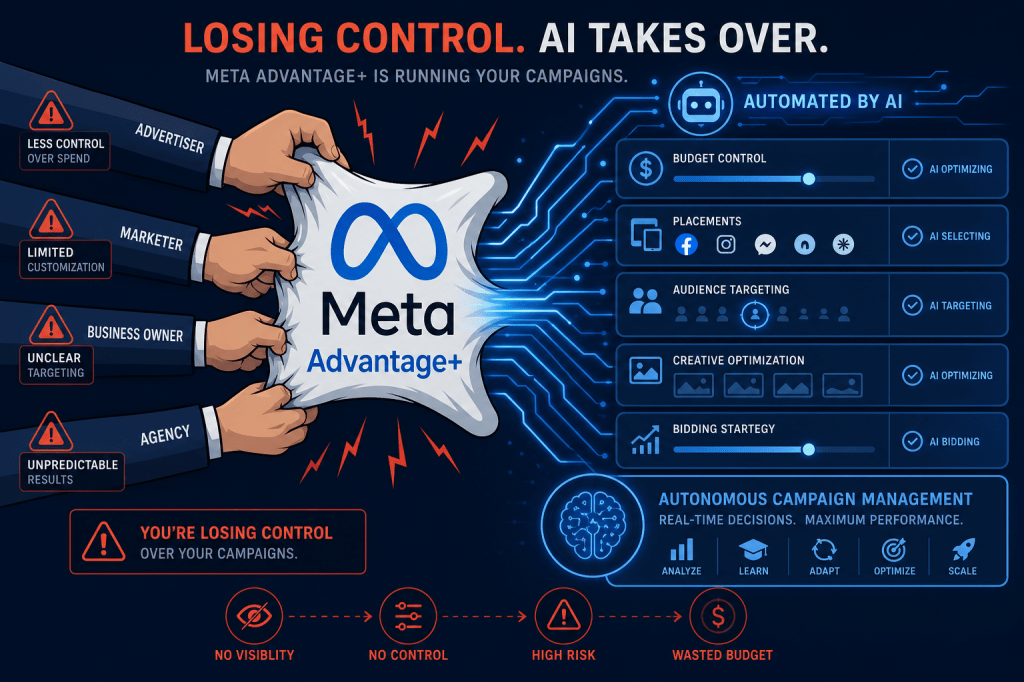
In early 2026, Meta made headlines by banning entire categories of law firm advertising, tightening ad review processes across verticals, and doubling down on Advantage+ — its AI-driven campaign automation that strips advertisers of granular control over targeting, placements, and creative rotation. For performance marketers who built their playbooks on precise audience segmentation and manual bid strategies, the ground is shifting fast. The question is no longer whether Meta will keep restricting advertiser control, but how quickly you can build a conversion strategy that doesn’t depend on platform-side levers you no longer hold.
The answer lies in post-click optimization — the set of strategies that improve what happens after someone clicks your ad. While Meta decides who sees your ad and how much you pay, post-click is the one domain that remains entirely yours. And in 2026, it’s where the smartest advertisers are gaining their edge.
→ Curious how return links work? See DeepClick in 1 minute — no review required, more impressions per click.
What’s Happening with Meta Advantage+ in 2026
Meta’s Advantage+ suite — including Advantage+ Shopping Campaigns (ASC), Advantage+ App Campaigns, and the newer Advantage+ Creative tools — has been expanding aggressively since its initial rollout. By Q1 2026, Meta reported that over 60% of active advertisers on the platform use at least one Advantage+ feature, up from roughly 40% in late 2024. But what Meta frames as “simplification,” many advertisers experience as a loss of control.
Here’s what’s changed:
- Ad review tightening: Meta has expanded its restricted categories beyond the traditional “special ad categories” (housing, credit, employment). In early 2026, law firm and legal services advertising faced sweeping bans in multiple regions, with accounts suspended without warning. Health and wellness advertisers report rejection rates climbing above 35%, according to industry surveys from performance marketing communities.
- Audience control erosion: Advantage+ campaigns increasingly override manual audience selections. Meta’s own documentation now acknowledges that “audience suggestions” in Advantage+ are treated as signals, not constraints — meaning your carefully built lookalike audiences may be ignored entirely if Meta’s algorithm finds cheaper reach elsewhere.
- Creative consolidation: Advantage+ Creative automatically generates ad variations — cropping images, adjusting text overlays, swapping CTAs — without explicit advertiser approval. A 2025 study by marketing analytics firm Varos found that Advantage+ Creative variations underperformed manually designed creatives by 12-18% on average for direct-response campaigns, despite Meta’s claims of improved performance.
- Budget allocation opacity: With Advantage+ Shopping Campaigns, advertisers cannot see which products or audiences receive budget allocation in real time. The “black box” effect makes it nearly impossible to diagnose underperformance until spend is already committed.
The pattern is clear: Meta is optimizing for its own revenue efficiency, not yours. Every lever they remove from your dashboard is a lever they gain on the auction side. For advertisers in restricted verticals — or any vertical where ad review is tightening — the risk compounds: you’re paying more for less control, and a single policy change can shut off your traffic overnight.
How Advantage+ Impacts Your Conversion Rates
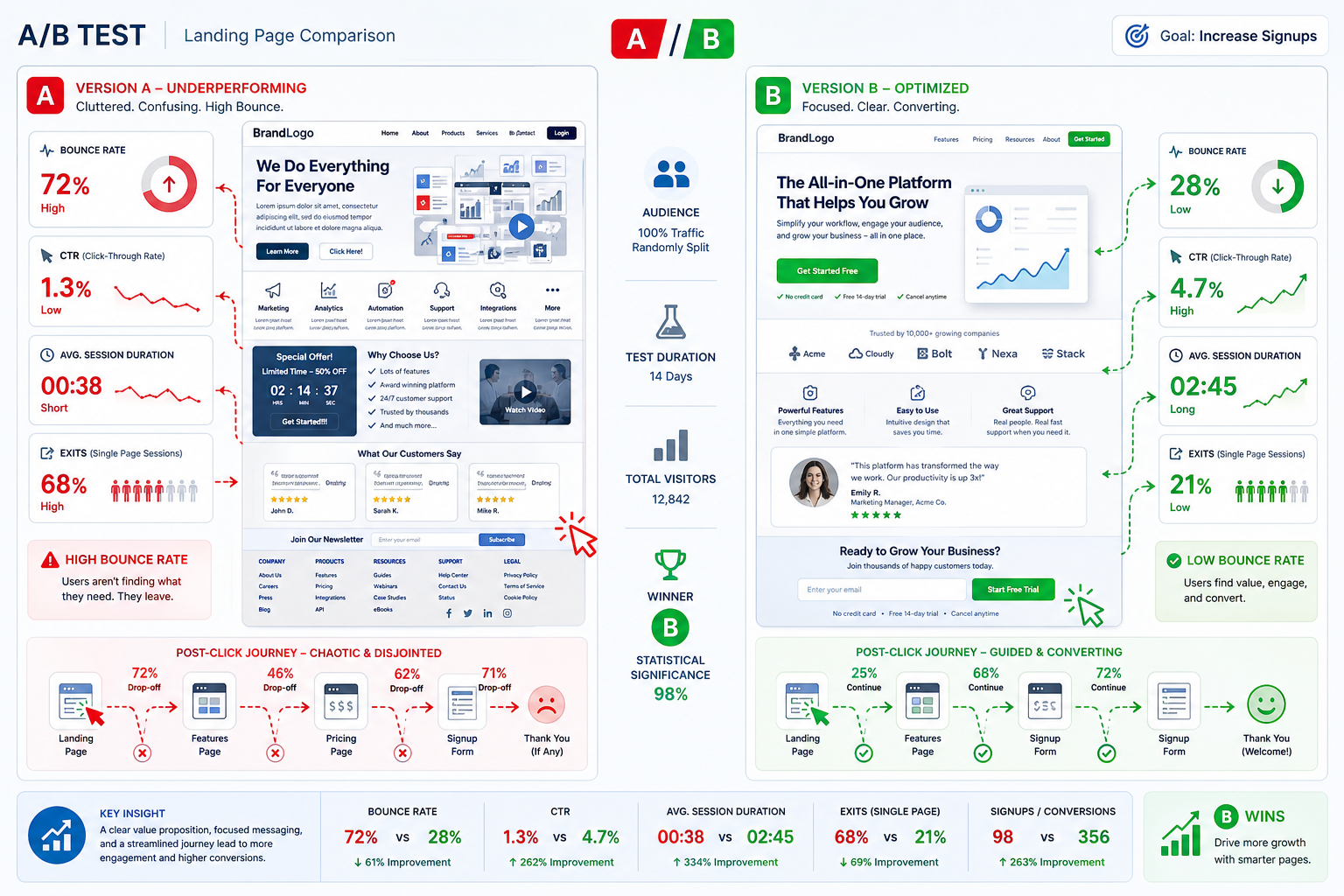
The shift toward Advantage+ isn’t just an operational inconvenience — it has measurable consequences for conversion economics. When you lose control over who sees your ads and how they’re presented, the quality of traffic reaching your landing pages changes, often for the worse.
Consider the data:
- CPA inflation: According to Revealbot’s Q1 2026 Meta Ads Benchmark report, the median cost-per-acquisition across e-commerce advertisers rose 23% year-over-year, with Advantage+ campaigns showing higher CPAs than manual campaigns in 7 out of 10 verticals tested. The exceptions were broad-appeal consumer goods where algorithmic targeting aligns naturally with mass-market demand.
- Bounce rate increases: When Advantage+ broadens your audience beyond your intended targeting, the mismatch between ad promise and landing page experience drives bounce rates up. Marketers switching from manual to Advantage+ campaigns report bounce rate increases of 15-25% in the first 30 days, before the algorithm “learns” — and even then, the baseline rarely returns to pre-Advantage+ levels.
- Lower intent traffic: Advantage+ optimizes for the cheapest conversions, which often means reaching users earlier in their decision journey. This inflates top-of-funnel metrics (clicks, landing page views) while depressing bottom-funnel outcomes (purchases, sign-ups, qualified leads). One SaaS advertiser documented a 40% increase in trial sign-ups alongside a 55% decrease in trial-to-paid conversion after switching to Advantage+ App Campaigns.
The compounding effect is significant. If your CPA rises 23% while your landing page conversion rate drops by even 10-15% due to lower-quality traffic, your effective cost per conversion can increase by 35-40%. For advertisers already operating on thin margins — or facing additional cost pressures like Meta’s digital service tax pass-through — this trajectory is unsustainable.
This is precisely why post-click optimization has shifted from “nice to have” to “survival strategy.” You can’t control Meta’s auction or its algorithmic decisions, but you can control what happens when that click lands on your property.
4 Post-Click Optimization Strategies to Protect Your Conversions
The following strategies are specifically designed for the Advantage+ era — they work regardless of how Meta changes its targeting, bidding, or review policies because they operate entirely on your side of the click.
1. Build Intent-Adaptive Landing Pages
When Advantage+ sends you a wider audience than you targeted, your landing page needs to handle the variance. Instead of one static page per campaign, deploy landing pages that adapt based on available signals:
- UTM-based content swaps: Use URL parameters to dynamically adjust headlines, hero images, and CTAs based on the campaign, ad set, or creative that drove the click. A visitor from a retargeting ad set should see different messaging than a cold-traffic visitor from Advantage+ broad targeting.
- Scroll-depth personalization: For visitors who scroll past the first fold (indicating higher intent), progressively reveal deeper content — case studies, pricing details, comparison tables. For bouncers, trigger an exit-intent offer that captures at least an email address.
- Device and connection-aware optimization: Advantage+ frequently shifts budget to mobile placements. Ensure your landing pages load in under 2 seconds on 4G connections. Google’s research shows that a 1-second delay in mobile load time reduces conversions by up to 20%.
The goal is to create a landing experience that converts across the full spectrum of intent levels that Advantage+ delivers, rather than optimizing for a single audience profile you no longer control.
2. Implement Multi-Touch Conversion Paths
With Advantage+ sending lower-intent traffic, expecting a single-visit conversion is increasingly unrealistic. Build conversion paths that capture value across multiple touchpoints:
- Micro-conversion capture: Before asking for the sale, offer a lower-friction commitment — a free tool, a quiz, a downloadable resource. This gives you a first-party data point for re-engagement, which is critical as Meta’s own retargeting capabilities become less precise under Advantage+.
- Server-side event tracking: As browser-based tracking becomes less reliable (iOS restrictions, cookie deprecation), implement Meta’s Conversions API (CAPI) to send conversion events server-side. Advertisers using CAPI alongside the Meta Pixel report 15-25% more attributed conversions, which helps Advantage+’s algorithm optimize toward actual results rather than partial data.
- Progressive profiling: Each interaction should collect incrementally more information. First visit: email. Second visit: company size and use case. Third visit: direct sales conversation. This approach aligns with the reality that Advantage+ traffic often requires 3-5 touches before converting, compared to 1-2 touches with well-targeted manual campaigns.
3. Deploy Return-Link and Ad Fallback Strategies
One of the most underutilized post-click strategies in 2026 is recovering the value of clicks that don’t convert on the first visit — without paying for another ad impression. Solutions like DeepClick’s return links help recover conversions lost to platform changes by creating additional touchpoints from a single ad click, without requiring new ad review cycles.
- Ad Fallback Pages: When a user clicks your ad but doesn’t convert, instead of losing them entirely, redirect to a secondary offer page that captures a different type of engagement. This technique alone can recover 10-20% of otherwise wasted clicks.
- Return link technology: Generate unique links that allow you to re-engage a clicked user with new messaging — without submitting a new ad for review. This is particularly valuable for advertisers in restricted verticals where every ad review cycle carries rejection risk.
- Complaint reduction: Ad Fallback Pages designed with user experience in mind can reduce ad complaints by up to 80%, which in turn protects your account health score on Meta — an increasingly important factor as Meta tightens enforcement.
This approach directly addresses the core Advantage+ problem: you’re paying for each click with less control over quality, so you need to extract maximum value from every click you receive.
4. Build a First-Party Data Feedback Loop
Advantage+ works better when it has accurate conversion data to optimize against. Paradoxically, most advertisers feed it incomplete data and then blame the algorithm for poor results:
- Offline conversion uploads: If your sales cycle extends beyond the 7-day click attribution window, upload offline conversion data weekly. This teaches Advantage+ which audiences actually generate revenue, not just which ones click cheaply.
- Value-based optimization: Instead of optimizing for a flat “purchase” event, pass actual revenue values through CAPI. Advantage+ can then optimize for high-value customers rather than treating all conversions equally — a distinction that can improve ROAS by 20-30% according to Meta’s own case studies.
- Negative feedback signals: Upload lists of low-quality leads, refund customers, or churned users as exclusion audiences. Even though Advantage+ may partially ignore exclusions, providing this signal improves algorithmic targeting over time.
The key insight is that post-click optimization isn’t just about what happens on your landing page — it’s about creating a data infrastructure that makes even Advantage+’s automated targeting work better for your specific business, as outlined in our Facebook Ads Conversion Rate Optimization Guide.
Your Post-Click Action Checklist for 2026
Here’s a prioritized checklist to implement these strategies systematically:
Week 1 — Audit and Measure:
- Pull landing page bounce rates segmented by Advantage+ vs. manual campaigns
- Calculate your true cost-per-conversion including post-click drop-off
- Identify your top 3 landing pages by spend and measure their conversion rates independently
- Verify Conversions API (CAPI) is sending all key events server-side
Week 2 — Quick Wins:
- Implement UTM-based headline swaps on your top 3 landing pages
- Add exit-intent capture to recover bouncing traffic
- Set up Ad Fallback Pages for your highest-spend campaigns
- Begin uploading offline conversion data if your sales cycle exceeds 7 days
Week 3-4 — Structural Changes:
- Build a multi-step conversion path for cold traffic from Advantage+ campaigns
- Implement value-based optimization through CAPI with actual revenue amounts
- Deploy return-link technology for restricted or high-risk verticals
- Create negative-feedback exclusion audiences from CRM data
Ongoing — Monitor and Iterate:
- Track conversion rates by traffic source weekly, not just in aggregate
- A/B test landing page variants specifically for Advantage+ traffic
- Review Meta’s policy updates monthly — new restrictions often come without warning
- Benchmark your CPA against industry data to detect algorithmic shifts early
The advertisers who will thrive through Meta’s Advantage+ era aren’t the ones fighting for control they’ll never get back. They’re the ones building robust post-click systems that convert regardless of who Meta’s algorithm decides to send their way. Start with the quick wins, build toward the structural changes, and you’ll have a conversion engine that’s resilient to whatever Meta announces next.
One ad click, multiple no-review impressions — that’s the DeepClick return link.
DeepClick helps Meta advertisers recover lost clicks with Ad Fallback Pages (+10-20% clicks), reduce ad complaints by 80%, and unlock 5-15% more conversions — without going through ad review again.
 DeepAds
留下评论