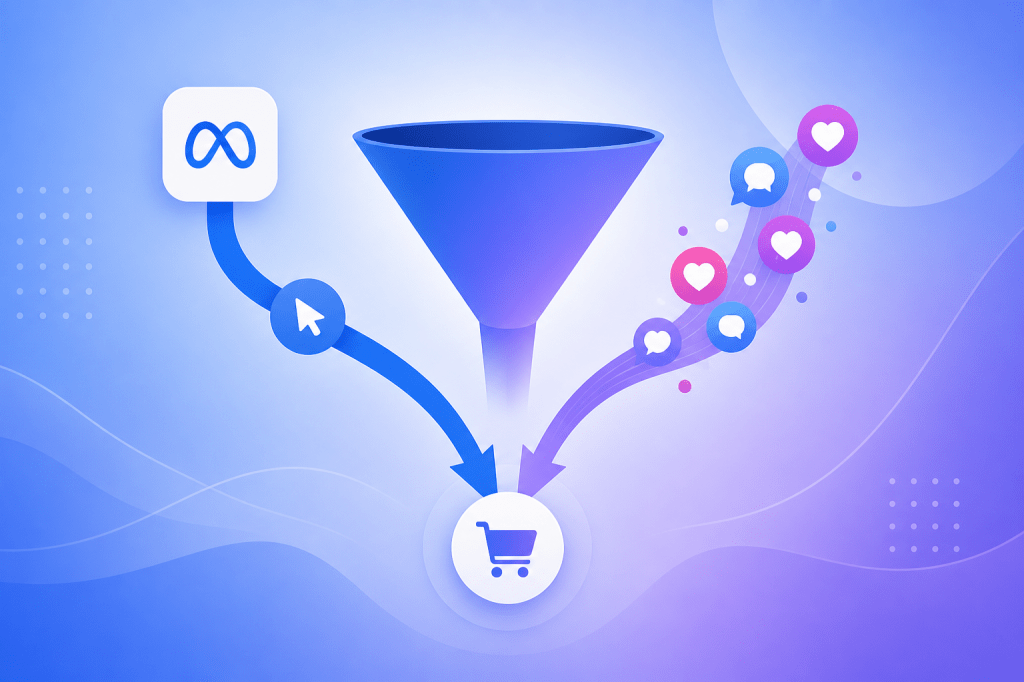
Meta just changed how it counts conversions — and if you’re still optimizing around click-through attribution only, your CPA targets are probably wrong. The new engage-through attribution window means Meta now credits conversions to ad engagements (likes, comments, shares, video views) even when users don’t click your ad. For performance advertisers running AI social apps or mobile games, this fundamentally shifts how you should evaluate post-click conversion rates.
→ Curious how return links work? See DeepClick in 1 minute — no review required, more impressions per click.
What Changed: Engage-Through vs Click-Through Attribution
In early 2026, Meta rolled out engage-through attribution as a default setting for Advantage+ campaigns. Previously, most advertisers relied on two windows: click-through (1-day or 7-day) and view-through (1-day). The new engage-through window adds a third layer — it attributes conversions to users who engaged with your ad creative but never actually clicked through to your landing page.
Here’s what this means in practice:
- Click-through attribution: User clicks ad → lands on your page → converts within the attribution window. This is the traditional model most advertisers optimize for.
- Engage-through attribution: User likes, comments, shares, or watches 15+ seconds of your video ad → later converts through a different path (organic search, direct visit, another ad). Meta now credits the original engagement.
- View-through attribution: User sees your ad impression → converts later. This remains unchanged.
The practical impact is that your reported conversion numbers may increase by 10-25% without any actual change in user behavior. Your CPA appears to drop, but the incremental value of those “engage-through” conversions varies significantly by vertical.
Why This Breaks Your CPA Targets

For teams running AI dating apps, AI companion products, or mobile game user acquisition campaigns, the engage-through change creates three specific problems:
Problem 1: Inflated conversion counts distort CPA calculations. If you were hitting a $12 CPA target under click-through-only attribution, adding engage-through conversions might show $9.50 CPA — but those extra conversions didn’t necessarily come from users who interacted with your landing page. Your actual post-click conversion rate hasn’t improved. You might see a similar dynamic to what we covered in our complete guide to Facebook Ads conversion rate optimization.
Problem 2: Budget allocation shifts to engagement-heavy creatives. Meta’s algorithm will favor ad creatives that generate engagement (comments, shares) over creatives that drive direct clicks. For AI social app advertisers, this means your best-performing creative by CPA might be a meme-style video that gets shares but sends no one to your install page.
Problem 3: Post-click funnel optimization becomes invisible. When 15-20% of your attributed conversions never touched your landing page, A/B testing landing page elements becomes unreliable. You can’t optimize what you can’t measure. This mirrors the broader ad measurement challenges facing performance advertisers in 2026.
3 Steps to Recalibrate Your Post-Click CVR
The solution isn’t to disable engage-through attribution entirely — Meta is making that increasingly difficult for Advantage+ campaigns. Instead, you need to isolate your click-through performance and optimize the post-click funnel independently.
Step 1: Segment Reporting by Attribution Type
In Meta Ads Manager, break down your conversion reporting by attribution setting. Navigate to Columns → Customize Columns → Compare Attribution Settings. Set up side-by-side views for:
- 7-day click only (your baseline)
- 7-day click + 1-day engage-through (Meta’s new default)
- 7-day click + 1-day view + 1-day engage-through (maximum window)
The delta between “7-day click only” and the combined window reveals exactly how many conversions are being attributed to engagement rather than clicks. For most AI app and gaming advertisers, this delta ranges from 8% to 22%.
Step 2: Recalculate True Post-Click CPA
Once you have the segmented data, recalculate your CPA using only click-through conversions. This gives you the real cost of users who actually visited your landing page and converted. Set your optimization targets against this number, not Meta’s blended CPA.
For example, if your blended CPA shows $10 with 100 conversions from $1,000 spend, but only 82 of those conversions came through click-through attribution, your true post-click CPA is $12.20. Optimize against $12.20. The additional engage-through conversions are a bonus — not a target to optimize toward.
This is especially critical for teams also navigating rising ad costs from Meta’s new digital services tax surcharges, where every dollar of wasted spend compounds.
Step 3: Optimize Post-Click Elements Independently
With your true click-through CPA isolated, focus your optimization energy on the elements that directly affect users who clicked:
- Landing page load speed: For AI app install campaigns, every second of load time drops mobile conversion rates by 12-15%. Use server-side rendering or AMP pages for ad landing pages.
- First-screen value proposition: Users who click (vs engage) have higher intent. Match your landing page headline to the specific ad creative that drove the click. Dynamic text replacement based on ad_id cuts bounce rates by 18-25%.
- Install or signup friction: For AI dating apps, reduce the install-to-first-match flow to under 3 taps. For mobile games, offer a playable demo before requiring download. Each friction point costs 8-12% of your click-through conversions.
- Re-engagement sequences: Users who clicked but didn’t convert are your highest-value retargeting audience. Build post-click fallback flows that re-engage within 24 hours — before the attribution window closes.
How AI App and Gaming Teams Should Adjust Bidding
The attribution change also affects your bidding strategy. If you’re using cost-per-result bidding (Meta’s recommended approach for Advantage+), the algorithm now optimizes for a blended conversion that includes engage-through events. This means:
- For AI social apps: Your bid cap should reflect your click-through-only CPA, not the blended number. If you set a $10 bid cap based on blended CPA, Meta will happily spend toward engagement-attributed conversions that cost you less per “conversion” but deliver lower-quality users who never saw your onboarding flow.
- For mobile games: Switch from cost-per-install to cost-per-purchase or cost-per-level-completion bidding where possible. This forces Meta to optimize for downstream events that can only happen if the user actually installed and played — making engage-through attribution less distortive.
Consider also using Meta’s conversion API (CAPI) to send server-side events that definitively link a conversion to a landing page visit. This creates a parallel measurement system that validates your click-through conversion data independently of Meta’s attribution model.
What This Means for Your 2026 Q3 Planning
The engage-through attribution rollout is part of Meta’s broader push to credit more conversions to its platform — a pattern we’ve seen with view-through attribution expansion and Advantage+ automation. For performance advertisers, the response should be consistent:
- Measure what matters to your business: Focus on post-click metrics (landing page conversion rate, install-to-signup rate, D7 retention) rather than Meta’s reported CPA.
- Invest in post-click infrastructure: The better your landing page and onboarding funnel, the more you’ll benefit from click-through traffic — and the less you’ll depend on attribution model changes for performance reporting.
- Diversify measurement: Use incrementality testing, hold-out groups, and server-side tracking to validate Meta’s reported numbers against actual business outcomes.
The advertisers who will thrive in 2026’s attribution landscape are those who treat post-click optimization as their competitive moat — not those who chase the lowest reported CPA across shifting attribution windows.
One ad click, multiple no-review impressions — that’s the DeepClick return link.
DeepClick helps Meta advertisers recover lost clicks with Ad Fallback Pages (+10-20% clicks), reduce ad complaints by 80%, and unlock 5-15% more conversions — without going through ad review again.


发表评论